What are Some of the Basic Geomechanical Considerations if the Injection Pressure is Above the Pressure Required to Initiate, Open or Re-open Fractures?
Historically, people have tried to translate hard rock hydraulic fracturing concepts to weak materials. This presumes the existence of a single planar fracture (SPF). Initiation and propagation are represented by conventional elastic fracture mechanics considerations. An alternate concept for hard rock is to consider that a highly connected, opened natural fracture/joint path forms. In soft, low modulus, inelastic formations development of the primary fracture is accompanied by softening and/or failure of the reservoir material in an elongated region around the fracture; creating additional porosity and permeability by one or more of the mechanisms discussed above (dilation, shear bands, microchanneling, ...). Another, and sometimes more appropriate concept is the formation of this hightly directional region of disturbed material with enhanced permeability and porosity, without the primary fracture. Based on the experience in oil sands and soils, it can be speculated that in general three regions develop:

This schematically shows a primary SPF (single planar fracture). There is no formation failure. Analysis and modeling is based on classical fracture mechanics.
|
-
There is fracture flow (high permeability, small storage),
-
There is an enhanced (disturbed) region around the fracture (the majority of the storage capacity for fines is in this region), and,
-
There is an undisturbed region, outside.
|
|
In weakly consolidated or unconsolidated formations, there can be substantial effects on permeability and porosity in the disturbed zone; and, depending on the modulus and the permeability, strong poro- and thermoelastic (or plastic) stress interactions are possible.
|
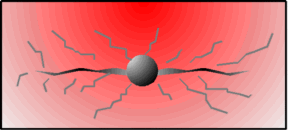
This conceptual version of fracturing in a soft material depicts a combination of SPF and microfracturing or microchanelling (hard rock, granular media).
|
As discussed earlier, there can be various models (or components) associated with fracturing, beyond the simplistic SPF concept. These are:

A homogeneous model. This "Homogenized" model incorporates a fracture, surrounding zone of enhanced permeability and porosity (blue) and an unfailed zone. This representation has been successfully used for oil sands, chalk, coal …
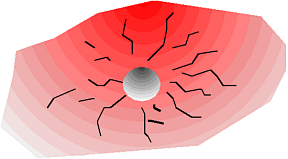
An induced fracturing or microchannelling model. This shows an induced fracturing or microchanelling model. In-situ fracture networks develop based on the local stress state induced by injection.
A jointed rock model. This depicts a jointed rock model. Joint deformation and permeability increase as a function of the effective stress state. This concept has been used to explain observed directionality in waterfloods (primarily hard rock - although shear localization may be represented for softer materials).

Can Injection Solids Be Accommodated?
All of these models have mechanisms for accommodating solids present in the injection water. For example, a model of solids transport can be conceived in failed media with resulting fracture networks. Significant storage capacity may exist even though the created porosity of the network is small, due to a large surface area.
Which Flow/Geomechanics Model is Appropriate for Soft Sands?
There is evidence for all of the above mechanisms (and more) apply under different circumstances. The difficult questions are:
-
Can we categorize the appropriate model based on the formation properties?
-
Can we determine an appropriate model by analysis of basic data (pressure and rate)?
-
What analysis methods are appropriate to identify the relevant model?
The situation becomes even more complicated when the potential for multiple interpretations exists (e.g., SPF vs. highly elongated fracture networks, jointed rock vs. creating fractures, changes of frac pressure with time…).
Is There Evidence for the Existence of Single Planar Fractures in Soft Formations?
|
There is abundant evidence in hard rock. In unconsolidated/soft media, there is some evidence. For example:
Water injection in oil sands (tiltmeter mapping, grouted fracture recovery in the Numac/Gulf oil sands project, interpretation from pressure transient analysis), Steam fracturing in projects by Esso, AEC and others (temperature logging in observation wells, history matching in patterns),
There is direct evidence in chalk reservoirs (Valhall, other pilots). In some cases, positive identification of the length and propagation rate of a SPF has been possible by logging after drilling and from the pressure response in offsets. A large (1500 ft+) fracture length was inferred, with limited height. Laboratory experiments in oil sands (Alberta Research Council), Injection experiments in the Frio water sand by ARCO, and, Fracture imaging in diatomite in California by Shell.
|
|
Is There Evidence for Stress-Dependent Permeability and Porosity?
There is a large body of literature on this subject for all types of lithologies, for production and for injection scenarios. Some examples for injection in highly stress-dependent materials include:
Brine disposal study (SPE JREE, April 99) in hard rock.
Analysis of oil sand injection tests (Duri field, UNITAR 1998, Paper 120)
Modeling of chalk reservoirs (step rate tests)
How can this stress sensitivity be detected? The obvious method is laboratory measrements on cores. However, core work will usually only provide information about matrix properties (unless simulated fractures are used). Also, it is difficult to obtain data at very low effective stresses in an unloading path, which is the region of interest (failure).
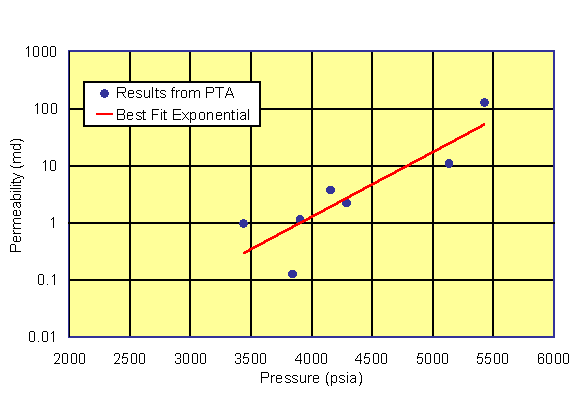
In addition, PTA or simulation analysis of SRT can provide very useful indications. Step rate testing (SRT) is preferable to single rate injection test. Conventional laboratory measurements provide useful data. The example below shows stress-dependent permeability for Oriskany sandstone. The interpretation was based on PTA and fracture modeling. Field testing is a valuable addition (or sometimes the only alternative) to laboratory work and its advantage is that it measures both matrix and fracture properties, integrated over a larger area. However, proper interpretation of the data requires sophisticated tools.
Is There Evidence That Supports A Three-Region Model?
(SPF plus Enhanced Region plus Undisturbed Region)
Yes, there is some evidence. Two situations that DE&S has been involved with are:
-
PTA Analysis of oil sand injection tests (Leshchyshyn, CIM 94-88, 1994),
-
Coupled flow and stress analysis of several injection tests (DE&S, SIMTECH).
Signatures of this type of situation include:
-
Conventional analyses overestimate injection pressures, and,
-
There is a rising derivative on a log-log plot during fall-off.
An example of this type of inferred in-situ condition was presented by Leshchyshyn, (in 1994, CIM 94-88) for water injection into an oil sand (PCEJ project). Three permeabilities were identified using conventional PTA:
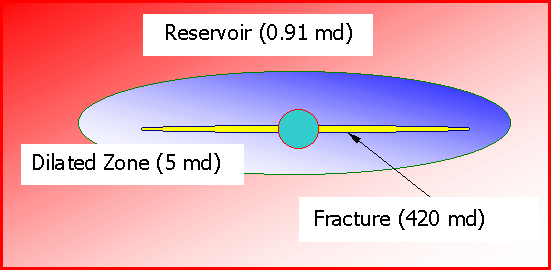
The high injection rate during early time indicated a permeability of 420 md. This necessarily had to be attributed to a fracture. Late time injection indicated a permeability of 5 md. This was presumed to be an enhanced zone (caused by dilation) around the fracture. The virgin reservoir permeability was only 0.91 md. Note that all of these permeabilities are effective permeabilities to water; absolute permeability of the oil sand tested was on the order of 1 d, and the oil sand is saturated with bitumen.
Is There Evidence For The Induced Fracturing/Microchanelling Model?
-
Large scale laboratory experiments have been performed by Golder Associates for an oil sands consortium.
-
Analogies can be drawn with the conclusions drawn for some heavy oil projects where cyclic steam injection has been applied.
-
Soil dilation theory and experiments suggests that this behavior can occur. The localizations can be shear-related rather than created in tension.
-
In this regard, the effect can be similar to (indistinguishable from?) stress-dependent properties due to, for example, homogeneous dilation.
-
In general, the fact that the actual small-scale mechanisms may not be identifiable is not critical. Any engineering analysis (e.g., numerical modeling) will require some form of homogenization of properties for for calculations although certain models allow directional specifications in three dimensions.
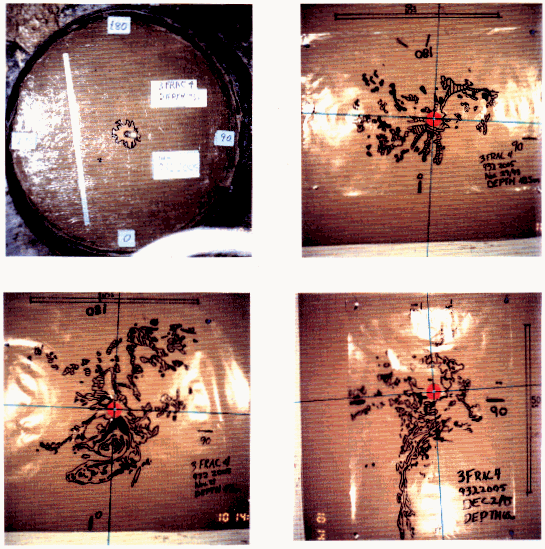
The laboratory experiments carried out by Golder Associates were performed in reconsolidated sand packs. A single, simulated wellbore was created in a 1.4 m diameter, 0.9 m high vessel. The reconsoldiated sand in the vessel was either saturated with water or an 1800 cP fluid. The injected fluid was water.
At high injection rates, complex dendritic fracture systems developed. At low rates, plastic deformation around the wellbore can afford development of a single wide fracture. This is supported by experience at the Alberta Research Council. The question remains whether these particular measurements can be translated to field conditions. In the figures, for injection into a sand pack with a high viscosity saturant, "fracture" morphology is shown at different depths into the vessel. Extremely complex systems develop, partly in response to the low stress environment and the mobility contrast. Apparently, some parts of this system were unconnected to the wellbore (or connected in a very tortuous path)!
Is There Evidence for Jointed Rock Behavior?
There is a large amount of data on joint orientation and directionality associated with waterflood response in hard rock reservoirs (for example Heffer, Computer Methods and Advances in Geomechanics, 1994).
Parallel work has been done in nuclear waste disposal modeling (e.g., the DECOVALEX Project) and in a large amount of literature on fracture network characterization in hydrology.
Whether the jointed rock representation is appropriate for a particular soft sand PWRI candidate depends primarily on our ability to characterize the rock in terms of fracture density, aperture and conductivity. In general, the softer the sand, the less likely this model would be. It is also improtant to appreciate the differences between existing and induced fractures.
What are the Differences Between Joints and Induced Fractures?
Jointed rock:
The fracture directionality is set by the geological regime and history of deformation which created the fracture/joint sets. Conductivity of the joints depends on the current stress state (and its history).
Induced fracturing:
The directionality is determined by the stress orientation at the onset of failure. This stress state can be significantly different from the initial stress state; therefore, it is not reliable to predict created fracture orientation based on initial stress measurements.
Identification of Joints and Fractures
Evidence of joints includes cores and various types of imaging logs. Evidence of existing natural fracturing can come from logs and PTA.
What is the Effect of Opening Joints/Natural Fractures or Creating New Fractures/ Channels on Fluid Flow?
Enhancing/creating fractures increases the dual porosity behavior character in porous media. Absolute and relative permeability can be impacted, as can capillary pressure. There is also the possibility for countercurrent imbibition - this entails movement of fluids in the opposite direction because of the different direction of the phase pressure gradients either due to capillary or salinity effects. The bottom line is that for situations with joints and/or fracturing, numerical/analytical modeling may require the simulation of dual porosity/dual permeability systems. This concept has generally not yet been recognized but we believe that it may be significant if dual porosity exists.
Modeling Tools for Soft Sands
All reservoir simulators account for the classical multiphase fluid flow phenomena. It should be noted that thermal effects are often ignored and this may cloud the analysis. Therefore, it is recommended that thermal models with temperature-dependent PVT are used whenever possible.
Many conventional reservoir simulators can represent porosity and permeability as being pressure-dependent. It is, however, necessary to use models with simultaneous solution of stresses to utilize the more correct dependency on effective stress. Such models range from very loosely coupled to fully coupled (see survey in Settari, SPEJ, Sept. 1998, and SPE 51927). Representation of discrete fractures is also possible in the GEOSIM system. Fracture mechanics models accounting for the geomechanical effects discussed above are rare (for example, STRESSFRAC of DE&S).
While several coupled codes can handle the stress-dependency in a homogeneous rock, the treatment of the joint system is more complex. Large joints can be modeled explicitly, using specific laws for deformation and hydraulic conductivity of the joints (e.g., Stephansson et al., Coupled Thermo-Hydro-Mechanical Processes of Fractured Media). Dense joints and fracture networks must be homogenized for analysis. V.I.P.S. provides numerical modeling of the type, and can also model discrete joints (or fractures of predetermined size). Similar ideas are being employed elsewhere (L. Teufel, New Mexico Tech, Sandia Laboratory code for fractured media). Codes which can model a large number of joints (FLAC, UDEC) arae limited to single phase flow and this is not acceptable for PWRI. GEOSIM currently can model only a small number of discrete joints, modeled directly by thin elements.
None of the above codes (with the exception of GEOSIM) seem to handle flow aspects of dual porosity in a coupled fashion.
For soft sands, the most important capabilities are believed to be the thermal effects, and some possiblity of specifying homogenized stress- and failure-dependent porosity and permeability with directional characteristics. It is intended to carry out a comparison of the different modeling approaches within the project.
Injected Solids Transport
We need to consider what happens if there are solids or particulates in the injection fluid. While the impact is certainly less dominant as compared to cuttings reinjection, it can be important. Conventionally, the damage concepts incorporate an external filter cake (on the fracture surfaces) and an internal filter cake (in the matrix, typically reaching only a few inches from surface). These solids, as anticipated, reduce the effective porosity and reduce the permeability in the invaded zone. It can be argued that solids mass balance is probably not critical for analysis of PWRI performance, as long as filter cake effects can be adequately represented.
Chemical/Mobilized Solids Effects
It is often speculated that this is a predominantly near-wellbore phenomena. This may or may not be true. The effects to consider include:
-
Mobilization or stabilization of fines. This can be a particular issue in soft sands.
-
Chemical effects (scales, corrosion, precipitation …). While permeability is reduced, some precipitation may afford a little increase in the stability of the sand structure.
-
As has been discussed, there is a strong coupling with thermal effects. In soft sands, stress alteration due to mobilization of solids may not be substantial but contraction/expansion may still be substantial.
Removal of this type of damage can be the most rewarding in terms of productivity improvement as opposed to engineering effort. It can also be the most frustrating, in terms of identifying appropriate stimulation chemistry, guaranteeing adequate diversion and placement in long soft sand intervals …
Developing Best Practices for Soft Sands Reinjection:
-
Identify, from field behavior, the specific mechanisms which are controlling injectivity in the field. Are thermal effects dominant? Does treating pressure exceed fracturing pressure? Is there full voidage replacement? …
-
Ranking the mechanisms to work on:
-
Ones that have the largest effect?
-
Ones that can be controlled by field operations?
-
Ones that can be worked on economically?
-
Other criteria?
-
To develop "Best Practices", we must provide tools for:
-
Identification of the operative mechanisms and an appropriate reservoir model,
Determining relevant in-situ properties,
-
Performing the redesign and forecasting the productivity improvements (to do economics of redesign),
-
Ultimately for "optimum" design from scratch - i.e., in a new play with limited offset information and no previous local injection experience. This is a particularly ambitious goal.
