Monitoring Workshop
Littleton, Colorado
(April 27 and 28, 2000)
Attendees:
|
Paul van den Hoek |
Bjarni Palsson |
|
Jean-Louis Detienne |
Laurence Murray |
|
Quan Guo |
John McLennan |
|
Alastair Simpson |
Bob Sydansk |
|
Paul Jones |
Ahmed Abou-Sayed |
|
Norm Warpinski |
Chris Wright |
Thursday, April 27, 2000
Introduction:
Laurence
Murray summarized the goals for this workshop.
A key question is "How do you prove up containment of fractures and
what sort of monitoring techniques do you need?" For the various methods, how successful are they and how do
production-centered methods need to be modified for produced water applications
- to be certain that there is appropriate interpretation. For Laurence, a key technology is well test
interpretation for fractured wells and soft sediments and what is the required
methodology?
Monitoring
and diagnostic methods for injectors have not developed at the same rate as for
producers. One reason is that hydraulic
fracture closure during testing can complicate interpretation.
Another
side of the coin can be considered to be the predictive piece. Just how good are available models. There are a number of codes around. It is important to identify the processes
that need to be legitimately included in these predictive models. The model audit has been nearly
completed. Additional feedback was
received at the workshop and the status of the fracturing model audit was
reported by Quan Guo (to follow).
In
addition to the modeling audit, an inventory of monitoring methods, citing
limitations and applications was requested.
Laurence
also emphasized the need for procedures for fractured injector
interpretation. Falloff testing was
indicated to be not completely accurate (closure during testing). What are the preferred test protocols and
what data are required. Best Practices is a major goal - e.g. describe
procedures for a multi-rate PLT followed by a falloff. In terms of well test interpretation in
general, what are the gaps in the methodologies and how can you optimize
cost. Environmental issues are of a
concern if operators are moving towards zero emission well testing. For example, can reservoir investigations be
done in a different way - not doing DSTs at all in order to avoid flaring.
What
is the applicability of the current monitoring techniques, and how can they be
improved and what needs to be done?
There
was a brief discussion about classical reservoir engineering interpretation of
closure. Infinite acting radial,
bilinear and linear flow regimes were defined.
Available Fracturing Models - Quan Guo:
Quan
Guo then provided an update on the audit of the available fracture models. Quan discussed his criteria for auditing the
models. Some semantic revisions to the
audit were requested and will be implemented.
Quan's presentation is available.
An Update on Hall Plotting - Bjarni Palsson:
Bjarni
Palsson summarized the status of the Hall Plot document that has been
circulated to operators for review.
Bjarni's presentation is available.
Multi-Rate Testing - John McLennan:
John
McLennan briefly covered some of the considerations in multi-rate pressure
measurements in layered formations.
These will be incorporated into the survey of monitoring methods. Abstracts of several relevant papers are available.
Laurence
Murray pointed out the influence of false pressure. Paul van den Hoek and Laurence Murray requested an inventory of
tools available - capabilities and limitations. Jean-Louis Detienne requested the same.
The
biggest injection issue is that the fractures change with time. Is there a possibility of matching fracture
closure characteristics e.g., type curves, to help in accounting for height
and/or length recession.
Fractured Injector Well Test Gap Analysis:
There
was a consensus on what some of the gaps in technology are. These included:
1. Inadequate representation of dynamic fractures
(changing dimensions), during falloff.
2. Single zone and single frac (the simplest scenario
that needs to be considered and is probably not adequately resolved - more
complicated situations and technical issues are listed in the items that
follow).
3. Single frac and multi-layered (height/length
recession).
4. Single zone and multiple fractures (co-located or
displaced).
5. Multiple zone and multiple fractures.
6. Pressure-dependent permeability.
7. Radial and linear composite reservoir
interpretation when there is a fracture present.
Action Items:
1. Allocation of JV funds for external party, if
necessary.
2. Survey operators for methods being used and
data. URGENT.
Open Discussion:
Laurence
indicated the value of temperature and warmback surveys. The temperature can change substantially and
the temperature front near the wellbore will change.
One
of the questions is whether you really get closure?
Microseismic Monitoring - Norm Warpinski:
Norm
Warpinski (Sandia National Laboratories) presented on microseismic monitoring
technologies (overview, interpretation and examples). Norm's presentation is available as are abstracts
of several relevant publications. A few
of the critical observations are:
ü Microseisms: The energy is likely too low for
measurement at the surface. Generally,
you will find that the treatment well is too noisy for the receivers. Most of the time you are in the near-field
in the treatment well. Preferentially,
receivers need to be in the far-field, which is 500 or more feet away from the
source.
ü The possibility for seabed deployment was
raised. It was indicated that there
would be noise but this situation may be okay.
ü Questions of source-to-receiver distance were
raised. Norm cited the Mounds test,
where the geophones were in shallow tiltmeter wells (~30 ft) and the fracture
was at ~2700 feet.
ü Most times you don't have multiple wells so you use
statistics. Signal frequency is up to 4
kHz.
ü Interpretation either uses homogeneous or layered
models.
ü You need an array or you cannot come up with a
unique answer. You want your array to
be about as long as the distance from the event but you lose sensitivity so
there are vertical limitations.
ü Questions were raised about permanent
deployment. Sensor drift over the
long-term, interpretation and data handling were raised as issues.
ü A crosswell survey is preferable for the velocity
determination.
ü Ahmed indicated that there have been published
cases where reflection measurements have been made.
ü Laurence Murray asked, "What is the influence
of stress reduction due to thermal effects?
Is there a threshold frequency?
Norm indicated that when there are slips over small areas the frequency
is high - large area slip (e.g., an earthquake) would be characterized by a low
frequency.
ü There was considerable discussion as to whether you
could characterize a frequency according to where it is coming from (e.g., tip,
fluid loss zone, and formation interface…).
LANL found that most of the events associated with waterflooding were
low frequency. You can filter the
events (wavelet analysis) and the different scales fall out.
ü Questions were posed about cost. In the past, most of these programs have
been associated with conventional hydraulic fracturing. For a frac job, the cost could range from $35,000
to $100,000 but there is no one company that can do the entire package. A two-day job in the United States, where
mobilization is not excessive, would probably cost $35,000 to $40,000.
ü Norm described the service offered by GRI. It is also performed by CSMA, out of
Cambourne and IFP. Ahmed indicated that
it has been done for cuttings injection programs for 75,000 pounds - a thorough
analysis was not done.
ü Norm strongly recommended that seismic experts
evaluate the data.
ü PDO may be an opportunity for Shell. Chris Wright indicated that PDO was looking
into it.
ü Various examples were given. The data showed some variations in azimuth
with progressive/successive injections.
The fractured zone was cored through and multiple fractures were found
over about 20 feet.
ü Discussion then went back to "How do you
really determine where the events are coming from? Is there something characteristic about specific events?"
ü Although the specific fracture plane may be masked
by leakoff-induced slip, Norm believes that if height growth is the issue, the
technique can be applied without too much trouble.
ü Laurence indicated that in many circumstances he
might not be as concerned about length as about height growth. Source analysis becomes an issue.
ü For waterflooding it would be important to
delineate the fracture tip boundary and where the fluid is going.
ü Laurence suggested that if the measurements are
coupled with thermal processes, that it might be possible to infer leakoff
distance from the thermal front and make a presumption about the flood front
based on the thermal front.
ü Norm indicated that for a layered situation,
interpretation needs to involve finite element analysis. In the overall process, the largest source
of error is measurement from the surface.
In weak rock, with pressure-dependent permeability, the velocities may
be changing with pressure and you will need more than surface devices.
Hydraulic Impedance Testing (HIT):
After
lunch, the session focused on Hydraulic Impedance Testing.
HIT - Laurence Murray:
Laurence
Murray led off with "HIT for Frac and Reservoir Monitoring." Some of the important observations are as
follows.
ü
Laurence first showed
characteristic, generic HIT signatures (Figure 1).
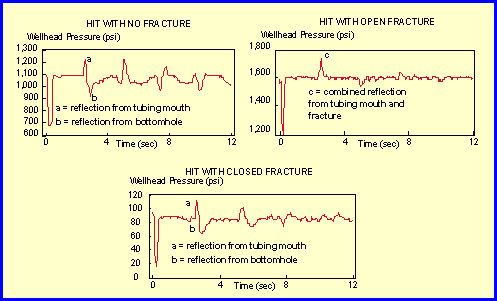
Figure 1. Three generic HIT signatures (no
fracture, an open fracture, and a "closed" fracture).
ü As it is important to know the wellbore impedance,
and because of specific completion string characteristics, it is desirable to
perform a calibration before the well is perforated.
ü Perforating itself can cause slightly lower
amplitude of the return.
ü Impedance contrast at the mouth of a fracture is
determined from repeated cycle reduction.
ü As BP has previously published, connectivity at the
wellbore is an issue. As you reduce
connectivity (e.g. inclined well), fracture height can be underpredicted. The signals are indicating height
connectivity to the wellbore and not necessarily picking up
"internal" fracture height.
One resolution is to compare the HIT-inferred height with PLT, ideally
including warm back. A consistent
question in all of the HIT presentations was "Can you accurately evaluate
fracture height?"
ü Laurence indicated that they have done modeling and
warmback evaluations. In some cases,
height can be reliably predicted. One
question that Laurence posed was "If there is low connectivity, should you
be looking at spherical wave propagation rather than planar wave propagation?
Or is it just that the pressure drop near the wellbore is inadequately
represented?"
ü New Wells versus Old Wells. A Wytch
Farm example (new well) was shown. An
SRT was done to start up. Before
fracing, in a 4 1/2 into 7-inch liner, reflection was seen from the liner and
the bottom of the well. Above frac
pressure you see the frac and the tubing.
If you go back to low pressure, you see the initial signature. This is a new well and you can see if in
fact it has been fraced.
ü The next example was an older well in the Miller
Field. Falloff data were
available. AS YOU GO DOWN IN PRESSURE DURING A PRESSURE FALLOFF, EXPECT TO SEE
CHANGE IN SIGNAL. IMPEDANCE CONTRAST IS
CHANGING AND THE FRACTURE IS CLOSING.
AMPLITUDE IS ALSO CHANGING.
ü The next discussion item was very important. With fracture closure, reflection
coefficients will change, according to the degree of closure. BP has had good success in inferring the
in-situ stress by processing the variation between the reflection coefficient
and the bottomhole pressure. The
procedure is to take the reflection coefficients and plot them as a function of
bottomhole pressure (refer to Figure 2).
If you assume a linear elastic fracture system and self-similar closure,
you can relate the reflection coefficient to a pressure that is characteristic
of what is going on in the fracture.
Extrapolate the reflection coefficient to zero and use that pressure as
a measure of the in-situ stress. If you
use the linear elastic and self-similar closure assumptions, it is possible to
do this extrapolation with only two points on the plot - you are implicitly coupling
a fracture model with the pressure measurements. This overcomes the commonly encountered difficulty that fractures
may not completely close and as such, in-situ stress cannot be precisely
defined.
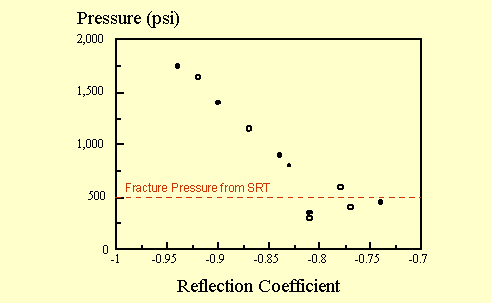
Figure 2. Reflection Coefficient versus pressure. Complimentary SRT data supports the use of this type of plot for inferring in-situ stresses.
ü Laurence described application of HIT in another
field situation (Miller Field) where there was over-voiding situation. The issue was "Why was injectivity
declining?" New HIT was performed
and this was compared with older tests that had been run. Small heights were detected because the well
was highly deviated. Using the
extrapolation to a zero reflection coefficient, fracture length change was
identified, as was an intercept pressure change, consistent with the
over-voiding. REPEATING HIT AT
DIFFERENT TIMES AND EVEN AT DIFFERENT TIMES DURING A FALLOFF CAN PROVIDE
IMPORTANT INFORMATION ON FRACTURE LENGTH.
ü There was some argument over presuming the shape of
the P-R curve extrapolation. However,
pressure differences in the "tail" (low values of the reflection
coefficient) associated with slightly different model assumptions should not
give significant differences in the forecasted in-situ stress.
ü Paul van den Hoek argued that full fracture closure
could occur below closure stress because of tortuosity and that it may not be
appropriate to extrapolate to zero if the fracture is propped open because it
is riding on asperities.
ü Laurence took the prediction one step farther. If you can infer a change in in-situ stress
from one time to another, using this technique (or actually any measure of the
change in stress), you can use poroelasticity to infer a change in reservoir
pressure. Although it was not
discussed, this is based on poroelasticity considerations. For example, after long-term injection,
Detournay et al., 1989,[1]
suggested [Equation 15 in their paper] that the change in closure stress for a
fracture can be approximated as:
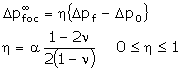
where:
|
|
closure
stress after long-term injection, |
|
pf |
injection
pressure, |
|
p0 |
formation
pressure (far-field average reservoir pressure), |
|
a |
Biot's
poroelastic parameter, and, |
|
n |
drained
Poisson's ratio. |

More precisely, with fewer approximations, the
asymptotic value of the closure pressure,  , is:
, is:

where:
|
so |
in-situ
total stress normal to the plane of the fracture, |
|
pf |
fracturing
pressure, and, |
|
nu |
undrained
Poisson's ratio ( |
 ).
).
Changes in the closure stress indicated on a plot of the Reflection
Coefficient versus the in-fracture pressure (pf) could therefore be
used to infer changes in the reservoir pressure.
ü Chris Wright sketched a relationship between width
and pressure, as part of the discussion of the extrapolation procedures. Paul van den Hoek cited the Oman data and
observations that had been made about the difficulties in inferring
height. There was a significant amount of
argument over this extrapolation procedure.
ü Laurence showed a supporting field example where
the SRT compared favorably with the extrapolation technique (Figure 2).
ü Pclosure ( ) cannot be readily determined.
ü Ahmed argued that the minimum stress is higher than
where we currently pick it. Paul van
den Hoek supported the statement that stress is predicted to be too low and
offered this as one of the reasons why net pressure is commonly underestimated
in conventional hydraulic fracture interpretation.
ü It is important to recognize the differences
between pressure indicating mechanical closure and the minimum in-situ stress
and to be cautious in the methods used for stress interpretation.
ü The extrapolation routine is not included in the
HIT summary that was previously circulated and needs to be added.
HIT - Paul van den Hoek:
Paul
van den Hoek then described a HIT program from the Middle East. Paul's presentation is available. A few of the major points are indicated
below.
ç
As can be seen from
the completions schematic (Figure 3), a short, 7-inch hanging liner was
present. This had a serious effect and
complicated interpretation substantially.
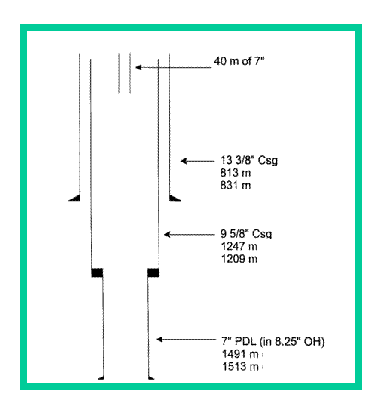
Figure 3. Completions schematic, showing a short, 7-inch hanging liner that caused significant extra effort for interpretation.
ü Multiple HIT measurements were done during multiple falloffs. One falloff measurement is shown in Figure 4. Perhaps one of the most revealing observations is that these curves demonstrated how significant water hammer effects can be.
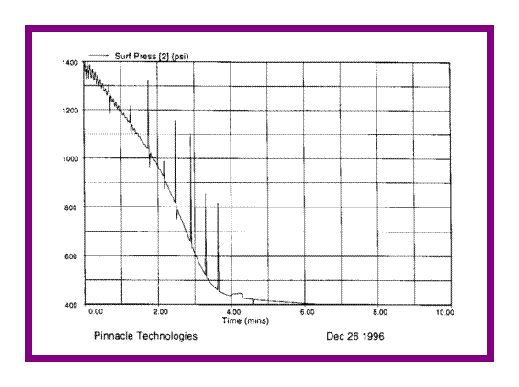
Figure 4. One of the falloff measurements
made. Each major spike is a HIT.
ü Possible fracture tip reflections were defined. It appeared that there was evidence for multiple fracturing.
ü The time delay (indicating travel to and reflection back from the fracture tip) changes as the pressure changes (the velocity of the wave and the length of the fracture are probably both changing - certainly the wave speed) and this allows you to build confidence as to whether this is really a fracture, presuming the fracture length is changing. If the delay time does not change, you are looking at some other feature - maybe a cavity?
ü As the pressure in the fracture is reduced, the absolute value of the reflection coefficient decreases, there is less impedance and amplitude of the reflected signal. The delay time changes because the velocity in the fracture changes because of pressure sensitivity of the velocity. The fracture is a stronger function of pressure. With pressure reduction, the fracture tip reflection changes and the mouth reflection also changes substantially.
ü The reflection coefficient purely depends on the mouth of the fracture, which changes as the net pressure changes. As indicated there are also velocity changes and more energy is put into the fracture. Reflection from the tip may even get bigger. Amplitude changes, and the delay time is reduced as the fracture length decreases.
ü Laurence will provide a report on this where he has looked at changes in tR.
ü Delay should be getting bigger as the fracture grows. Often, you will see a closed end reflection close to the reflection from fracture tip. Laurence argues that there are similar effects in weak rock. For example, if there are two reflections and one is seen to close because of a change in the delay time (and not the other) this may indicate that one of them is a cavity (or a static fracture).
ü The theory is that you can measure length from tip reflection and height can be calculated from the reflection coefficient. The problem with these methodologies is that the reflection coefficient is not particularly sensitive to dimensions after about 10 m (or less). Figure 5 shows the reflectance coefficient versus the fracture dimension that is controlling compliance.
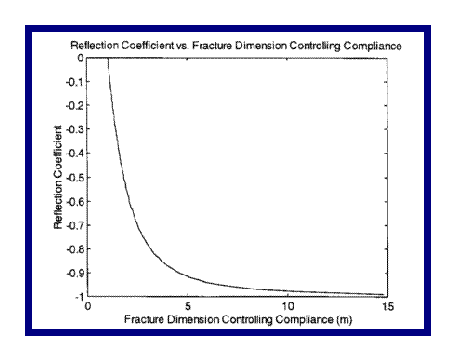
Figure 5. Variation of the Reflection Coefficient with the fracture dimension controlling compliance ("how much and how fast the fracture opens and closes") - either height or length depending on whether the fracture is "tall and short" or "small and long".
ü A further complication occurs if you are not "totally connected" to the well. There was agreement on this issue. How do you overcome this?
ü Paul argued that tip reflection was sometimes difficult to determine. Laurence disagreed and indicated that certain parameters need to be constrained. PLT and HIT have shown similar height at the wellbore. What else can you do to better constrain height? Laurence suggested using the P-R curve. Establish the zero reflection coefficient pressure and then back-extrapolate using your preferred model, to get the best fit on the data, using height and/or length as variables.
ü Laurence agreed that there was a higher certainty on length than on height. Height remains an issue.
ü Jean-Louis asked if the following was true. "With a proper test, you can infer all geometric dimensions."
ü Laurence feels that it is a good indication of length and, it has indicated significant lengths (more than 100 m) under some circumstances.
ü Paul and Laurence both agreed that there is uncertainty on height but less on length.
ü If you are just using a reflection coefficient it remains difficult to infer height. However, if you can use the backward extrapolation method (described above) there are improved possibilities for zooming in on height.
ü It was recommended that measurements be done at different fracture lengths (at different times during a falloff and at different times during the life of a well).
ü Chris Wright was queried on Pinnacle's perception of the height issue. Chris indicated that, in the past, Pinnacle has concentrated on looking at closure stress with HIT. Chris feels that, for conventional hydraulic fractures, they have not seen good tip reflections because of connectivity issues and material in the fracture.
ü This is a very important point and Jean-Louis focused it in on PWRI. HE SUGGESTED THAT WHAT IS MEASURED IS THE FREE VOLUME THAT IS NOT BLOCKED BY MATERIAL IN THE FRACTURE. Chris and Jean-Louis both speculated that you are measuring free volume. There was some objection based on "How different is the impedance contrast between the material and the rock?" The difference may be large enough that you do not see the material filling the fracture but this in not known and it is an important point to consider.
ü In some of their testing programs, Chris indicated that height interpretation could not be successfully done using HIT alone. They inferred height using fracture modeling.
Tiltmeter Measurements - Chris Wright:
Chris
Wright (Pinnacle Technologies) presented on potential applications of tiltmeter
technology. Chris' presentation is available in a zipped
file. (Please note - this
presentation file is very large and will take some time to download.) For
additional information, abstracted publications are also available.
Case studies were presented. Some of
the relevant points are as follows.
ü Downhole tilt mapping has been commercially done for about two years.
ü Tilt-mapping is performed "regularly today to 10,000 feet."
ü If surface tilt mapping is done, you usually cannot reliably get fracture dimensions.
ü For downhole tilt mapping, the problem that you usually encounter is the offset distance (distance from the event to the tiltmeters). The distance dramatically influences the reliability of the measurement and the predicted length of a fracture.
ü Existing tools are 2 7/8-inch. A smaller tool is being built, in partnership with Halliburton. The downhole tools are run in on centralizers.
ü Resolution is 5 to 10% of the offset distance.
ü If there is a large offset, there is better prediction of length than height.
ü If there is a small offset, there is a better prediction of height than length.
ü Chris provided some examples of batch injection (cuttings) monitoring situations.
ü Chris then showed application for a "long-term" waterflooding evaluation in sandstone and carbonate (the Queen Formation and some others). The operator was trying to flood five zones at one time. Apparently, there was some type of bottomhole control for each zone. Injection was at about 200 or 300 BWPD.
ü Another example was a very shallow, darcy-permeability sandstone penetrated by multiple injection wells. There were breaches to the surface. In reality, the fractures were not horizontal, not all horizontal or not completely horizontal. Injection rate was 5000 to 20,000 BWPD.
ü
The discussion focused to formation behavior when the
injection rate was low. For low rate
injection, there was strong evidence of composite shear effects. This means that shear fracturing was
probably occurring and the trends of the measured features did not align with
the maximum principal stress direction.
Mobilization of these shear zones was impacted by the amount of leakoff,
activating certain shear zones at low rates.
At higher rates, the mapping showed a more discrete feature aligned with
the principal stress direction.
V.I.P.S. has shown similar rate sensitivity effects in 80 fields.
ü Fracture containment (or lack of) measured with tiltmeters and microseismic monitoring is not always predicted by available fracturing models. In an injection program in the Atoka shale, fractures measured were longer than they were high and it was difficult to rationalize why there was not more vertical growth. A hypothesis made was that there was interface delamination and that this controlled of vertical growth. In other cases, thermal effects could cause containment, but this example was for a shale.
ü Chris then discussed treatment well tilt monitoring. This is where the tiltmeters are in the injection well itself and not in an offset. There was considerable discussion of noise, although Chris contended that the tilt signal was so high that it could be readily discriminated. Norm Warpinski, offline, suggested that he was more cautious about use of these devices in the injection well, although he had not researched it.
ü Paul Jones asked about the applicability of this technology for long-term monitoring. What is the long-term reliability? Chris indicated that temperature is the real issue, but that, in general, the instrumentation is quite rugged. They have deployed a downhole string for a steamflood for nine months, in one situation.
ü As indicated earlier, they are building a one-inch diameter tool.
ü Ahmed asked "Why do you see a tilt for the situation where the tiltmeter is in the injection well? It requires a very slight offset for tilt to be measured, but Chris indicated that they have found this to be the case."
ü The next and crucial question posed to Chris was "Have they been run in a horizontal well." The answer is no. Existing tools only have an 8 to 10° tolerance. A new generation tool is anticipated to be able to handle inclinations of plus or minus 30 degrees. This is one of the current limitations.
ü What are the restrictions in predicting dimensions in the same well. There may be difficulties in this associated with resolution. THIS COULD BE THE KEY CURRENT RESTRICTION. IN A HORIZONTAL WELL, IF THE FRAC GOES ALONG THE WELL YOU CAN MEASURE TILT. HOW DO YOU MEASURE HEIGHT IF THE FRAC IS TRANSVERSE TO THE WELL?
ü It was argued that the tool could be used in an openhole.
ü The typical cost of a job is $20,000 for deployment in offset wells and a couple of days of measurement (minimum)
ü Typically, more wells are used and with detailed interpretation, the price is closer to $50,000 or $100,000 U.S.
ü The biggest limitation has been if there is a suitable offset. Chris hopes that within a year that they will have the thin tools.
Laurence
asked, "What are the possible methodologies for modifying this technology
for use in an horizontal environment?
He suggested that possible methods could include fiber optics and
diffraction technologies.
Companies
offering fiber optics include Sensor Highway Ltd (http://www.sensorhighway.com/) and
Flight Refueling. There is also Pruett
Industries (http://www.pruettind.com/fiber.html). Mike Chambers, with BP Amoco in Aberdeen,
would be a contractor contact for more information on this type of
hardware. With fiber optics, methods
for handling perforations are an important issue.
Diagnostics - Laurence Murray:
After
Chris' presentation, Laurence showed an example from Prudhoe Bay. He showed a seawater thermal profile with
cooling in the oil zone above and back to geothermal through the tar mat and
into aquifer below (Figure 6). Going to
hotter produced water the thermal profile and fracture profile were
significantly different (more downward) growth.
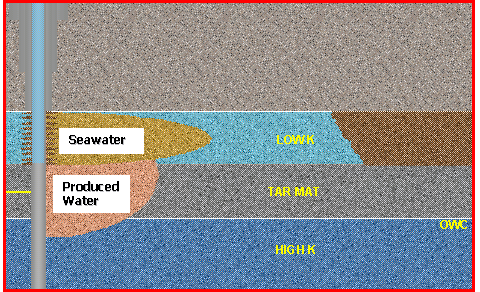
Figure 6. A Prudhoe Bay example where fracture growth was impacted by thermal effects.
Another
fracture diagnostic is looking for where there are very rapid changes in
rates. This is demonstrated in Figure
7. Seawater was injected first, then
produced water. The change in the
pressure-rate trends shows that the produced water injection eventually caused
more substantial fracturing. The
permeability of these wells is about 25 md.
It
is even possible to use very simple diagnostics and correlations. An example was given for wells in thin pay,
50 or 60 feet, which injected differently than those that were know to have
grown out of zone. The correlation was
used as a diagnostic. If a reduction in
injectivity was not seen, it was determined that fluid was not being pumped
where it was thought.
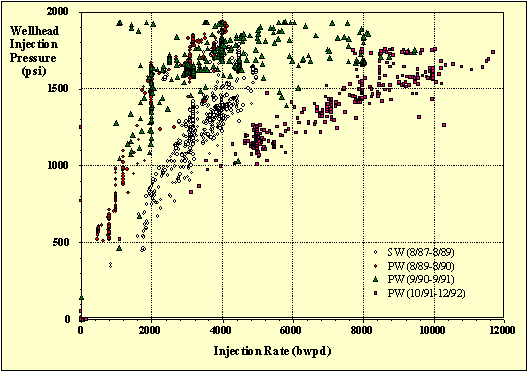
Figure 7 A plot of wellhead pressure versus rate for seawater and produced water, showing different inflections for different fluids.
Open Discussion:
Other
techniques were discussed. These
included:
Offset well response: Norm Warpinski related fracturing in one well and
making pressure measurements in another.
If you have a model, you can invert the data then solve for the fracture
geometry. This is a form of
interference test.
Offset well response: Laurence reasoned that if a frac grew out of
zone, you would be underreplacing voidage and would be depleting and this could
be detected in offsets.
Offset well response: Laurence indicated that production in offsets was
quite diagnostic.
Multi-rate Testing: In one scenario, BP used temperature logging,
pressure-rate data, assessed produced water response in the injector and
measured offset well response. They
also did a multi-rate falloff.
Protocols were indicated. There
were 3 to 4 days of steady injection, followed by a falloff, followed by low
rate reinjection and a falloff and finally a high rate injection with a
falloff. The purpose of the different
injection rates was to look for changes in kh or skin and consequently infer
different entry profiles. One of the issues with this is well test
interpretation because fracture geometry is likely changing. How fast is the response changing due to
closure versus kh? Norm Warpinski talked
about a situation where he saw five orders of magnitude differences in fracture
conductivity during closure in a tight gas reservoir.
Chris
Wright asked if anyone had seen cases where reservoir permeability had been
changed by injection. Laurence
indicated yes and that this was particularly true in naturally fractured wells
(refer to Figure 8).
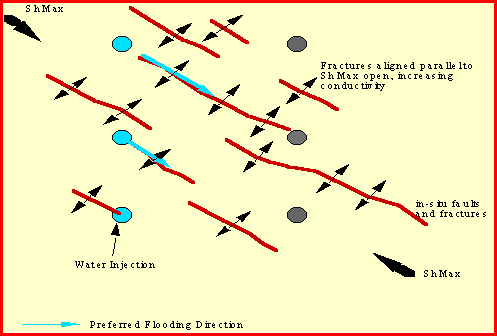
Figure 8. With inflation of pre-existing natural fractures, their conductivity (in the direction of their length and possibly slightly orthogonal to this) increases. The superficial result in the overall reservoir will seem to be an increase in the permeability in the directions of the fractures.
Chris
Wright indicated that it is possible for shear-related effects to happen right
at the wellbore. He cited the KTB
project in Germany (very deep) as an example.
Microfracture testing was misinterpreted. A tensile hydraulic fracture was not created. Flow went into a shear feature.
Laurence
talked about a situation for evaluating flooding directionality (as in Figure
8). How do you translate injection to
an increase in permeability? Where you
have dynamic data (chronological information), look for offset production and
do appropriate statistical processing (Spearman Rank Correlation).
Laurence
showed Kuparuk data. The maximum stress
direction, as inferred from breakouts, varies but due to the presence of a
basement fault. Permeability in the
target zones is low. In an evaluation
of available data, they were looking for a preferred and correlated response between
injectors and producers. Definite
preferred communication directions were found and they flipped depending on
what side of the fault that you are on.
The situation becomes even more interesting when you look at the
details. For low rate injection,
mobilization of complimentary shear planes (low conductivity probably and not
aligned with the maximum principal stress) fanned out around the strike of the
inferred maximum principal stress direction.
More planar fractures, more generally aligned with the maximum principal
stress were formed at higher rates. As
suggested above, if there are preferentially aligned pre-existing fractures
that are jacked open by changing pressure regimes, permeability enhancement can
occur in a particular direction during long-term injection. Chris Wright argued that some of this was
natural anisotropy. Indeed it may be,
but the bottom line was that BP put these directional trends into coupled
simulators to identify unswept oil and to avoid drilling an excessive number of
infill wells.
Regardless,
of what other monitoring is done, you still need to consider monitoring of
water quality. You may consider
saturation logging, in infills particularly (or a sidetrack to an
injector). Laurence indicated that when
you are sidetracking injectors you must be careful with your mud weights
because of elevated local pressure.
Conventional
tracers (long time injection at constant rate) were discussed and recognized as
accepted technology.
Norm
Warpinski suggested using 4D seismic for front tracing. It works best (for this) in a compressible
formation. Laurence has a demonstration
case and there are numerous examples.
The rock impedance contrasts and the fluid impedance contrasts are
essential. What can you do in the
meantime with the geophones that are there?
Specifically, if there are already geophones on the seabed.
Jean-Louis
asked about techniques for reducing fracture height if it has already grown too
high. He indicated that pumping cooler
water could increase the stress contrast between the entry zone and zones into
which the fracture had already grown.
Some North Sea operators are cooling produced water and inducing a
stress barrier. Laurence indicated that
you could commingle with seawater to cool cheaply. Paul Jones suggested there are cases for transferring from one
platform to another. Alastair Simpson
indicated the incumbent difficulties for scale formation in heat
exchangers. Laurence indicated that
commingling would be preferable. Water
analyses were talked about, as part of flow assurance efforts and it was
indicated that the usual "ten" ion analyses were often inadequate
(e.g. zinc and lead are not represented).
Friday April 28, 2000
Open Discussion:
There
was a brief recap of the previous day and it was planned that Laurence would
present some of the information that he has on predicting thermal fracturing in
high angle wells.
Some
of the issues to be resolved included:
ü What is it that really needs to be included in models, particularly in terms of storage?
ü What steps are required to improve techniques and tools for measurement, surveillance and prediction?
ü Are there improved methods for evaluating multilayered reservoirs? e.g. flow profile along with falloff. Need to do measurements in individual layers.
ü Fractured Injector Well Tests: What is the right protocol? For example, if you shut-in and do the SRT, it may be different than if you are injecting. A list of what should be done was requested.
ü There is nothing (?) specifically available for falloff test analysis in fractured injectors. It was indicated that there was no commercial code available for it. The way forward is to first talk to Tony Settari to see if he can do this and, if not, to raise it at the next steering committee meeting and retain a third party to evaluate this. This is an urgent action item.
3
People should look in
their own companies for forgotten/obsolete well test software that may be of
value. Laurence indicated that there is
unpublished information on fracturing from horizontals with mode I and II
fracturing.
Microseismic:
ü Laurence's conclusion was that common situations might preclude utilization of the technology at the depths of interest. Paul van den Hoek believes that it may be more generally applicable on land. Laurence believes that the signature of the processes may be more analyzable than has been previously done, to tell you more about what the signals mean (origin).
ü Paul van den Hoek reiterated that Norm had indicated that the leakoff dominantly causes events. Laurence suggested that it might be possible to resolve this with frequency analysis. Microseismic may need further effort on event discrimination and this is done all of the time for seismic (Laurence).
ü Paul Jones brought up the issue of gas reservoirs being more favorable for microseismic activity than oil reservoirs. Chris Wright summarized that few or none of the events were associated with the tensile events. He believes that frequency analysis will be difficult. What does the different frequency character mean? Historically, in gas reservoirs, events have been more localized to the fracture plane. As a post-meeting addendum, John McLennan suggests that we should be cautious in assuming that gas reservoirs are always better candidates for identifying fractures with microseismic techniques. In fact, gas compressibility and inherent signal attenuation in gas would seem (to him at least) to suggest otherwise. Part of the reason may have to do with the rocks where the measurements were made. In relatively tight gas reservoirs there will be less leakoff and the energy released with fracturing may be higher because of the brittle nature of the rock.
ü What have people tried to do for reprocessing microseismic data to highlight events localized to the fracture? Paul Jones indicated that it would be desirable to know more specifically what are the current limitations. Paul further indicated that if the Sponsors see a need for this technology to mature, maybe the JIV should give direction to appropriate organizations. Paul van den Hoek indicated that it might be necessary to focus these efforts on waterflooding. Chris Wright felt that it is interpretation rather than measurement that requires nonincremental development. The source parameters can be identified. MAJOR FOCUS ON WATERFLOODS.
ü Laurence brought up that it could be done as a tomographic measurement, depending on whether you would be willing to drill a rathole. Some work has been done at Ekofisk on microseismic monitoring and there apparently is a publication.
ü From a flood front perspective it was felt that you are probably generating a lot of events. Near-wellbore characterization and remote evaluation (in the reservoir) are both desirable.
HIT:
ü Jean-Louis is interested in knowing what the response is if the fracture is partially filled with plugged material. Laurence indicated that work has been done at Forties with seawater and produced water - but much of this was done below fracturing pressure and skins were high. There may be an example well.
ü Looking at specific interpretation of HIT data, Chris Wright indicated that Pinnacle is negotiating for situations to deploy downhole tilt mapping and microseismic measurement. Laurence indicated that there are many situations where falloff and HIT have and should be used together. Maybe they will only delineate the same leakoff area; however, the combination could be more useful if there are dramatic length differences.
ü Paul van den Hoek acknowledged the validation that he is seeing in various programs and they would generally do HIT on a falloff. He would like more testing.
ü Jean-Louis brought up the issue of fracture closure and what do we really measure. What would happen on a falloff when the fracture is more or less filled with material? It was suggested that there would be a prolonged, slow pressure decline.
ü Laurence Murray returned to a containment perspective. The assumption is sometimes made that the fracture is just closing on width in a single layer. What happens if there are multiple layers? How do you recognize height recession from HIT? You would be looking at variation in the reflection coefficient as a function of pressure during shutdown and relating this to closure and you might even look at individual trends. Laurence assigned himself an action item to find information for looking at these trends. Laurence will find one case where very strong trends are available showing this.
ü Also, in terms of height, Paul van den Hoek offered that the first thing done should be a two-dimensional interpretation and that reflection coefficient interpretation would be better with higher frequency. BP has looked at a spread of frequencies, for example, a well defined signal -CHIRP - contains a frequency spectrum.
ü BP has done work on land (Alaska) with stacked CHIRPs. You could pick your frequency band, send it down and stack the or the pulse could be applied by brute force using a large amplitude delta function, high frequency pulses with high amplitude. BP hasn't really pursued this because of time constraints. BP argues that there is a possibility to use a different type of signal.
ü CHIRP can be done at full injection. You do many and stack them together. You lose frequency, but you still get some high frequency signals. The higher frequency will allow you to resonate the fracture and the parameters can be determined from resonating.
ü Paul van den Hoek indicated that the ultimate goal is a good signal to noise ratio over an extended time during injection. It could also be done at reducing rates. 10 to 100 Hz is ideal. On injection, you could use CHIRP and you could use conventional HIT on falloff. Laurence will provide a Patent Number.
ü An Action Item was to get clearance and analysis for releasing CHIRP data to the JIV and for the JIV to encourage the service industry to proceed forward with this technology.
Tiltmeters:
ü A significant issue is using the technology in the same well in deviated and horizontal situations. Deviation and coupling with the formation are relevant and it would be reasonable to encourage the industry to accelerate current methods for doing this.
ü Sponsors requested a review of what is currently the status of same-well tiltmeter usage.
ü It seems that some development would be required for interpreting measured tilts in the horizontal situation. Pinnacle is planning to partner with Halliburton. Halliburton will develop coupling aspects. The issues are deployment, coupling and interpretation in a horizontal well.
Recap:
ü Jean-Louis would like Best Practices on injectivity testing. What do people currently do? The answer was to set up a pilot; generally a one well trial. Jean-Louis indicated that one of their business units was ready to try a pilot and it would be useful to have some general guidelines on putting together a program.
ü Paul Jones outlined an example pilot that he was familiar with. Injection started with the cleanest fluid and then gradually went to dirtier fluid. 2.5 million gallons were put away. It was found that fracturing might ultimately have occurred.
ü BP has done the two extremes in pilots - filtration followed by no filtration.
ü Laurence cited a situation where they bypassed all filtration and didn't see any change in injectivity (Figure 9).
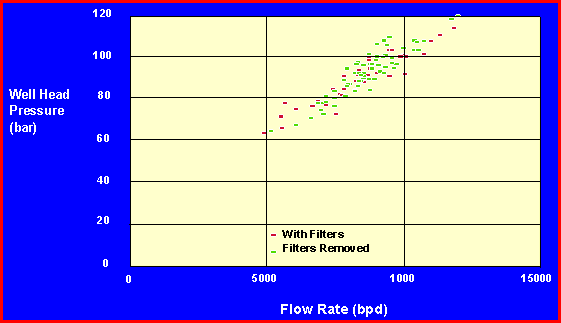
Figure 9. WHP vs. rate, with and without filtration, showing no obvious effect in this field situation.
Predictive Methods - Laurence Murray:
Laurence
presented slides from SPE 59354, "Predicting Multiple Thermal Fractures in
Horizontal Injection Wells; Coupling of a Wellbore and a Reservoir
Simulator." This abstract is available.
"To generate a procedure for the well
commissioning requires us to be able to predict bottom hole injection
temperature, rate and pressure variation along the horizontal (or highly
deviated) section and couple this into a reservoir fracture model. Achieving this using separate models soon
becomes impractical, requiring too many iterations between coupled
problems."
"This paper presents an overview of how an
existing commercially available transient wellbore model has been couple to a
special purpose reservoir simulator, and how this has been applied to the
modelling of multiple thermal fractures in horizontal injection wells. This paper also reports how the wellbore
simulator has been modified to allow the prediction of depth dependent bottom
hole temperatures. This paper will also
comment on the application of this new coupled model to intervention work in
production wells."
Jean-Louis
asked Laurence about TSS in the BP models and emphasized that he is aware of
field cases where scale could be an overriding issue.
In
his presentation, Laurence reiterated the importance of the startup process on
a horizontal injector. BPOPE was used
and the fracture forecasting was based on LEFM (linear elastic fracture
mechanics). It was an inverted seven
spot. How do you represent early-time
behavior? A constant temperature
injection was represented and early-time thermal fracturing was not seen. At later times, when the temperature was
constant the modeling showed no radial flow and everything was going into fractures.
A
fracture grid can be coupled to a reservoir simulator and, with code
modifications, the transient profile can be developed. V.I.P.S. has simulated this same well. Visage appears to underestimate the
bottomhole pressure. As an Action Item,
Laurence will e-mail the final version of the V.I.P.S. report.
The
concept of rate-dependent fracture morphology came up again - at low rates,
shear fracturing can occur; at higher rates, tensile features seem to be more
common.
Storage
capacity of fractures came up. It was
indicated that most of the laboratory blocktests (although particle size may
have been somewhat too large) showed that everything stays in the
fracture. One possibility for resolving
large pumped solids volumes is storage remote from the main fracture in other
fractures (the disposal domain concept - see below).
In
terms of storage capacity, Ahmed indicated that single planar fractures are not
a realistic storage mechanism. Laurence
believes that you need to include natural and induced fractures.
Predictive Tools - Ahmed Abou-Sayed:
Ahmed
presented on desirable predictive tools. The requirements indicated are as follows.
1. Plugging representation (contents, rock properties,
flow, time). Paul van den Hoek agreed
that this is a major item.
2. Fracturing criterion (pressure, stress,
temperature, plugging).
3. Initial beanup rates and follow-up rate policy.
4. Pre-existing conditions (skin, perforations, and
fractures).
5. Backflow and crossflow provisions.
6. Voidage replacement targets (pore pressure
buildup).
Ahmed
then indicated the Well/Reservoir
Scenarios that need to be considered.
1. LAW (low angle wells) vs. HAW (high angle wells)
with multi-layer intersections,
2. ERD (extended reach drilling) wells with
multi-reservoir intersections,
3. Vertical/deviated wells with and without
fracture(s),
4. Soft vs. hard formations,
5. Openhole vs. cased hole (perforation strategy),
6. Mechanical control devices (wellbore hydraulics),
and,
7. Converted producer vs. new injector.
Ahmed
advocated that you can't find one model that is going to handle everything and
that single planar models are not the answer.
He felt that the disposal domain proposed by Moschovidis et al. was an
appropriate conceptual representation.
Paul
van den Hoek talked about a practical application where he felt that multiple
fractures could be adequately represented by a single fracture. Laurence suggested that a prerequisite for a
disposal domain concept might be batch injection. Ahmed did not disagree but emphasized that you may only need to
have a reduced treating pressure and new initiation will subsequently occur.
Paul
van den Hoek argued for not modeling all of the details.
Jean-Louis
recognized that with conventional fracture volumes, that there is not enough
volume to accommodate all solids in a single fracture. This being the case, "Does the
injectivity drop to zero if a fracture is filled?" Laurence indicated that there are cases
where injectivity has been completely lost.
The reason that BP has not completely pumped these wells is because they
would grow into an aquifer or elsewhere.
Jean-Louis
asked Paul van den Hoek why his Oman example does not show significantly more
height. Paul indicated that Jean-Louis
is asking an essential and basic question, "Where do the solids go and how
does this affect the height growth?"
Paul indicated that he was unable to match available Prudhoe Bay
information and that this must mean that there was height growth. Looking at Prudhoe Bay, Laurence agreed that
these wells would grow out of zone.
All parties argued about where the solids go.
Disposal Domain - Ahmed Abou-Sayed:
Ahmed
then showed one procedure that he has applied for cuttings reinjection, where
you represent "shoving" a certain volume of solids into a pie-shaped
region around a wellbore - it is essentially a single planar fracture that is
rotated. Containment and length are
evaluated using a planar model (such as PWFRAC) and storage is determined with
the disposal domain concept. The
pressure increment is correlated with the angle of the pie. Some containment guidelines are available in
the European PWI Guidelines (Laurence will provide the full text of guidelines
in "Proposal for Injection into non-Productive Horizons") which have
been published in a recent Newsletter.
The
contractors were instructed to add this to the modeling survey. A spreadsheet, performing these
calculations, was demonstrated. Ahmed will provide the spreadsheet. The next question raised was "Where do
the solids go and how does it impact on fracture growth." To address this, Ahmed agreed to provide a
Newsletter article on how to link together storage and height.
Can
these models effectively take into account differences between cuttings and
produced water? You can likely use the
disturbed region for storage in produced water injection.
What
are other concepts beyond the disposal domain concept? What obvious things are missing? Paul van den Hoek indicated that apparently
we really still don't know where the solids go and the disposal domain concept
may not be appropriate in continuous injection into high permeability
formations. Ideally, you may want a
model that can represent a fracture and supplementary shear zones.
Paul
van den Hoek summarized what Laurence had shown on the previous day - that
there could be a preferential zone rather than a discrete feature, that fluid
loss is a controlling factor and that these shear zones may also provide
storage volume. There are various publications
in the literature (refer to various K. Heffer papers).
There
was additional discussion on how solids disposition impacts height growth -
back to the disposal domain - and altered stress fields. It may reach a point where a fracture will
preferentially grow into other zones.
Chris Wright indicated that in the Mounds injection program, the last
injections grew down and pressure dropped.
Laurence indicated that there seems to be a lot of evidence.
In
terms of the disposal domain concept, Paul van den Hoek asked, "What
happens if there is continuous injection during waterflooding?" Ahmed indicated that, for waterflooding,
efficiency is low; eventually however, there should be tip plugging, and once
the tip plugs, there is a mechanism for generating enough pressure for
initiation of new fracture branch(es).
One mechanism is shear initiation immediately behind the plugged
zone. Another is generation of
fractures from the wellbore. How could
this been put into the disposal domain spreadsheet? Ahmed suggested that it can act like an alternate borehole
breakdown relationship - a new feature is forced to initiate at an unfavorable
position on the wellbore? Bifurcation
was seen in the block tests. Tangential
stress around the wellbore is used to enforce a maximum angle for the
"pie" in the spreadsheet.
There
was additional discussion of the characteristics of the fractures in the
disposal zone. Chris Wright suggested
the analogy of produced sand reinjection.
Paul van den Hoek wondered "How is the compliance is
accommodated?" Chris Wright
indicated that the pie zone may be preferentially oriented and that he believes
that it is composed strictly of multiple planar features. Laurence argued that the shear features
eventually line up. Fracture signatures
for growth are an unknown.
In
terms of more general issues, Paul van den Hoek emphasized that there are
numerous loose ends (e.g., there is data in previous reports like PEA-23 but
the scale of the block tests may not be large enough. What sort of information is not captured in the block tests?)
"Control Issues":
ü Do you need to have control or allow intervention mechanisms?
ü What happens during the life of the well? i. e., flow controls.
ü Is there a way of handling various scenarios without intervention?
ü You may have surveillance equipment, but what do you do if a problem is recognized?
ü
In a layered or high angle well situation, will there
be options for previous intervention.
Laurence believes that he has to find some method for controlling
individual zone behavior. He showed an
example from Alaska, with the tar mat below, shale up top and in the pay kv/kh
is somewhat better below. Crosscutting
fractures have been generated along the length of the well. Injection was initially below frac gradient
but there was cooling and all fracturing was bounded by the thermal front. Simulations showed more flow leaving the
heel than the toe. However, in the simulation, changing just one parameter reversed this
situation! The formation pressure - it was reduced by
500 psi. The vertical permeability
change is relevant. The well is
slightly inclined and this is why the toe grows down first. Fiber optics may show temperature variation
to delineate an injection window but this may be very small. Laurence's default position is continuous monitoring
and a minimum on-off across each zone.
Maersk have a well with downhole flow control. This is a dynamic programming problem but you have to have the
hardware in the hole. Control will be
more difficult in a layered reservoir.
What about remotely operated chokes?
What are people doing to handle
this issue?
Action Items:
1. Spreadsheet to be provided by Ahmed Abou-Sayed.
2. SPE Produced Water Reinjection Guidelines. Ahmed will provide an additional review
article in the Newsletter. For the
disposal domain concept, this will help to clarify the link to height growth
mechanisms - how the disposal domain mechanism impacts height growth.
3. Laurence Murray will check on filtration data.
4. The PEA-23 block test information needs to be put
on the web site.
5. Ahmed's write-up (Action Item 2) will clarify
containment. The question was raised
whether "Is the JIV at the point where it needs to decide about a
predictive tool?" Presuming that
the disposal domain concept is reasonable, there may be a picture (semi-quantitative)
of how injection growth occurs. This
item needs to be put on the Steering Committee agenda. Preferably the model would be a spreadsheet
approach. Individual modules could be
built and subsequently put together or, at the end of the JIV, a third party
could be chartered to put them together.
The current contractors would have right of first refusal to develop
this unified package. The four options
that could be proposed at the Steering Committee Meeting are 1) adopt the
spreadsheet and do nothing else, 2) is anyone in the contractor group willing
to take this on and go forward - either funded or 3) licensed, or 4) finally
give it to an external party. Agenda Item for the Steering Committee
Meeting.
6. Action - Layered and Monitoring Tasks- Polling the
Operators on what is their philosophy for mechanical control - for current
service and for produced water. Maersk
has thought about the design issues for robust service. What about smart wells for injectors. "Review of Operators on the Control
Side for Layered or High Angle Wells - Monitoring and Responding."
The
workshop was adjourned. An operator
meeting followed.