Mitigation Procedures for Conformance in
Heterogeneous Layered Reservoirs
Introduction
At the Layered Formations' Workshop, considerable emphasis was put on maintaining conformance and sweep efficiency during PWRI, for, among other purposes, maximizing recovery of oilduring waterflooding operations. Two generic methods for addressing conformance issues were identified:
Method 2 is the focus here. Method 1 is beyond the scope of this JIP.
"Is there something that you can do to avoid having to do remedial work in the first place and how do you design to maximize recovery in order to avoid remediation?" What are the successful practices that can be adopted - starting at Day 1 - to avoid the need for future remediation?
The Big Picture
Before reading any farther, recognize the overall role of PWRI. In an overall PWRI framework, produced water reinjection is not just a disposal operation. It is part of an integrated reservoir management strategy where water disposal is only one facet. PWRI has to be explicitly incorporated in the framework of optimizing recovery of hydrocarbons derived from water injection. As such, produced water reinjection must be simultaneously viewed as a means for: 1) economic and stringent environmental compliance, 2) a means for maintaining reservoir pressure and overcoming voidage, and 3) a method for mobilizing and transporting in-situ hydrocarbons to producers, at tolerable water cuts, during secondary oil-recovery flooding operations.
Recognizing the importance of contacting and mobilizing unswept in-situ oil, conformance in multi-layered scenarios becomes an essential considerationwhenever the business objective is to maximize oil recovery. In this regard, the issue of crossflow must be considered in planning for any injection operations.
"Many methods for predicting the oil recovery performance of waterfloods assume that the layers in the reservoir are each continuous from well to well, uniform in properties and insulated from each other except at the wellbores. We generally visualize such a reservoir as a layer cake, with icing between each layer serving as the insulating material."
"From what we know, few reservoirs satisfy the concept of shale streaks or impermeable beds acting as continuous material isolating each layer from each other."
From a waterflooding perspective (matrix), crossflow effects can improve the recovery performance at favorable mobility ratios and the reverse is true if the mobility ratio is unfavorable. The mobility of a fluid is the effective permeability of that fluid divided by the fluid viscosity. For example, water mobility is kw/m w and oil mobility is ko/m o. Mobility is saturation dependent. Mobility ratio has been defined as:
The subscript "d" denotes the displacing phase. In PWRI, the displacing phase is water and we can approximately consider the mobility ratio to be:
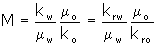
The water permeability is that in the water-contacted portion of the reservoir and the oil permeability is that in the oil bank (two different and separated points). These are simplifications if there is a saturation gradient behind the water front. Changes in mobility ratio can also occur after breakthrough. As a rule-of-thumb, Craig, 1971, suggested that the most commonly encountered values of mobility ratios during waterflooding range from 0.02 to 2.0. Most existing waterflooding operations involve unfavorable mobility ratios.
As another rule-of-thumb, in conventional waterflooding, using very elementary considerations, crossflow effects can improve the recovery performance (vertical coverage) at favorable mobility ratios (M < 1) and the reverse can occur for unfavorable mobility ratios (M > 1). BUT - this presumes that vertical coverage is desirable - that all zones have unswept oil. If this is not the case, it may be desirable to inhibit vertical coverage.
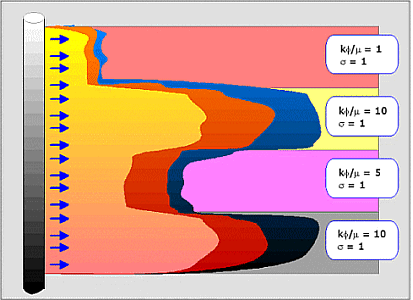
Figure 1 is a schematic of how flow might occur in a layered PWRI injector. Presume that all zones are "perforated" and initially open at the wellbore. "Normalized" values of permeability are shown for each layer. Presume that the in-situ stress (s) is the same in all zones. Figure 1 is a situation where there is negligible crossflow. Penetration is greater in the higher permeability zones and for the purposes of illustration, plugging at/near the wellbore is assumed to occur earlier in the lower permeability intervals.
|
Figure 1. |
Multi-layered formation assuming no crossflow, but also demonstrating reduced recovery in lower permeability intervals and the potential for rapid breakthrough. |
While Figure 1 shows a situation that may not be desirable, because coverage of all zones is not uniform, you can rest assured that this situation does not occur often because there will likely be crossflow (pressure and fluid-flow communication between layers). Figure 2 is a schematic of how crossflow can occur.
|
|
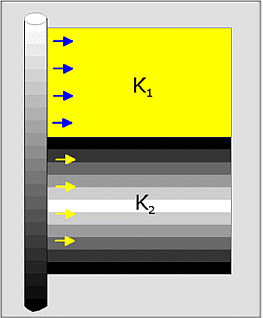
Figure 2. Suppose that there are two adjacent layers with permeability k1 and k2 (more precisely, mobility needs to be considered). Do not consider plugging at this time. If k1 >> k2, the radial pressure gradient can be higher in Layer 1 than in Layer 2 after injection has occurred for some time. This is because most of the flow has been going into the higher permeability layer. The spreading pressure increase in Layer 1 can create a vertical pressure gradient in Layer 2 (i.e., at least away from the wellbore, the pressure in Layer 1 can be higher than in Layer 2 and vertical flow will want to occur into Layer 2. If k2/k1 £ 0.01 the direction of flow in Layer 2 would be almost vertical. |
With crossflow, such as shown schematically in Figure 2, and also in Figure 3, flow can be diverted to zones where there is no hydrocarbon to be swept. Figure 3 shows incipient crossflow from higher to lower permeability zones at a relatively short distance from the wellbore.
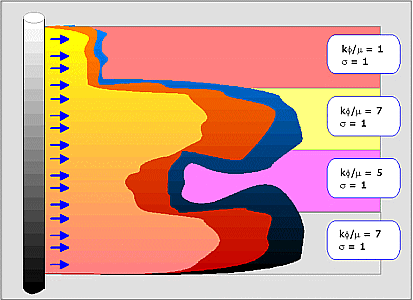
| Figure 3. | Incipient, near-wellbore crossflow is schematically shown where flow is diverted to a lower permeability zone. |
Water breakthrough in the high permeability layer has serious consequences. The water mobility and transmissibility will skyrocket in the high permeability layer due to relative permeability effects. Then, oil recovery and sweep efficiency can be seriously impacted.
To the PWRI specialist, crossflow can have three manifestations. There can be horizontal crossflow on shut-in, occurring at the wellbore. This has been demonstrated on Heidrun. There can be near-wellbore vertical interlayer flow, as is shown in Figure 3. There can also be crossflow deep in the reservoir due to permeability contrasts, or in-situ inhomogeneities. Figure 4 is an example, showing movement of fluid to the water zone (perforated only in the oil zone) because of more favorable relative permeability and gravity. Note in this example that flow is to a higher permeability zone.
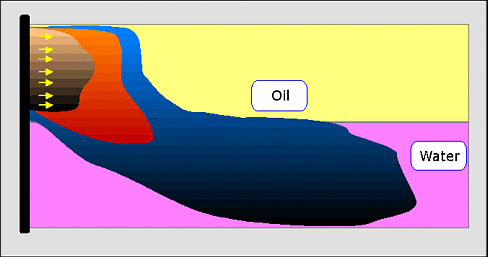
|
Figure 4. |
Impaired sweep in the oil zone because of the more favorable relative permeability in the zone with higher water saturation. Injectivity may be adequate but hydrocarbon recovery is drastically reduced and impaired. |
The situation in PWRI is frequently more complicated since some form of vertical fracture may have often formed. Figure 5 schematically shows diversion of fluid to a lower permeability zone because of fracturing. Injectivity may appear to be adequate, but this cannot be considered exclusive of sweep efficiency. The inverse situation can also occur after water breakthrough in a high permeability layer.

| Figure 5. | Impaired sweep in the higher permeability zones because of fracture growth into the overlying lower permeability material. |
The Conformance Crossflow Consideration
Beyond the normal operational and near-wellbore considerations when designing a PWRI project, there is an important and fundamental conformance crossflow consideration that should be addressed when designing and implementing a PWRI project involving a layered reservoir. If the formation for PWRI injection is layered without crossflow between the layers and there is good cement behind pipe and if water injection is being conducted at a pressure below which hydraulic fracturing will occur and there exits is an unfavorable mobility ratio, then where feasible and possible, the water injection rate should be proportioned into each reservoir layer in a manner to maximize and optimize oil recovery from the well pattern. Thus, in this manner, the design of the PWRI project can have a significant impact on the reservoir-engineering question of the inter-well oil recovery factor.
However, if the water is injected at sufficiently high pressure such that hydraulic fracturing occurs (e.g., thermally induced vertical fractures), then there is little that can be done conventionally to control the relative water injection rate into the various reservoir intervals. Thus, little can be done during the PWRI injection design to affect the inter-well sweep efficiency and the reservoir-engineering question of the inter-well oil recovery factor.
Likewise, if there is crossflow between the reservoir layers, then there is little that can be done conventionally during PWRI injection to control the relative water injection rate into the various reservoir intervals. Thus, in this case too, little can be done during PWRI injection to influence sweep efficiency and ultimate inter-well oil recovery.
The Challenge
You can imagine that there are a large number of parameters that can impact and that affect optimizing injectivity concurrently with hydrocarbon recovery. There are some methods that might be adopted for mitigating future problems. Some of these are described in the following section. One of the outcomes of the Layered Formations Workshop was to get operator input on how they would mitigate future conformance problems (to maintain injectivity and sweep). To restrict this exercise, four generic formation scenarios were delineated. These are shown in Table 1.
Table 1. Generic Scenarios
| Permeability | Hard/Soft | Case |
|
high |
Hard |
1 |
| low | Hard | |
| high | Soft | 2 |
| low | Soft | |
| high | Soft | 3 |
| low | Hard | |
| high | Hard | 4 |
| low | Soft |
Table 1 shows four generic injection target scenarios, each with two zones of different combinations of mechanical properties (hard, soft) and different permeabilities (low, high). What would you do to avoid future remedial activities in each of these cases? Remember NO FUTURE INTERVENTION is possible for this exercise. There may or may not be a possibility for in-well, near-well, or far-well reservoir crossflow. These possibilities are expected to have a significant impact on the following exercise. What are the practical means to ensure injection coverage of, and good conformance for, these reservoir packages? "How do you control the well during its life?" Part of this relates to starting the operations out correctly! "Are there situations where mechanical differences between formations can be overcome without using mechanical means for isolation? If so, how are these differences overcome?"
Also remember that there is a REQUIREMENT FOR MULTIPLE ENTRY POINTS. EVERYTHING ELSE WILL REQUIRE SACRIFICNG SOME PRODUCTION. The presumption is that injectivity and recovery require flow in both zones. CONFROMANCE IS AN IMPORTANT ISSUE AND AN IMPORTANT CONSEQUENCE OF THE DESIGN AND MANAGEMENT PROCESS.
Possibilities
The following items describe some of the possibilities that you could consider (upfront) to mitigate future injectivity and sweep difficulties.
Dual laterals are currently used on Magnus. The economic decisions may come down to how sustainable the injection needs to be over the life of the reservoir. Sometimes you find that over the life of a field you may not have to inject as much for voidage replacement as earlier on in the life of the reservoir.
At Prudhoe Bay, in the WPWZ, there are some multilayered situations with crossflow and vertical fracture growth (through the tar mat) may be undesirable. Is there something that you can do during completion? What would be an alternative? One possibility would be to drill a well that is s-shaped and is subhorizontal through the zones above and below the tar mat. One of the problems can be formation damage during drilling as well as difficulty in cleaning perforations. You may want to create multiple fractures in the horizontal sections. The problem then becomes how to create these fractures? Alternatively, your may have to think of using multi-laterals. Regardless, one key in these horizontal sections is how to operate the well to get conformance. One of the difficulties is to keep the fractures from growing down through the tar mat.
Backflowing is an option only in situations where formation integrity is adequate
Examples have been provided (refer to the Layered Formations Workshop) where the importance of cleaning up perforations has been demonstrated. In one situation, the perforations were cleaned up before injection. They were backflowed and solids lifted to be certain that the perforations were clean. The permeability was between 200 and 300 md. The perforations had to be clean to allow water in for cooldown.
In general, especially in softer formations, you will want to have a soft shut-in to avoid water hammer effects. On the other hand, in some gravel pack scenarios, recall that water hammering has shown some possibility for temporary cleanup.
Fracturing does not always work. For example, BP has tried to put propped fractures in the Sag River to get water in and try to get thermal benefit. They have found that these fractures can plug up when going from seawater to produced water in maybe 12 months. (As an aside to mitigation considerations, BP has also found out that these fractured wells clean up with seawater. Maybe the seawater pushes proppant away. They clean up with ~300 bbls of seawater. Solvents can also be used. Seawater flushes do not give a sustainable benefit and there is a need to flush with seawater every few months.)
Suppose that you have a long horizontal or an extended reach well where fracture initiation will preferentially occur at the heel. One possibility for encouraging some injection farther along the well is to set two ECPs at the toe, for pressure isolation. Pressure isolation may only required for a short period of time so that initiation of a fracture could be ensured at the toe, either from explicit fracturing or as a result of some cooldown operation.
In some formations and injection scenarios, you may not rely on thermal effects and you may well need mechanical isolation for long-term performance. "What are people thinking of for controlling conformance in soft formations? Are mechanical methods for guaranteeing conformance required from the start, in soft formations, to avoid the costs of remediation or the costs of trying to pre-condition certain layers. For example:
Cases have been reported where the differences in fracture toughness (or stresses) between zones can make it extremely difficult to guarantee conformance. Suppose that there is an upper zone with high stresses and high fracture toughness. A lower zone, below an intervening shale, has lower stresses and a lower KIC. It might be determined that thermal manipulation of the stresses will not work because the contrast in stresses is too high. This was a situation (an actual BP Amoco example), where conformance was accomplished mechanically. It is unique because the mechanical completion was manipulated thermally (rather than the formation). An inflatable packer was set between the two zones. Produced water was used to keep the inflatable from unseating (i.e. to avoid unseating caused by cooldown). The upper zone was broken down and after a couple of days, injection was switched to seawater. With seawater cooling, the bridge plug eventually unseated and it was pulled. An inflatable had to be used because there was a 4 1/2-inch injection string with a 7-inch casing below (refer to the Layered Formations Workshop).
Are there specific situations when mechanical control may be the only currently effective means for guaranteeing adequate coverage of all zones? Various operators have tried to use orifice packers but they have sometimes been found to plug up.
Example 1:
Options for conformance are even more difficult when you go to soft rock because you may not have the thermal benefit.
There was a high pressure difference across a shale separating two zones. The completion was a liner that was uncemented. It was desirable to avoid injection into a high permeability water zone. This was accomplished by setting a maximum bottomhole injection pressure. During injection, poroelastic effects caused the stresses to increase in the water zone and flow was diverted to the oil zone. "BP follows this practice more generally in converting producers to injectors by sidetracking "to ride the pressure wave."
This is an extended reach/near horizontal well. It was in the same zone but the pressure varied from the toe to the heel. What are the possibilities for using different formation pressures for controlling fracture initiation preferentially? Fractures may initiate preferentially where permeability is lower. Stresses may be less in zones that have been depleted. It is important to have a feeling for your reservoir to be able to do this.
"The top layer in this field has a permeability of approximately 100 md (net-to-gross of 0.8) with an underlying interbedded zone with a net-to-gross of 0.4 and some local permeabilities up to a darcy. The upper zone has lower stresses. In the lower zone, shmin is 8000 psi, whereas it is 7000 psi (plus or minus) in the upper zone. Both zones have residual oil. The relative permeability to oil in the lower zone, kro, is 0.3. It is 0.5 in the upper zone. One possibility would be to use a level 5 or higher multilateral to allow you to physically isolate each zone. Do you perforate and complete or complete and then perforate?"
Types of Crossflow:
Recall that there are three generic types of crossflow. There is horizontal crossflow into different layers that can occur during shutdown. There is near-well crossflow that can occur close to the wellbore because of permeability differences and differential plugging. Also, there is in-reservoir vertical crossflow, which occurs farther out in the reservoir. Remembering that forecasting the future potential for crossflow can be difficult. As such, when considering mitigation activities, good planning might suggest, within reasonable economic bounds and risk, that the mitigation technique that is adopted could be used to avoid more than one type of potential crossflow. While filling out the following tables, also consider and annotate which of the foregoing methods can be effective in overcoming which types of crossflow.
Case 1
|
High Permeability, Hard Formation |
|
|
Low Permeability, Hard Formation |
|
|
OR |
|
|
Low Permeability, Hard Formation |
|
|
High Permeability, Hard Formation |
|
|
Method |
Your Experience or Opinion or Corrections |
|
Drilling individual wells |
|
|
Dual completions |
|
|
Cased Multilaterals |
|
|
Openhole Multilaterals |
|
|
Sidetracking |
|
|
Single Drainholes |
|
|
Multiple Drainholes |
|
|
Sidetracking |
|
|
Variable Wellbore Trajectory |
|
|
Wandering Wells |
|
|
Climbing Wells |
|
|
Backflowing |
|
|
Profile Modification |
|
|
Selective Perforating |
|
|
Perforation Spacing, Geometry ... |
|
|
Under- or Overbalance |
|
|
Propellant Fracturing |
|
|
Modified Limited Entry |
|
|
Cased Hole Stimulation |
|
|
Openhole Stimulation |
|
|
Wedge Fracturing |
|
|
Multiple Fracturing |
|
|
Scouring |
|
|
Mechanical Control |
|
|
Thermal Effects: |
|
|
Poroelastic Effects |
|
|
Different Formation Pressures |
|
|
Relative Permeability and Saturation |
|
|
Dual Production/Injection Wells |
|
|
Controlling Production |
|
|
Annular Injection |
|
|
Zone Pressurization |
|
|
Manipulating the Injection Fluid |
|
|
WAG - One Well No Dual Completion |
|
|
Controlling Override |
|
|
Cyclic Zone Production |
|
|
Plugging Material in Injection Stream |
|
|
SMART Wells |
|
|
Deferred Production |
|
|
Other |
|
|
Other |
|
|
Other |
|
Case 2
|
High Permeability, Soft Formation |
|
|
Low Permeability, Soft Formation |
|
|
OR |
|
|
Low Permeability, Soft Formation |
|
|
High Permeability, Soft Formation |
|
|
Method |
Your Experience or Opinion or Corrections |
|
Drilling individual wells. |
|
|
Dual completions |
|
|
Cased Multilaterals |
|
|
Openhole Multilaterals |
|
|
Sidetracking |
|
|
Single Drainholes |
|
|
Multiple Drainholes |
|
|
Sidetracking |
|
|
Variable Wellbore Trajectory |
|
|
Wandering Wells |
|
|
Climbing Wells |
|
|
Backflowing |
|
|
Profile Modification |
|
|
Selective Perforating |
|
|
Perforation Spacing, Geometry ... |
|
|
Under- or Overbalance |
|
|
Propellant Fracturing |
|
|
Modified Limited Entry |
|
|
Cased Hole Stimulation |
|
|
Openhole Stimulation |
|
|
Wedge Fracturing |
|
|
Multiple Fracturing |
|
|
Scouring |
|
|
Mechanical Control |
|
|
Thermal Effects: |
|
|
Poroelastic Effects |
|
|
Different Formation Pressures |
|
|
Relative Permeability and Saturation |
|
|
Dual Production/Injection Wells |
|
|
Controlling Production |
|
|
Annular Injection |
|
|
Zone Pressurization |
|
|
Manipulating the Injection Fluid |
|
|
WAG - One Well No Dual Completion |
|
|
Controlling Override |
|
|
Cyclic Zone Production |
|
|
Plugging Material in Injection Stream |
|
|
SMART Wells |
|
|
Deferred Production |
|
|
Other |
|
|
Other |
|
|
Other |
|
Case 3
|
High Permeability, Soft Formation |
|
|
Low Permeability, Hard Formation |
|
|
OR |
|
|
Low Permeability, Hard Formation |
|
|
High Permeability, Soft Formation |
|
|
Method |
Your Experience or Opinion or Corrections |
|
Drilling individual wells. |
|
|
Dual completions |
|
|
Cased Multilaterals |
|
|
Openhole Multilaterals |
|
|
Sidetracking |
|
|
Single Drainholes |
|
|
Multiple Drainholes |
|
|
Sidetracking |
|
|
Variable Wellbore Trajectory |
|
|
Wandering Wells |
|
|
Climbing Wells |
|
|
Backflowing |
|
|
Profile Modification |
|
|
Selective Perforating |
|
|
Perforation Spacing, Geometry ... |
|
|
Under- or Overbalance |
|
|
Propellant Fracturing |
|
|
Modified Limited Entry |
|
|
Cased Hole Stimulation |
|
|
Openhole Stimulation |
|
|
Wedge Fracturing |
|
|
Multiple Fracturing |
|
|
Scouring |
|
|
Mechanical Control |
|
|
Thermal Effects: |
|
|
Poroelastic Effects |
|
|
Different Formation Pressures |
|
|
Relative Permeability and Saturation |
|
|
Dual Production/Injection Wells |
|
|
Controlling Production |
|
|
Annular Injection |
|
|
Zone Pressurization |
|
|
Manipulating the Injection Fluid |
|
|
WAG - One Well No Dual Completion |
|
|
Controlling Override |
|
|
Cyclic Zone Production |
|
|
Plugging Material in Injection Stream |
|
|
SMART Wells |
|
|
Deferred Production |
|
|
Other |
|
|
Other |
|
|
Other |
|
Case 4
|
High Permeability, Hard Formation |
|
|
Low Permeability, Hard Formation |
|
|
OR |
|
|
Low Permeability, Hard Formation |
|
|
High Permeability, Hard Formation |
|
|
Method |
Your Experience or Opinion or Corrections |
|
Drilling individual wells. |
|
|
Dual completions |
|
|
Cased Multilaterals |
|
|
Openhole Multilaterals |
|
|
Sidetracking |
|
|
Single Drainholes |
|
|
Multiple Drainholes |
|
|
Sidetracking |
|
|
Variable Wellbore Trajectory |
|
|
Wandering Wells |
|
|
Climbing Wells |
|
|
Backflowing |
|
|
Profile Modification |
|
|
Selective Perforating |
|
|
Perforation Spacing, Geometry ... |
|
|
Under- or Overbalance |
|
|
Propellant Fracturing |
|
|
Modified Limited Entry |
|
|
Cased Hole Stimulation |
|
|
Openhole Stimulation |
|
|
Wedge Fracturing |
|
|
Multiple Fracturing |
|
|
Scouring |
|
|
Mechanical Control |
|
|
Thermal Effects: |
|
|
Poroelastic Effects |
|
|
Different Formation Pressures |
|
|
Relative Permeability and Saturation |
|
|
Dual Production/Injection Wells |
|
|
Controlling Production |
|
|
Annular Injection |
|
|
Zone Pressurization |
|
|
Manipulating the Injection Fluid |
|
|
WAG - One Well No Dual Completion |
|
|
Controlling Override |
|
|
Cyclic Zone Production |
|
|
Plugging Material in Injection Stream |
|
|
SMART Wells |
|
|
Deferred Production |
|
|
Other |
|
|
Other |
|
|
Other |
|