Sand Production on Water Injectors:
History on Heidrun
Summary
This is a combination of the presentation by Håvard Jøranson at the Soft Formations Workshop, the Report prepared by Ormis for Statoil and SPE 47329 by F.J. Santarelli, ORMIS, Stavanger, Norway, E. Skomedal, P. Markestad, H.I. Berge, and H. Nasvig, with Statoil. Particular acknowledgement is due to ORMIS.
This summarizes a Heidrun field case, operated by Statoil in the Norwegian Sea. The case concerns a series of water injectors - i.e. both subsea and platform - that underwent extreme losses of injectivity over short periods of time. When worked over, the wells showed extreme amounts of sand fill that sometimes were several hundreds of meters above the top perforation.
The reasons for the injectivity losses were:
Even under no flow conditions corresponding to shut-in periods, the rock around the wells is too weak to sustain the stresses and fails.
Second, because of permeability heterogeneity, the wells are cross-flowing during shut-in periods. This allows sand to be produced in front of the perforated interval.
Third, under routine operation conditions, the produced particles in front of the perforated intervals are not able to settle down in the rathole before injection restarts and hence plug the perforation tunnel upon injection restart.
Finally, during a standard shut in, pressure waves as large as 90 bars are generated because of the "so-called" water hammer effect that hits the formations, as would a seismic wave. As a consequence, the formation already weakened by sand production undergoes liquefaction. This triggers large amounts of sand to be released in the well, and totally eliminates injectivity.
At the Workshop, Håvard summarized the overall problems and operational solutions that have been implemented.
Introduction
The problem of sand production has been studied extensively for years by the oil industry and much is known about it1-9. However, this problem has naturally been associated with producers and not injectors for various reasons.
The stress condition around injectors is less prone to lead to sand failure than on producers because of "negative" drawdown.
Injectors are rarely back produced and therefore, sand is quite unlikely to be brought to surface and hence to give a problem.
Etc.
In poorly consolidated reservoirs, injectors may experience sand failure. In fact, in poorly consolidated reservoirs, injectors are sometimes equipped with sand control means. As for producers, wells with sand controls often suffer from injectivity losses compared with naturally completed wells. However, almost nothing seems to have been reported in the literature in the past about the problem. One exception is a recent paper by Conoco10, which presents a case of injectivity losses on water injectors in a weak sandstone reservoir similar to the one addressed below. (This paper was the focus of considerable discussion during the Workshop. Many strongly disagreed with some of its consclusions.)
In this poorly consolidated reservoir, havng both subsea and platform injectors, that were naturally completed, there were both progressive and dramatic injectivity losses. Several wells even lost all injectivity.
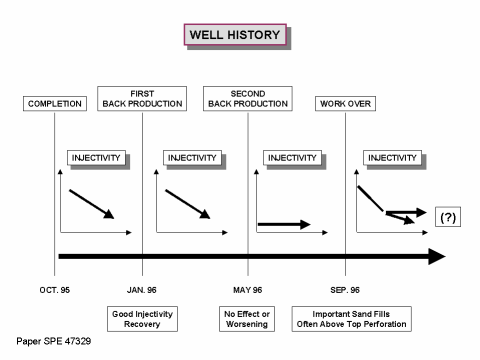
The history of the subsea injectors is summarized. For the formations and in-situ stresses expected, the rock around the injectors is under failure conditions during shut-in periods. During these shut-in periods, cross-flow is felt to take place - from one layer to another - leading to sand production. It is felt that the traditional field operating conditions did not allow enough time for these produced particles to settle. This was felt to be a first cause for injectivity loss - i.e. plugging of the perforation tunnels, leading to progressive injectivity loss. The dramatic injectivity losses in some wells (going from 8000 to 0 m3/D in half an hour) has been attributed to pressure waves generated during the sudden pump shutdowns. The field operating conditions were altered to avoid the recurrence of these problems.
The Subsea Injectors
The production and injection wells on the field were pre-drilled before being put into operations in the fall of 1995 (Figure 1). The subsea injectors are sub-vertical, with deviations less than 25°. After perforating in the aquifer, the wells were quickly back-flowed to cleanup the perforations. About 5 m3 of water were back-produced. Initially, the wells had quite good injectivity indices. They were able to meet their targets (with capacities to deliver up to 9000 m3/D with the field injection system).
Figure 1: Schematic of the injection history for the 6 subsea wells.
Conditions soon started to deteriorate. Daily monitoring of the injectivity indices showed a steady decrease. In order to try to improve this situation, the decision was made to back-produce the wells, in the winter of 1996. The amount of fluid produced was small - i.e. less than 50 m3. Immediately on resuming injection, the injectivity was good. However, it decreased quickly within 30 minutes. It was then decided to flow longerand to clean sand from the flow line before restarting injection. During this operation, the wells were back-produced for 700 m3 to 800 m3. The result was dramatic. The injection rate of all wells was above 8000 m3/D and wellhead pressures were often at one-half of the full pump capacity.
However, as had occurred after the initial completion, the injectivity inices started to decline. Furthermore, injectivity decrease became more dramatic. In several cases, injectivity was completely lost after briefly shutting-in the injection system. Unlike "classical," progressive injectivity loss, this behavior was very dramatic. For example.
One well was injecting at almost 7000 m3/D until there was a brief (30 minutes) shutdown. Subsequently, the flow meter did not record any flow. The well was pressurised for injection a couple of times and then closed. The wellhead pressure data allowed an estimate of the injectivity just after the main injection loss. Specifically:
(II/cwV0) t = Log{Dp0/Dp}
In this equation, t is the time, II is the injectivity index, cw is the compressibility of the water, V0 is the volume of the well, Dp is the wellhead pressure difference between time t and the static closure pressure, and Dp0 the same at t = 0. Figure 2 shows that during the first shut-in after injection loss, II/cwV0 = 0.045 minutes-1. During the second shut-in, the injectivity had decreased by almost ten times, with II/cwV0 = 0.005 minutes-1.
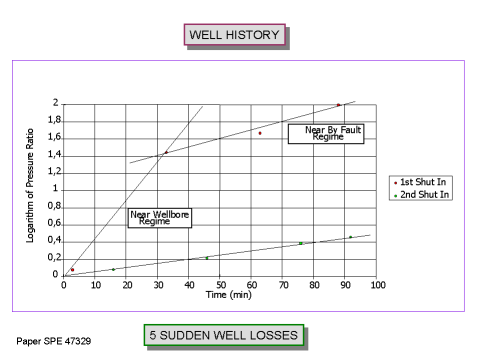
Figure 2: Wellhead pressure history during a sudden injectivity loss.
With these injectivity losses, field injection targets could no longer be met. A second attempt to cleanup the wells by back-producing was made in the spring of 1996. This failed:
The injectors that had lost injectivity completely could not be back produced for any significant period of time.
In addition, another well lost all flow capacity during this back-flow period.
A workover program was performed in 1996. During the workover, significant sand fill was found in the wells that had lost all injectivity. In some cases, the fill extended several hundred meters above than the top perforation. Coiled tubing was used to circulate out the sand. Grain size distributions of the recovered material indicated that it was formation sand. After clean up, the wells were "reinstated."
Once again, the injectivity indices were extremely satisfactory. However, the indices started to decrease again and another well lost all injectivity in the winter of 1997.
At this stage, Statoil undertook a major effort to determine the cause(s) of the injectivity declines. Some of the results are summarized in the following discussion.
Rock Mechanics Considerations
The production wells in the field are almost all completed with sand control. Several sand ups have occurred when attempts have been made not to use sand control. For various reasons, it had been decided not to install any sand control on the injectors - drill them sub-vertically in the reservoir section to limit the risk of sand failure. The high injectivity targets for these wells, (set at above 8000 m3/D could not have been met with sand exclusion hardware.
The first step in Statoil's evaluations was to determine whether or not the sand around the wells was under failure conditions during the shut-in periods. All rock mechanics tests from cores taken in the injectors were acquired in order to estimate the integrity of the reservoir rock. It was found that the rock ranged from being very weak - i.e. UCS of about 2 MPa - to weak - i.e. UCS of about 10 MPa.
The second step was to estimate the in-situ stress conditions in the field (Table 1).
Table 1: Main In Situ Stress Parameters
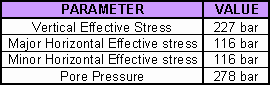
The the in-situ stress regime was determined as follows.
Four-arm calliper logs from various vertical wells in and around the field were analysed. There was no evident preferred orientation.
The density logs were integrated to approximate the overburden stress in the reservoir.
A minifrac and a step rate test had been performed just after completion of one of the injectors. This provided a good determination of the magnitude of the minimum horizontal stress.
The magnitude of the maximum horizontal stress was assumed to be equal to the minimum horizontal stress. This assumption was justified/necessary because there was no evident preferential breakout orientation, there is a salt layer below the reservoir, and leakoff test pressures on the vertical wells were much larger than the minimum stress.
The next step was to use the numerical procedures that had been developed by Statoil11 to predict sand production. The purpose was to assess the state of the near-perforation cavity and to compare it with wells producing sand. Core that had been preserved in Seal Peal was used to perform triaxial tests and establish the rheology of the reservoir rock. These data were used as input parameters for the numerical simulator, along with the in-situ stress conditions (Table 1). The study revealed that the perforation cavities in each of the four zones analysed were in a state of plasticity that would correspond to sand production if they were flowed.
This means that the formations around the injectors would fail under shut-in conditions - i.e. no pore pressure gradient around the well. It was proven both theoretically and experimentally that extended flow of injection water would cause small, but consistent, reductions in the rock strength (~10 to 20%). This is due to the fact that the pH and potassium content of the injected water destabilises the Kaolinite12 that is the main clay component of the reservoir rock. However, even though this is a contributing factor, its overall contribution is too small to completely explain the problems experienced by the injectors.
Cross-Flow
The loss of injectivity on the wells was attributed to shut-in periods. It seemed quite important to study the flow conditions during shut-in periods - i.e. cross-flow between layers - in order to check if sand could be produced at that point in time. PLT logs on injectors had determined that cross-flow occurred.
The field has no voidage and pressure differences between layers could not explain these cross- flows. Another rationale explanation was permeability heterogeneity along the injected interval. Since three of the six subsea injectors had been cored extensively, it was possible to assess detailed permeability profiles in these wells. Core measurements indicated that the permeability typically varies from 0.1 md to 5 darcies along the perforated intervals.
In evaluating the role of permeability, the first step was a comparison of the core and in-situ values. Core measurements that had been performed on samples with obvious artifacts (due to core damage or anomalies visible from the core photographs - i.e. cracks) were eliminated from comparison. In addition, qualitatively abnormal core data were not considered - i.e. permeability greater than 3000 md. After this, the test permeability and an equivalent permeability calculated from core measurements agreed to within approximately 20%.
The core permeability was then used to establish layers with homogeneous permeability and porosity - for supplementary use in a numerical flow simulator - i.e. ECLIPSE TM. Two geometric configurations were included in the flow simulations.
The first geometry corresponded to a well in an infinite reservoir - i.e. axisymmetric geometry. Each "petrophysical" layer was divided into 5 elements. This provided a good vertical description of the flow between and within layers. There were no-flow boundaries at the top and bottom of the model. For this scenario, there was injection for 24 hours at 7000 m3/D followed by a 24-hour shut-in.
The second geometry modeled a sector between one injector and a producer. Flow was not allowed at the boundaries of the sector. At the injector, there was injection at 7000 m3/d for 24 hours, followed by a 24-hour shut-in. The producer continued producing at 7000 m3/d during the entire 48 hours.
In both cases, single-phase flow was used. Two specific wells, with different permeability profiles, were studied.
In all cases, significant cross-flow was predicted during the shut-in periods. The associated flow rates were as high as 450 m3/D and flow was always the less permeable layers to the most permeable one (Figure 3). Flow did die out rather quickly - e.g. down to less than 100 m3/D over a 1-hour period. However, in the case of the sector model, the rate of decrease was slower because of the presence of the production well.
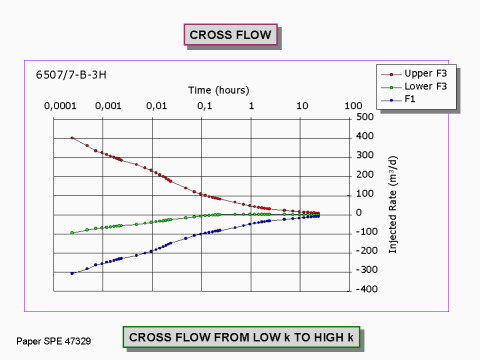
Figure 3: Cross-flow between layers during injector shut-in (from an ECLIPSETM simulation).
Recognizing that cross-flow occurred, the next question was whether the cross-flow was sufficient to erode sand from the formation. To address this, downhole sampling was carried out in conjunction with the shut-in pass of a PLT log. There were between 0.7 and 7 g/l of sand in these samples - indicating significant sand production during shut-in periods.
Particle Settling during Shut-in Periods
The next problem was to infer what happens to the sand produced during the shut-in periods- "How quickly will the sand grains settle in the rat-hole?" There are three considerations in any particel settling/particle transport evaluation. These are:
Gravitational effects drive settling;
Buoyancy effects oppose settling;
There is drag between the fluid and the solid. In its linear form, this is characterized by Stokes' law13.
Early calculations revealed that the traditional form of Stokes' Law could not be used because of the high Reynolds' numbers. Stokes' representation was extended by using an empirical correlation between the friction coefficient and the Reynolds' number - known as the Prandlt abacus13.
After this analytical, mathematical framework was established, it was possible to model the cross-flow situation with relatively few simplifying assumptions. The assumptions that were made are somewhat justified by the rapid decline of the shut-in cross-flow. The relevant assumptions are as follows.
All particles adjacent to the perforated interval were produced at the time of the shutdown.
There is no fluid flow during the shut-in period itself except at very early stages.
These two assumptions are considered to be conservative for this situation because:
If particles are produced long after the shut down, they will take longer to settle than in the model.
If the cross-flow does not die out quickly, it will provide additional "forces" to keep the particles in suspension - the crossflow occurs from the bottom to the top of the interval.
At this point, knowing the particle size distribution of the formation sand, it was possible to calculate the percentage of sand that would remain adjacent to the perforated interval for shut-in periods of various durations. Figure 4 shows that if the shutdown is short (~ one-half hour), more than 50% of the produced particles remain in front of the perforated interval. If injection is restarted at this time, these particles will be injected into the perforation tunnels, with a consequent loss in injectivity (Figure 5).
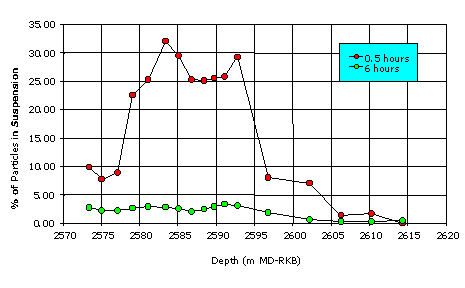
Figure 4: Percentage of particles remaining in front of the perforated interval for two typical shut in duration.
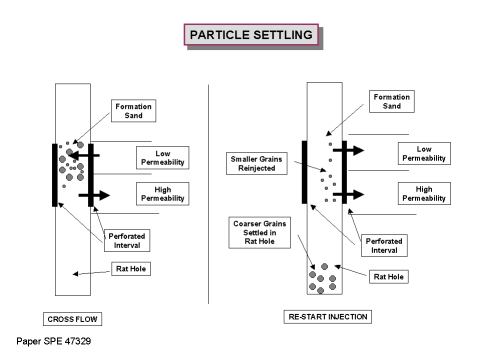
Figure 5: Schematic of perforation tunnel plugging.
On the other hand, if enough time is given to allow the particles to settle in the rathole - e.g. 6 hours in Figure 4 - only a few particles (usually fines, which have a smaller settling rate) will be re-injected and the injectivity impairment will be much smaller.
This mechanism of progressive injectivity losses was confirmed by field observations in two ways.
In one well, a camera was used to inspect the perforated interval. Although there was clear brine in the hole and there was a clear picture, the camera survey did not reveal perforation entrance holes. This indicated that they were filled with sand.
Afer enforcing a four hour delay before restarting the pumps after an emergency shutdown, the shut-in periods stopped causing significant injectivity reduction (Figure 6).
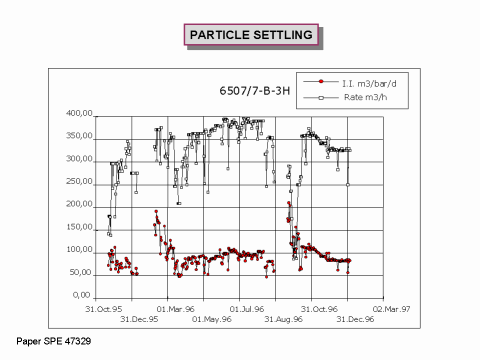
Figure 6: Typical evolution of the injectivity index with time.
Note that Figure 6 also shows periods where the injectivity index increases. This been attributed to Thermally Induced Fracturing (TIF). Thermally Induced Fractures improve the tolerance to solids in the injected water. However, particles that are too coarse, such as those present in the water during brief shut downs - i.e. up to 200 Sudden Well Losses
Progressive injectivity losses having been explained by a physical mechanism. Efforts were then directed to comprehend the sudden injection well losses that had occurred several times. These sudden well losses always occurred in conjunction with an emergency shutdown of the injection system.
What happens during an emergency shut down? The pumps stop in about 3 seconds, effectively closing the injection loop. However, it took 20 seconds for the various components of the injection systems to be isolated from each - when the wing valves on the wellhead are closed and when the master closes after 50 seconds.
When a valve is suddenlty closed on a pipe, with liquid circulates at a given velocity (v), a pressure pulse is created. This is known as the water hammer effect13. Figure 7 is a schematic of this phenomenon. Downstream of the valve, the first elements of liquid suddenly go from a velocity v down to 0. Further down the system, the other fluid "elements" continue travelling at a velocity v. This sudden complete stop of the flowing fluid has two consequences.
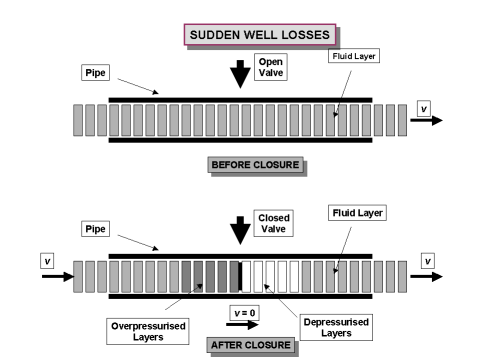
Figure 7: Schematic of the generation of the water hammer pressure wave.
There is a decompression of the fluid layer. This corresponds to an effective pressure drop.
Prior to closing the valve, extra pressure is required for flow. This is because of wall friction. When this is removed because the flow is arrested, further depressurisation occurs.
As a consequence, a pressure wave is generated and this wave quicly travels down the system - i.e. injection lines and subsequently tubing. Once all of the fluid in motion has come to a stop - i.e. when the wave has reached the bottom of the well, the pulse is reflected. The wave velocity is a function of the liquid medium, the pipe geometry and the stiffness of the pipe. For a water-filled pipe, velocities are typically slightly more than 1000 m/s.
Consider the simplest case. One can make the following assumptions.
The shutdown is instantaneous;
There is no attenuation of the wave as it travels down the pipe;
The reflector at the bottom of the well is perfectly elastic.
With these assumptions, Figure 8 is a schematic of shape of the wave generated just downstream of the valve. Simple calculations show that, for the typical injectors studied here, the water hammer pressure is around 55 bars and the friction losses in the tubing are approximately 35 bars. The amplitude of the total wave (combining the two components) generated by instantaneous closure of a valve on the injection system is 90 bars.
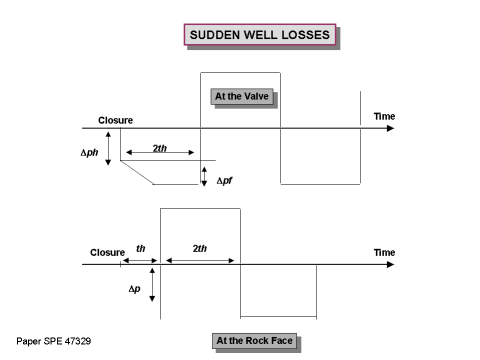
Figure 8: Schematic of the shape of the water hammer pressure wave.
Consider a portion of the string that is adjacent to the perforated interval. For a period of time at this location, the flowing fluid will not sense the depressurisation. When the wave arrives, depressurization will occur quickly. Soon afterwards, the wave reflection from the bottom of the well will be felt (Figure 8). For the typical injector geometry evaluated, the time until depressurisation at the completed depth is approximately 10-2 seconds.
This corresponds to a very brief change in the total and effective stresses acting on a perforation tunnel. In particular, very large changes in the deviatoric stresses occur. The result can therefore be compared to that of a seismic wave. If the sand around the hole has a sufficient porosity, it can be liquefied. When this occurs, sand flows into the well and can partially or entirely cover the perforated interval. This will lead to a sudden and significant loss of injectivity.
Field Evidence:
Water Hammer Effects and Sand Liquefaction
A mechanism had been proposed to explain the sudden and dramatic injectivity losses that had been experienced. Since there ws no proper theory to model the entire process, it was felt that field evidence was necessary. A specific data acquisition campaign was planned to supplement the elements already available.
First, the existence and shape of the water hammer pressure was evaluated. This was considered important because the geometry and timing of the process are different from the ideal conditions considered in the previous section – i.e. elastic rebound, no smearing or attenuation of the waves, etc. A well was subjected to a large injection rate - i.e. 5000 m3/D - and the pump were suddenly shutdown. Prior to this, the well had been equipped with a wellhead pressure gauge. The sampling frequency of the gauges was 10 Hz. Ideally, a higher frequency range (100 Hz or even 1kHz) would have been preferred. The timing of operations and the availability of the equipment precluded this.
Figure 9 is the pressure record from the wellhead gauge. The first wave train is clearly visible. Its magnitude corresponds quite well with available theory. The reflection is quite attenuated and the wave dies out after a few reflections. Figure 9 demonstrates several features:
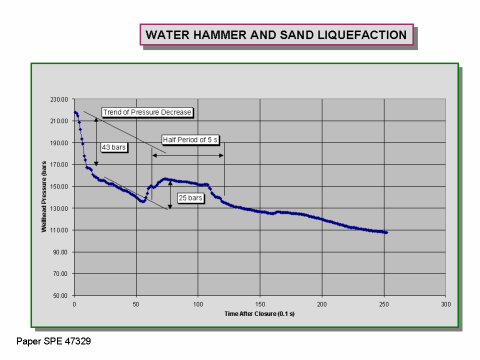
Figure 9: Recording of the water hammer pressure wave at the wellhead.
A friction reducer was used during the well test. The wellhead pressure corresponds to a reduced frictional loss component. The value of 43 bars, for the water hammer pressure, is consistent with theory.
The magnitude of the reflected wave is only ~15 bars. This is approximately one-third of the amplitude of the original wave. This attenuation was caused by fill in the rathole. Since this reflector was not a stiff surface, an elastic reflection (no energy loss) did not occur and the wave was attenuated. Other reflections are visible but thet become very small.
The pressure record also indicates wave smearing. The successive reflected waves move from being a square wave to a much more sinusoidal shape. This phenomenon is associated with tubing restrictions that slow down part of the wave and create small partial reflections.
The reflection time (th) was estimated to be approximately 3 seconds. This is consistent with a reflection somewhere near the bottom of the well, considering the expected wave velocity. Wave smearing prvented a better estimate.
It seemed that pressure variation caused by system shutdown had been corroborated. Did this cause sand production? It is anticipated that the porosity in the sand producing zone exceeded its virgin value of approximately 30 %. Physical tests of cavities7 have revealed that a 7 to 10 % porosity increase can be expected in the failed zone around a perforation after sand production. This would correspond to an altered porosity in the neighborhood of 37 to 40 percent near vicinity the wellbore. Comparing this "altered" porosity with the water hammer pressure wave magnitudes (several tens of bars), it is expected that the altered formation is well within the range of possible liquefaction14.
The first evidence of liquefaction was the behaviour of the sand fill when the wells were back produced for the second time in early 1996. In one case during this 1996 campaign, solids filled the well to 400 m above the top perforation. A hypothesis for lifting so much sand is that it behaved as a slurry. Lifting stopped when the density of the column became too large for the corresponding wellhead pressure. Simple calculations showed that the volumetric slurry composition was about 60% sand. This is compatible with a liquefied material.
There was other evidence of liquefaction while cleaning out a sand-filled well with coil tubing. In this well, the sequence of events was as follows.
Fill was tagged at a depth, D.
As required by the intervention program's protocols, the sand was cleaned out down ten meters.
The coil tubing was then lifted above the perforated interval and the well was circulated for half an hour until the returning viscosified brine was clear of solids.
The coil tubing string was brought down again to tag the depth. It found sand fill at "D," indicating that the well had filled itself due to gravity. Overbalance conditions had existed throughout the entire operation. This is a strong indication of the presence of liquefied material behind the casing.
This sequence of operations was repeated twice with the same results. However, on the third sequence, the tagged depth was 10 meters below D. This suggested that the zone of liquefied sand around the well had been removed.
Operational Consequences
The problems encountered downhole were largely generated or exagerated by the surface facilities. Various equipment and protocol modifications were considered and/or implemented.
Design of a system to damp water hammer pressure waves was studied but was judged to be infeasible.
Emergency injection system shutdown procedures were reviewed. These were minimized, without jeopardizing safety.
A minimum shutdown of four hours was implemented - to allow enough time for particle settlement in the rathole.
These measures have been in place since the spring of 1997. Since then, injectivity has been maintained and there have been no further well losses.
Contributors
In the SPE paper that summarized the Heidrun report (that has been submitted to the JIP), Santarelli and his co-authors acknowledged J.H. Jøranson, O Godo and A. Mannerak (Statoil) as well as E. Papamichos (IKU) and I. Vardoulakis (U. of Athens).Nomenclature
cw is the compressibility of the injected water (bar-1),
D is depth (m),
II is the injectivity index (m3/D/bar),
t is time (seconds),
th is the pressure wave to travel time from the wellhead to the well bottom (seconds),
v is the fluid velocity (m/s),
V0 is the tubing volume (m3),
Dp is the wellhead pressure difference (bar),
Dph is the wellhead pressure difference due to water hammer effects (bar), and,
Dph is the wellhead pressure difference due to the rebound of the water hammer pressure wave (bar).
Bibliography
Risnes, R., Bratli, R.K., and Horsrud, P.: "Sand Stresses Around a Wellbore", SPE J., pp. 883-898, 1981.