 Back to Key Issues
Mitigation/Stimulation:
Determining if it is Matrix or Fractured Injection
Key Issues
Most injectors are believed to be fractured during their injection life. Injection into fractured wells is characterized by a derived injection pressure at the formation/sand face which is higher than a value that is representative of an in situ stress equivalent to a fracture propagation of closure pressures. However, without fracture closure stress information it is often difficult to identify when the injector is under matrix injection and when the injector is fractured. This is particularly true when thermal stresses and poroelastic effects on fracture propagation pressure are considered. The key issues and considerations for identifying the injection regime (matrix or fractured) include:
Relevant references are cited.
If the Fracture Propagation Pressure is Known?
Case 1: When you know the fracture propagation pressure, compare it with the formation face pressure. Be certain to consider poroelastic and thermoelastic effects.
When the relevant propagation pressure is known, for example, from a step-rate test, identifying whether the well is experiencing matrix or fracture injection requires calculation of the formation face injection pressure and comparing this pressure with the fracture closure stress (or equivalent). Remember that the pressures required to reopen, initiate, maintain open and/or propagate the fracture can change with changes in stress near the wellbore (or around a pre-existing fracture) due to poroelastic effects and due to temperature changes associated with injection of fluid at a temperature that is different from the static reservoir temperature.
If the formation face pressure (i.e., downstream of the completion) is greater than the pressure required to extend the fracture (or initiate a fracture if one does not already exist), the injection is occurring under fracturing conditions. If the fracture is stagnant, it is injecting under matrix conditions (as is also the trivial case where a fracture has not been initiated).
The Wellbore Hydraulics tool and the radial damage model, PWRAD, should be used in analyzing injection data to identify the relevant pressure (formation face - not bottomhole and NOT wellhead).
If the Closure Stress is Known?
Case 2: If closure pressure or far-field stress is known, compare the formation face pressure with the closure pressure. Be certain to consider poroelastic and thermoelastic effects..
When the fracture closure pressure or far-field stress is known, you may need to estimate fracture propagation pressure from far-field stress and fracture size. For sizable fractures in produced water injection applications, hydraulic fracturing simulation often shows that the net pressure may be small, and, for most formations, you can assume that the propagation pressure is fairly close to the in-situ stress. However, thermal stresses and poroelastic stress effects on fracture propagation pressure must be incorporated in estimating fracture propagation pressure.
Some very rough guidelines (based on Sponsor experience) are available. For every foot of additional fracture length the injection pressure will increase by approximately 2 psi for a 100 md formation and 3 psi for a 1 darcy formation. Use the Multilateral/Multilayer Injection tool to estimate these effects.
If there is No Stress Information?
Case 3: If you have no reliable stress information, with which to compare the formation face pressure, either measure it specifically (refer to Step Rate Testing in Monitoring) or, at the very least, attempt to infer performance from historical rate-pressure data.
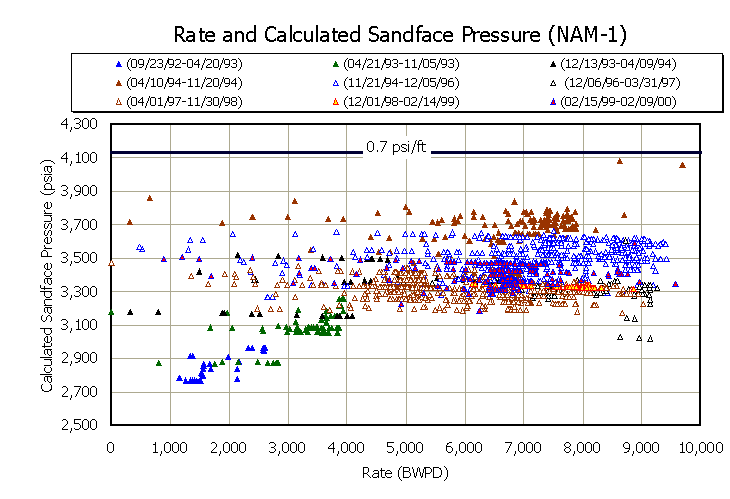
Figure 1: This is a plot of the formation face pressure with rate for Well NAM-1. In this plot, it is important not to draw too many conclusions on early time data because there was a non-return valve in line and friction may not have been adequately represented.
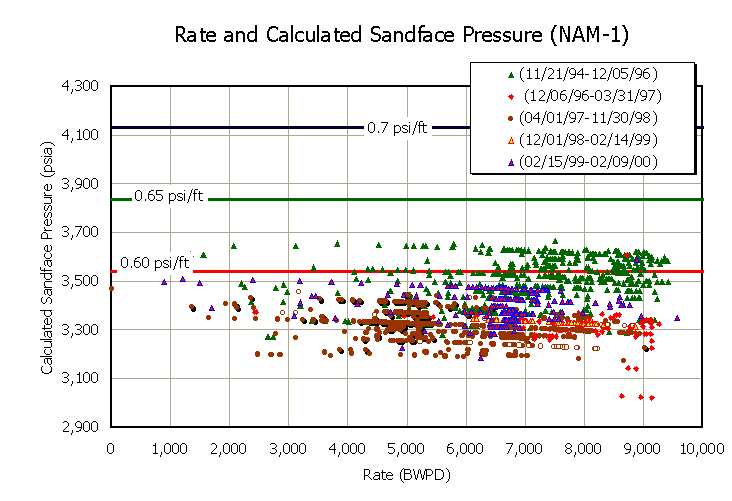
Figure 2: This is a plot of the formation face pressure with rate for Well NAM-1, showing all of the data after the NRV had been removed.
Stress Changes Due to Pressure and Temperature Changes in the Reservoir
Recommendation 1: Wherever possible account for stress changes due to poroelastic and thermoelastic effects.
If the far- or near-field pore pressure changes (either due to voidage effects) or simply due to the fluid leaving the wellbore or fracture, the in-situ stresses acting on the fracture will change. An increase in pressure leads to an increase in stress and vice versa. Similar effects arise due to temperature changes in the reservoir caused by injecting a fluid that is at a temperature that is different from the reservoir itself. Figure 3 is an excellent example, from a produced water injection pilot.
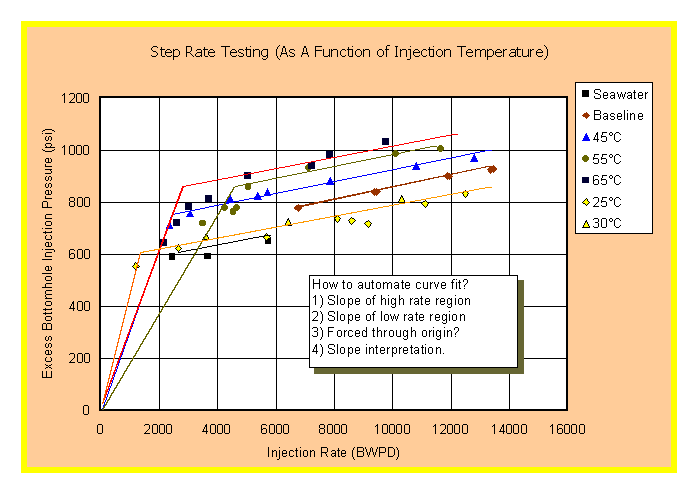
Figure 3: An example of the variation in stresses near a wellbore for injection of different temperature fluids - from a North Sea PWRI pilot.