Audit of Available Models for Use in Consolidated Formations
Summary of PWRI Model Capabilities (part 1 of 2)
|
Capabilities |
BPOPE |
BP |
DE&S |
Diffract |
Hydrfrac |
Hydfrac
V3 |
MWFlood |
Perkins
|
|
Wellbore Temperature Profile |
ü |
|
|
|
|
ü |
|
|
|
Matrix Injection Before Fracturing |
ü |
ü |
ü |
|
ü |
ü |
|
|
|
Thermal Stresses |
ü |
ü |
ü |
|
ü |
ü |
ü [2] |
ü |
|
Poroelastic Stresses |
ü |
ü |
ü |
|
ü |
ü |
ü |
ü |
|
2-D Fracturing Model |
|
ü [3] |
ü |
ü |
ü |
ü |
|
ü |
|
P3D Fracturing Model |
|
|
|
|
|
|
ü |
|
|
3-D Fracturing Model |
ü |
|
|
|
|
|
|
|
|
Fully Coupled with Reservoir Model |
ü |
|
ü |
|
ü |
ü |
|
|
|
Partially Coupled with Reservoir Model |
|
ü[4] |
|
ü |
|
|
ü [4] |
ü [5] |
|
Not Coupled with Reservoir Model |
|
ü |
|
|
|
|
|
|
|
Multiple-Layer Formation |
ü |
~[3] |
ü |
|
~[6] |
~ [6] |
ü |
|
|
Variable Saturation in the Invaded Zone |
ü |
|
ü |
|
ü |
ü |
ü |
|
|
Two Phase Flow |
ü |
|
ü |
|
ü |
ü |
-[7] |
|
|
Changing Viscosity with Temperature |
ü |
ü |
ü |
|
ü |
ü |
|
|
|
Secondary Fracture Considered |
|
|
|
|
|
|
|
ü |
|
Damage |
ü |
ü |
ü |
ü |
|
ü |
|
ü |
|
Internal Formation Damage Considered |
? |
~[8] |
|
ü |
|
ü |
|
|
|
External Filter Cake Considered |
ü |
~[9] |
|
ü |
|
ü |
|
ü |
|
Injection Regime [10] |
TIF, HF |
HF |
HF |
TIF, HF |
TIF, HF |
TIF, HF |
HF |
TIF, HF |
|
Tip Plugging Enabled |
|
|
|
Yes [11] |
No |
Yes [4] |
No |
No |
|
Reference(s) |
1, 21 |
2 |
4 |
3 |
5 |
6 |
7 |
8 |
|
Used By or Available To |
BP |
PWRI Toolbox |
DE&S, Taurus |
TFE |
TFE, IFP |
TFE, IFP |
TFE and Various |
Various |

[1] http://www.mfrac.com/mwflood.html - Developed and marketed by Meyer and Associates, Inc. with specifications provided by Elf.
[2]
The thermal back stress can be transient. A back stress is applied in accordance to 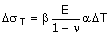 .
.
 is the difference
between the fracture temperature (specified and constant) and the virgin
reservoir temperature (specified and constant). Regardless of fluid loss or fracture length or time, this back
stress is constant if the coefficient b is constant. b is the Perkins and Gonzalez shape parameter. It is defined by b (semi-minor axis of
thermal front perpendicular to the fracture) and a (semi-major).
is the difference
between the fracture temperature (specified and constant) and the virgin
reservoir temperature (specified and constant). Regardless of fluid loss or fracture length or time, this back
stress is constant if the coefficient b is constant. b is the Perkins and Gonzalez shape parameter. It is defined by b (semi-minor axis of
thermal front perpendicular to the fracture) and a (semi-major).
For b/h
(fracture height is h) < 0.01,  . For b/h > 10, b ®1.0.
[3] Multiple fractures (in different zones) can be considered.
[4] Using Perkins and Gonzalez semi-analytical relationship.
[5] Pseudo-analytical/numerical.
[6] But fracture is contained in one zone.
[7] Only uses an oil displacement factor and routines like Perkins and Gonzalez for the flood front position.
[8] As skin.
[9] Using PEA-23 formulation.
[10] TIF is thermally-induced fracturing. HF is hydraulic fracturing (sometimes referred to as forced fracturing).
[11] With capability for reactivation of propagation after fracture growth has stagnated.
Summary of PWRI Model Capabilities (part 2 of 2)
|
Capabilities |
Predictif |
PWFRAC |
Shell/ |
Shell
1 |
Shell
2 |
TerraFrac |
Visage |
WID |
|
Wellbore Temperature Profile |
ü |
|
|
|
|
|
ü |
|
|
Matrix Injection Before Fracturing |
ü |
|
|
|
|
|
ü |
ü [12] |
|
Thermal Stresses |
ü |
ü [13] |
ü |
ü |
ü |
ü |
ü |
|
|
Poroelastic Stresses |
ü |
ü |
ü |
ü |
ü |
ü |
ü |
|
|
2-D Fracturing Model |
ü |
|
ü [14] |
ü [15] |
|
|
ü |
|
|
P3D Fracturing Model |
|
|
|
|
ü |
|
|
|
|
3-D Fracturing Model |
|
|
|
|
|
ü |
- [16] |
|
|
Fully Coupled with Reservoir Model |
|
|
|
|
|
|
ü |
|
|
Partially Coupled with Reservoir Model |
ü |
ü |
ü |
ü |
ü |
~ [17] |
|
ü |
|
Not Coupled with Reservoir Model |
|
|
|
|
|
|
|
|
|
Multiple-Layer Formation |
|
|
|
ü |
ü |
ü |
ü |
|
|
Variable Saturation in Invaded Zone |
|
|
|
|
|
|
ü |
|
|
Two Phase Flow |
ü |
|
|
|
|
|
ü |
|
|
Changing Viscosity with Temperature |
ü |
? |
|
~ [18] |
~ [18] |
|
- [19] |
|
|
Secondary Fracture Considered |
|
|
|
|
|
|
ü [20] |
ü |
|
Damage |
ü |
ü |
~ [21] |
ü [21] |
ü |
|
- [22] |
~[23] |
|
Internal Formation Damage? |
|
ü |
|
ü |
ü [38] |
|
|
~[23] |
|
External Filter Cake Considered |
|
ü |
|
ü |
ü [25] |
|
|
~[23] |
|
Injection Regime [24] |
TIF |
TIF, HF |
TIF, HF |
TIF, HF |
TIF, HF |
HF |
TIF, Matrix |
Matrix |
|
Tip Plugging Enabled |
No |
Yes |
|
Yes |
~[25] |
|
|
? |
|
Reference(s) |
9 |
10, 11 |
12, 13, |
15 |
16 |
17, 18 |
19 |
20 |
|
Used By or Available To |
TFE |
PEA-23 |
? |
Shell |
Shell |
Various |
V.I.P.S. |
U.T. PWRI [26] |

[12] Matrix and fixed fracture length.
[13] Not all PEA-23 participants have the thermal version.
[14] Various KGD and radial models.
[15] Constant height with a “square” fracture option to approximate radial growth.
[16] Weakly represented by fault elements and zones of elevated strain.
[17]
Uses  fluid loss, source
functions for poroelasticity and Biot, Medlin, Massé solution for thermal
stresses.
fluid loss, source
functions for poroelasticity and Biot, Medlin, Massé solution for thermal
stresses.
[18] Different properties (viscosity, relative permeability, saturation can be represented in specific elliptical zones around the fracture.
[19] V.I.P.S. indicated that this could be done. However, they were not able to do this in the simulations that were carried out for this project on a well in Alaska.
[20] This is accomplished by a permeability reduction associated with constitutive behavior but macro fractures are not specifically propagated.
[21] Damage is represented as a fracture face skin or reduction in the effective conductivity of the fracture. Weakly represented (internal filter cake only).
[22] This is accomplished by a permeability reduction associated with constitutive behavior and does not represent plugging-related damage.
[23] Solids only??
[24] TIF is thermally-induced fracturing. HF is hydraulic fracturing (sometimes referred to as forced fracturing).
[25] Channeling implemented.
[26] University of Texas at Austin PWRI Consortium.
Comparison of Fracturing Model
|
Model |
Fracturing
Model |
Fracture |
||
|
2D |
P3D |
3D |
||
|
BPOPE |
|
|
ü |
S.I.F. |
|
BP Spreadsheet |
ü |
|
|
Stress [27] |
|
Diffract |
ü |
|
|
Stress |
|
DE&S Model |
|
ü |
|
Stress |
|
Hydfrac |
ü |
|
|
S.I.F. |
|
Hydfrac V3 |
ü |
|
|
S.I.F. |
|
MWFlood |
|
ü |
|
S.I.F. |
|
Perkins and Gonzalez |
|
|
|
Stress and S.I.F. [28] |
|
Predictif |
|
|
|
Stress |
|
PWFRAC |
[29] |
|
|
S.I.F. |
|
Shell/Maersk Model |
|
|
|
S.I.F. |
|
Shell 1 |
|
|
|
S.I.F. |
|
Shell 2 |
|
|
|
S.I.F. |
|
TerraFrac |
|
|
|
S.I.F. |
|
VISAGE |
|
|
|
Effective stress, but no fracture growth. |
|
WID |
|
|
|
Proprietary |
Case studies show that fracture height growth can be substantial in many cases (see for example, the cases presented by Elf for an offshore field in West Africa, and cases presented by Maersk for the Dan field). P3D or 3D fracturing models are required to simulate these PWRI-induced fractures.
One opinion is that a fracture criterion based on fracture toughness and stress intensity factor is preferred as non-linear effects such as in soft formations can be modeled by adopting results from non-linear fracture mechanics. Another school argues that the nonlinear aspects are too difficult to represent and that a stress-based criterion is appropriate, particularly for soft formations.
The intrinsic equations for the three-dimensional fracturing models in BPOPE and TerraFrac are the same.

[27]
Friction pressure input
from experience.
[28]
Length iteration until
both satisfied.
[29] With adequate tip plugging, fracture propagation
terminates and in current versions it is not possible to reactivate
propagation.
Comparison of the Reservoir Model
|
Model |
Coupled Reservoir Model |
Two-Phase |
Saturation |
Temperature |
||
|
No |
Partially |
Fully |
||||
|
BPOPE |
|
|
ü |
ü |
ü |
ü |
|
BP Spreadsheet |
|
ü[30] |
|
|
|
|
|
Diffract |
|
ü |
|
|
|
|
|
DE&S Model |
|
|
ü |
ü |
ü |
ü |
|
Hydfrac |
|
|
ü |
ü |
ü |
ü |
|
Hydfrac V3 |
|
|
ü |
ü |
ü |
ü |
|
MWFlood |
|
|
|
~ |
~ |
~ [31] |
|
Perkins and Gonzalez |
|
|
|
~ |
~ |
~ [32] |
|
Predictif |
|
ü |
|
ü |
|
ü |
|
PWFRAC |
|
ü |
|
|
|
~[33] |
|
Shell/Maersk Model |
|
ü |
|
|
|
|
|
Shell 1 |
|
ü |
|
|
|
|
|
Shell 2 |
|
ü |
|
~ |
|
|
|
TerraFrac |
ü |
|
|
|
|
|
|
VISAGE |
|
|
ü |
ü |
ü |
ü |
|
WID (proprietary) |
|
? |
|
|
|
|
The reservoir model in the BPOPE model is a three-dimensional finite difference model for heat transfer and two-phase fluid flow.
The reservoir model in the Duke model is a one-dimensional (perpendicular to the fracture face) finite difference model for heat transfer and two-phase fluid flow.
Coupling between fracturing simulation and reservoir simulation is necessary in PWRI modeling.

[30]
Weakly, using Perkins
and Gonzalez type considerations.
[31]
Elliptical fluid loss and Perkins and Gonzalez type of
methodology (pseudo-analytical).
[32]
Pseudo-analytical.
[33]
A customized version was developed for two of the
PEA-23 participants.
Comparison of Fundamental Damage
|
Model |
Internal |
External |
Compound |
Dynamic |
|
BPOPE |
|
|
ü |
|
|
BP Spreadsheet |
|
ü [35] |
ü [35] |
|
|
Diffract |
ü |
ü |
|
|
|
DE&S Model |
ü |
ü |
|
ü |
|
Hydfrac |
ü |
ü |
|
|
|
Hydfrac V3 |
ü |
ü |
|
ü [36] |
|
MWFlood |
|
|
|
|
|
Perkins and Gonzalez |
|
ü |
ü |
|
|
Predictif |
|
|
ü |
|
|
PWFRAC |
ü |
ü |
|
ü |
|
Shell/Maersk Model |
|
|
ü [37] |
|
|
Shell 1 |
ü |
ü |
|
|
|
Shell 2 |
ü [38] |
ü [39] |
|
|
|
TerraFrac |
|
|
|
|
|
VISAGE |
~ [40] |
|
|
|
|
WID (proprietary) |
? [41] |
? [41] |
|
? [41] |
Few models are available to characterize formation damage, both internal and external, due to solids and oil in water.

[34]
When the velocity in
the fracture width is sufficiently high, material on the surface of the filter
cake can be dislodged and swept along the fracture (often known as dynamic
filtration).
[35]
Skin is incorporated for radial flow as is the PEA-23
relationship for fracturing.
[36]
Refer to Figure 4, SPE
paper 68974.
[37]
Weakly represented.
[38]
Mobility representation.
[39]
Channeling.
[40]
Damage is due to mechanical effects related to
effective stress levels, not plugging.
[41]
Speculated based on the modelling methodology used in
the radial flow version of WID – NOT CONFIRMED.