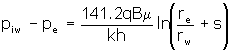
Various methods for monitoring acidizing can be appropriate - both for monitoring actual stimulation effectiveness - but also might be considered for looking at longterm injection performance. One technique was published by Prouvost, L.P. and Economides, M.J.: "Real-Time Evaluation of Matrix Acidizing Treatments." The basis of these procedures is radial flow theory. The procedures, for stimulation monitoring are:
McLeod and Coulter, 1969, presented a method in which the transient response to the injected fluid is analyzed while the data are collected. The analysis is conducted in discrete intervals because the pressure transients within each interval are dependent on a constant skin effect. Each stage of injection or shut-in during the treatment is considered as a short well test. The transient reservoir pressure response is analyzed using line source diffusivity solutions. The analysis is only valid if skin does not change in the individual test segment and does not allow for continuous assessment of the evolution of the treatment.
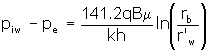
In two publications in 1979, Paccaloni, comprehended evolving skin and presented a technique in which instantaneous pressure and rate data are analyzed and related to the evolving skin effect. Paccaloni selected an "acid bank" of finite length and assumed steady-state flow across it. The reservoir transients can overwhelm the pressure differences due to the changing skin. The skin effect is thereby distorted. For example:
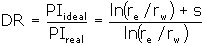
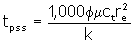
The technique proposed by Prouvost and Economides allows a continuous calculation of the skin during the treatment. At any time, the difference between the simulated pressure response, psim(t,so), and the measured value, pmeas(t,so), is the difference in the actual skin used for the simulation, so.

The recommended procedures for the pre-treatment injection test were as follows.