Application of
PEA-23 Methodology
to an Example Prudhoe Bay Well
The following is an example of the PEA-23 correlation as applied to a well in the Prudhoe Bay field.
Step 1: Plot the pressure versus the injection rate to determine
whether the injector is fractured or not and to determine the fracture
pressure.
Figure 1 shows the pressure difference (bottomhole pressure minus reservoir pressure) versus the injection rate, for both the produced water (PW) and seawater (SW). The reservoir pressure was assumed to be approximately 4000 psi and constant throughout the well life. It appears that the water was injected into this injector under fracturing conditions. Note that the reservoir pressure was used in this first diagnostic plot, strictly for the purpose of determining whether or not the injector was taking fluid under fracturing conditions.
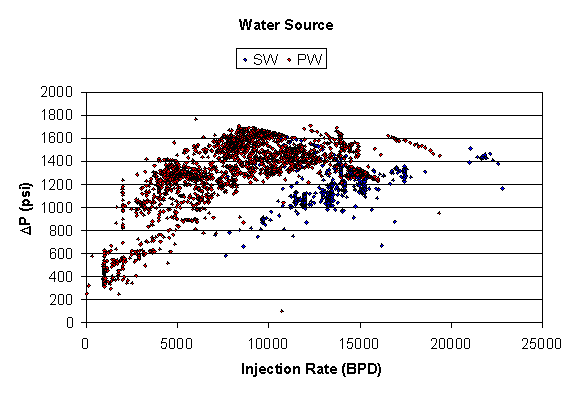
Figure 1. Pressure vs.
Rate for both Produced Water (PW) and Sea Water (SW).
Step 2. Determine injectivity index based on fracturing pressure as a function of water quality.
Since water quality data for the Prudhoe Bay injectors were given as averages over periods of months and years, the historical data were separated according to periods of nominally constant water quality; there were eleven periods in all. The periods were differentiated in terms of the water source (PW and SW) and also in terms of the average water quality. The data from Prudhoe Bay were originally segmented to give one Oil In Water (OIW) and one Total Suspended Solids (TSS) per period. After segmenting the data into the various periods, a separate pressure/rate plot was constructed for each period. From this plot, two distinctions in the flow were made, the first being matrix injection, and the second injection under fracturing conditions. This can be seen in Figure 2; for one period of produced water injection. In this figure, matrix injection [also including periods where a fracture is stagnant – i.e., no changes in dimensions] appears in pink while fractured injection is shown in the darker red. A best-fit curve was drawn through the matrix injection data and the fractured injection data, using a built-in Excel function. In Figure 2, the upper equation signifies the fractured injection with a higher intercept of about 1200 psi, giving a fracture pressure of about 5200 psi at a depth of approximately 9000 ft. This value is in agreement with the gradient used for these wells in the initial PEA-23 work - for the Prudhoe Bay wells a fracture gradient of ~0.58 psi/ft was used in the PEA-23 analyses. The lower equation in Figure 2 indicates the matrix injection slope (differential from reservoir pressure). The slopes of both these curves are indicative of the Reciprocal Injectivity Index (RII) from fracture “stress” and from reservoir pressure, respectively.
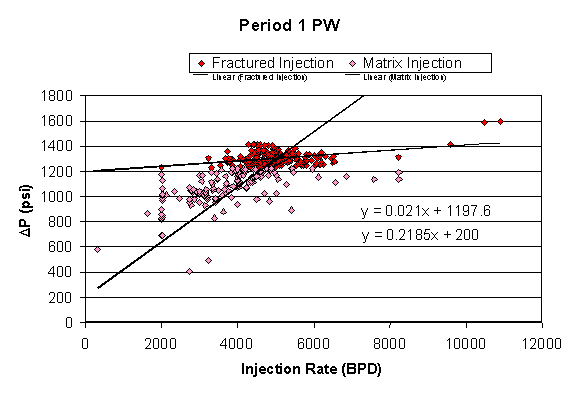
Figure 2. Pressure vs.
rate plot for Period 1.
The first equation (for fractured injection) is what concerns us here because it is from these values that the PEA-23 relationship was based. The slope during the fracturing portion gives the Reciprocal Injectivity Index, from which the Injectivity Index used in the PEA 23 relationship can be obtained.
Step 3. Repeat Step 2 to obtain Injectivity Indices at different water
qualities.
Following the methodology outlined in Step 2, we can calculate the Injectivity Index from fracture stress for each period. Table 1 lists the individual values for each period. The values shown for seawater are notably higher, especially in Period 5, where the SW injection was maintained for a substantial period of time. Periods three and ten give relatively smaller seawater injectivity values since the period of injection is small and the thermal effects associated with the lower temperature seawater have presumably not fully developed. The Injectivity Index for produced water varies from approximately 30 to 50 BPD/psi - considerably lower than 83 BPD/psi reported for seawater injection during Period 5.
Table 1. RII and II for Fractured Injection During Each Period
|
Period |
Start Date |
Water Type |
Number of days |
Intercept/Frac Pressure |
Slope/RII |
II |
|
1 |
16-Sep-85 |
PW |
347 |
5198 |
0.0210 |
48 |
|
2 |
29-Aug-86 |
PW |
147 |
5201 |
0.0222 |
45 |
|
3 |
23-Jan-87 |
SW |
30 |
5066 |
0.0159 |
63 |
|
4 |
22-Feb-87 |
PW |
182 |
5200 |
0.0227 |
44 |
|
5 |
23-Aug-87 |
SW |
622 |
5060 |
0.0121 |
83 |
|
6 |
6-May-89 |
PW |
365 |
5096 |
0.0249 |
40 |
|
7 |
6-May-90 |
PW |
365 |
5199 |
0.0301 |
33 |
|
8 |
6-May-91 |
PW |
366 |
5296 |
0.0338 |
30 |
|
9 |
6-May-92 |
PW |
57 |
5260 |
0.0283 |
35 |
|
10 |
2-Jul-92 |
SW |
37 |
5060 |
0.0356 |
28 |
|
11 |
8-Aug-92 |
PW |
388 |
5200 |
0.0164 |
61 |
Step 4. Determine I0 used in PEA 23 Relationship
Perhaps the most difficult part of using the PEA-23 relationship is determining the Injectivity Index for clean water (I0). Originally, it was anticipated that using a viscosity-corrected seawater value would be reasonable. We have found that simply taking the SW value for II is insufficient, since provisions have to be made for thermal fracturing and varying fluid properties effects. A different approach was adopted. First, rearrange the PEA-23 equation to read:
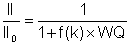 ............................................................................................. (1)
where:
f(k) is a function of permeability defined as
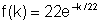 ................................................................................................... (2)
and WQ is a water quality parameter (from PEA-23) defined as
 ..................................................................... (3)
Taking the reciprocal of the equation (1) gives:
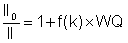 ............................................................................................. (4)
or:
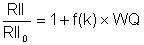 .......................................................................................... (5)
Multiplying throughout by RII0 gives:
 ................................................................................ (6)
Using the above relationship, it is now possible to obtain values for RII0 and f(k) by plotting RII versus WQ and obtaining a best fit curve to determine the intercept (RII0) and the slope (RII0 x f(k)). This procedure was carried out and is demonstrated in Figure 3.
The equation shown in Figure 3 (where y is the RII and x is the WQ) leads to the following numerical evaluations:
 .................................................................................................... (7)
 ............................................................................................................ (8)
 ............................................................................................ (9)
 .................................................................................................... (10)
 ............................................................................................................ (11)
The documented permeability for this well, according to the data files provided by the JIP is 100 md, which implies the permeability effects used in the PEA 23 relation works for this injector.
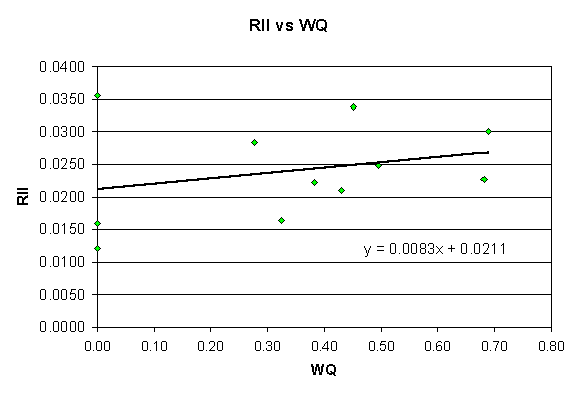
Figure 3. RII versus WQ for each period.
Step 5. Plot the injectivity index predicted from PEA23 relation
with field data.
Now that we have determined both parameters in the PEA-23 correlation [II0 and f(k)], this formula is applied to each injection period to determine a new II - calculated using the correlation. The results of this process can be seen in Table 2. The final column of this Table shows the Injectivity Index for each period, calculated using the PEA-23 relationship.
Table 2. Injectivity
Index calculated from PEA-23.
|
Period |
Start Date |
Water Type |
OIW |
TSS |
Water Quality(0.05*TSS+ |
II for Fractured Injection |
|
1 |
16-Sep-85 |
PW |
85 |
7.41 |
0.43 |
41 |
|
2 |
29-Aug-86 |
PW |
133 |
5.80 |
0.38 |
42 |
|
3 |
23-Jan-87 |
SW |
0 |
0.00 |
0.00 |
47 |
|
4 |
22-Feb-87 |
PW |
146 |
11.58 |
0.68 |
38 |
|
5 |
23-Aug-87 |
SW |
0 |
0.00 |
0.00 |
47 |
|
6 |
6-May-89 |
PW |
334 |
5.22 |
0.49 |
40 |
|
7 |
6-May-90 |
PW |
273 |
9.97 |
0.69 |
38 |
|
8 |
6-May-91 |
PW |
64 |
8.11 |
0.45 |
41 |
|
9 |
6-May-92 |
PW |
48 |
4.88 |
0.28 |
43 |
|
10 |
2-Jul-92 |
SW |
0 |
0.00 |
0.00 |
47 |
|
11 |
8-Aug-92 |
PW |
50 |
5.79 |
0.32 |
42 |
Values obtained from this calculation are compared with the actually measured values (refer to Table 1). Table 3 shows a comparison is drawn and the error percentage is calculated.
Table 3. Comparing
the Injectivity Index from
PEA-23 and those
obtained from the historical analysis.
|
Period |
Start Date |
Water Type |
II |
II |
Error % |
|
1 |
16-Sep-85 |
PW |
48 |
41 |
14 |
|
2 |
29-Aug-86 |
PW |
45 |
42 |
7 |
|
3 |
23-Jan-87 |
SW |
63 |
47 |
- |
|
4 |
22-Feb-87 |
PW |
44 |
38 |
14 |
|
5 |
23-Aug-87 |
SW |
83 |
47 |
- |
|
6 |
6-May-89 |
PW |
40 |
40 |
0 |
|
7 |
6-May-90 |
PW |
33 |
38 |
14 |
|
8 |
6-May-91 |
PW |
30 |
41 |
38 |
|
9 |
6-May-92 |
PW |
35 |
43 |
22 |
|
10 |
2-Jul-92 |
SW |
28 |
47 |
- |
|
11 |
8-Aug-92 |
PW |
61 |
42 |
30 |
|
Averaged Error |
17 |
||||
The PEA-23 correlation gives an average overall error of 17%, with some periods predicting better than others.
Finally, Figure 4 is a plot of the actual RII values (Table 1) and those predicted from the PEA-23 correlation. It should be noted that over each period, only one average value of TSS and OIW were available; consequently a straight-line is shown in Figure 4 for each of the periods. The match between the two curves seems to be acceptable.
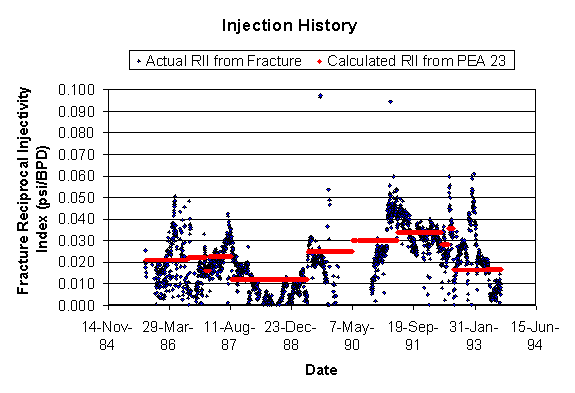
Figure 4. RII-time history.