 Mechanical Stimulation
Stimulation Methods For Enhancing Injectivity Of Produced Water Disposal Wells
Introduction
This article is a brief overview of the literature to survey the state of technology and historical use of various stimulation methods to enhance the injectivity of produced water injection and disposal wells.
The article is limited to stimulation methods. The associated topic of water treatment to enhance injectivity is not a subject of this JIP study. We will cover some chemical aspects to avoid inadvertently missing relevant references. Emphasis was placed on the petroleum experience, although non-petroleum sources were included to identify practices in the related fields of geothermal energy production, hydrology, and chemical waste disposal.
What are Some Injector Stimulation Applications?
Oil and Gas Production Operation
Waterflooding, WAG and Hydrology
PW and Chemical Waste Disposal
Geothermal Energy
EOR and Chemical Injection
In addition to the literature, discussions were held with staff from various operating companies and international service organizations to uncover related ongoing efforts not yet published or unreported failures. The following individuals contributed through private communications with the editor:
|
R. Cooper |
(Schlumberger) |
|
U. Ahmed |
(Geoquest) |
|
M. Soliman |
(Halliburton) |
|
R. Barree |
(Marathon) |
|
A. Jennings |
(Mobil) |
|
I. Abou-Sayed |
(Mobil) |
|
Z. Moschovidis |
(Ex-Amoco) |
|
T.W. Thompson |
(Golder Associates) |
Knowhow Accessible to the Public
A public domain review was carried out. This extracted information from two major databases: Petroleum Abstracts and GEOREF. An additional search was made using the CARL system to access the literature available at the Colorado School of Mines (CSM). Additional references were obtained from the appended reference lists in various papers.
Under the keywords INJECTION CAPACITY and INJECTIVITY there are more than 600 citations in SPE, Petroleum Abstracts, GEOREF and the CARL system. About 100 papers have a strong relevance to the topic of the JIP. In addition, the work published by GRI in two topical reports discussing the area of disposal of produced water from coalbed methane operations are quite useful addition to the review Order References from GRI?.
Injection/Injectivity Stimulation: 12 Papers
Injection Capacity: 70 Papers
Injectivity: 600 Papers
GRI: 2 major review articles on US gas fields
What Information is Available?
Petroleum Related:
The review covered water injection (waterflood and/or produced water disposal), and removal of wellbore damage. As explained earlier, water treatment alone was de-emphasized. The knowledge base for producer stimulation is vast. However, there are generally technical differences between injection and production related stimulation. Injector stimulation is the focus of this article.
Both production and injection operations require removal of near-wellbore damage and/or an increase in flow capacity (through increased surface area - effective wellbore radius.
In production wells, the potential for ongoing damage is limited (in general) to the release and migration of reservoir fines, or scale. In addition, indiscriminant increase in drawdown pressure, to meet production targets, can often lead to impairment of near-wellbore permeability due to pore collapse.
During injection operations, the formation is continuously subjected to foreign (and generally contaminated) waters at elevated pressures. This leads to different conditions than those encountered in production scenarios, where formation fluids are flowed at lower pressures. Fines movement, usually aggravated by water flow, frequently increases formation plugging. Therefore, in injection wells, while the potential for damage is ongoing and progressive, elevated injection pressures may provide permeability enhancement and lessen the impact of insidious damage.
Hydrological/Waste Disposal:
Review of the performance of waste disposal wells shows that injectivity tended to be impacted by plugging, due to large molecules and/or suspended solids.
Geothermal Energy:
Injection problems and practices into hot geothermal reservoirs have some similarities with oilfield situations. In many cases, geothermal injection is into fractured formations, geologically and geochemically different from typical water disposal formations, albeit similarity to injection into carbonate reservoirs. Most geothermal injection is into formations at temperatures higher than those experienced in water disposal wells - they may be similar to the emerging global HTHP reservoir environments. These might show differences in geochemical reactions and formation damage.
Chemical EOR Injection:
Damage from water/chemicals injections during EOR operations is often associated with the nature of the injected chemical (for example, large molecule polymers can lead to severe formation plugging).
Applications of Injector Stimulation
The table below shows various reported stimulation applications and the corresponding treatments in various injector situations.
| Injector Applications | Stimulation Treatment |
|
Waterflood / PW Disposal |
Fracturing |
|
EOR |
Fracturing |
|
Chemical Waste Disposal |
"Chemical Water" Treatment |
The "chemical water" treatment technique entails wellbore treatment with a designed chemical (e.g., alkaline, solvents, dispersants). This is differentiated from treatment of the injection stream to avoid damage, and is parallel to the use of acidizing as a stimulation technique.
What Kinds of Treatments Are Done?
Fracturing to connect a well to a natural fracture system
Acidization to improve near-well permeability
Fracture acidizing to create flow channels
Chemical jobs to remove sludge and damage
Chemical Water Treatment to improve life
Various injection stimulation and mitigation scenarios are possible. For example:
For Matrix Injection
The challenges and issues include:
Fine filtration/water quality regulation are possibilities for maintaining longer term injectivity. Unfortunately, even with exhaustive and expensive measures:
rapid injectivity decline is often indicated. Frequently, there are few proven techniques for:
long-term mitigation
Injection into Natural Fractures
Stimulation activites can be carried out in order to:
establish well connectivity with conductive and extensive fracture network(s), and to
slow injectivity reduction. Even in natural fracture systems:
plugging is possible.
Injection into an Induced Fracture(s)
As we all know, there are circumstances where engineered fracturing treatments and intentional injection above pressures required for fracture reopening and/or propagation may be advantageous. Some of the possible methodologies include continuous stimulation - ongoing injection above "fracturing" pressure. There is evidence that exhaustive water treatment restrictions can be reduced and that cleanup can be less frequent.
The Table below shows reported stimulation efforts applied by various companies for injector stimulation. By necessity, this is a partial list only.
| Treatment | Companies |
|
Stimulation (Fracturing) |
BP, ARCO, Maersk, Marathon, Anaconda |
|
Stimulation (Acidizing) |
Shell, ADMA, Saudi ARAMCO, Petronas |
|
Stimulation (Chemical) |
BP, ARCO, Amoco, Exxon, ADCO |
|
"Chemical Water" Treatment |
Phillips, Shell, Gulf, Chevron, TORCO |
|
Thermal Fracturing |
BP |
Another way of looking at this is to assess some of the major ongoing stimulation campaigns, looking at issues and keys to successful applications.
| Companies | Issues/Tactics |
|
ADMA/ADCO |
biocide and corrosion issues |
|
Amoco/Marathon |
chemical treatment (EOR) |
|
ARAMCO |
systematic and consistent, TQM |
|
ARCO (Alaska) |
mechanical innovations |
|
BP Amoco (Alaska, North Sea) |
various technologies, TQM |
|
Petronas (Malaysia) |
acid placement methods |
|
Shell (worldwide) |
leader in acidizing and acid fracturing technologies |
Applicable Technologies
Some of the applicable technologies are listed below. A few of them will be discussed in more detail later.
Mechanical Stimulation
Improved Well/Fracture Connection
Sand Slugs,
Oriented Perforations
Overpressured Breakdown (ROPE)
Thermal Fracturing (Cold Regions)
Self-propagating (10-25 psi/°F)
"Conventional" Propped Fractures
Pack Plugging Can Still be a Problem
Embedment is an Issue in Soft Formations
Wedged Fractures (Proppant Banking)
WAG Applications
Discussion
In their training booklet, API (1978) refer to the following seven methods for stimulation and treatment of saltwater disposal wells:
One missing practice (in the API booklet), use of cold seawater to generate thermal fracturing, may be added to this list - for application in cold regions (North Sea and Arctic/Siberian environments).
Most reported experiences involved acidizing, hydraulic fracturing, and treatment with solvents dispersants and other chemicals. There is little discussion of high rate or propellant fracturing, and only passing reference to sand jetting or slug injection (ARCO), underreaming, and backflowing (BP).
Classical hydraulic fracturing has been applied to injectors worldwide. In addition, fracture designs - based on the effects of cold water injection - have been applied on Alaska's North Slope, and the North Sea. In addition, other "new" fracturing technologies and protocols continue to evolve. The use of controlled fracturing, with and without proppant, in horizontal injectors in tight chalk, and fracturing of injectors with tail-ins using neat fluid - no proppant near the wellbore (clear-channel fractures), may all increase injectivity while maintaining injection control. Each new technique may only have applicability in specific environments. The mindset for fracture design according to conventional production well standards, rules-of-thumb, etc needs to be abandoned. For example, overflushing in production well stimulation is usually avoiding. Caution is usually applied in flowback after stimulation of production wells or methods such as forced closure are attempted to prevent near-wellbore choking. In an injection well situation it may be advantageous to have an unpropped near-well area. If subsequent injection is above the minimum principal stress this area will be conductive. An example of this (a Wedged or Gap Fracture) is shown below.
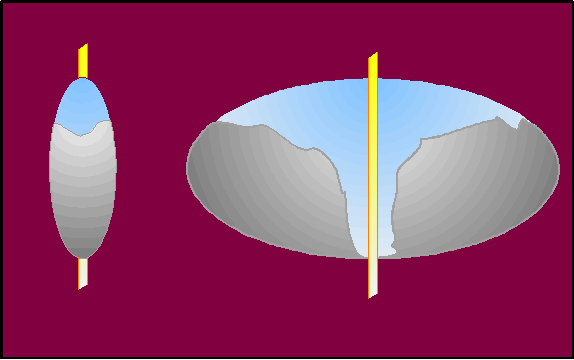
The characteristic features of this novel technique are:
As in production well applications, in the Middle and Far East, experience with injector acidizing emphasizes (not surprisingly) the importance of using diverting agents to block off high permeability streaks and thief zones. This is evidenced in acidizing in offshore Abu Dhabi and Malaysian fields, as well as, the Arab-D limestone in Saudi Arabia. Shell's WHISPER acidizing techniques for limestone acid fracturing has also been cited as a method for optimizing well performance in carbonate reservoirs.
Downhole chemical treatments include use of surfactants and solvents to improve injectivity. The Grayburg waterflood is an example. Various other chemicals (oxidizers, biocides and organic cations) have been used to remove plugging. Surfactants are used to decrease near-wellbore residual oil saturation. Also, observations in the Middle East (ADMA/ADCO) have indicated that injectivity can increase "spontaneously" while injecting into the lower Cretaceous limestones in Abu Dhabi, probably as a result of increased acidity of the injected water.
Concluding Remarks
Certain trends may be captured from the reported knowledge. Most operating companies face the issue of injectivity maintenance in seawater or produced water injectors. Water treatment and filtration appears to be the first line of defense in this battle. However, an ever increasing number of companies are conscious of the added cost of treatment and more emphasis is being put on solving the injectivity problems and/or reducing the volume of water reaching the surface. Water shutoff and downhole separation are leading technological options to achieve this desired result. Major oil companies are actively pursuing methods to reduce surface water cut of the production stream to a maximum of 25%. They are also vigorously implementing gas and water shutoff in oil wells.
Injectivity enhancement has received widespread interest for the longest time. Unfortunately, the results have been mixed. Acidizing seems to work for a short time before injectivity impairment sets in again (North Slope experience). Although fracturing has also had mixed results, it seems to offer some longer term relief. There is evidence that no injector escapes from being fractured (intentionally or unintentionally) during its life cycle. Even so, conventional, propped fractures do not appear to result in a permanent increase in injectivity. The problem may be compounded when injecting scale-prone waters - however, damage in scale-sensitive situations can be more prominent in non-fractured wells where near-wellbore pressure drop, due to radial flow, increases the likelihood of scale formation in that critical zone of the reservoir.
Extensive work has been done by North Slope operators to establish the validity of thermal fracturing as a viable mechanism during cold water injection. The positive impact on injectivity maintenance and enhancement has not escaped the interest of other operators. A down side of this type of application can be loss of vertical conformance or uncontrolled areal sweep. When possible, containment of the thermal fracturing within the cooled zone lessens the adverse economical potential associated with loss of vertical conformance.
The extent of fracture propagation during produced water injection remains a subject of research. Current JIP efforts, work in Alaska and the previous PWRI JV work have achieved significant breakthroughs in delineating the phenomena involved and in attempting to provide quantitative evidence and thorough evaluation of these processes.
Dealing with the cyclic variation in injectivity of WAG wells offers some promise for possible stimulation of multi-phase fluid injectors. Creation of near wellbore "clear channel", can be achieved by a fracture that is wedged open by proppant at the bottom and radially away from the wellbore. A clear channel fracture incorporates the advantages of highly effective well fracture communication while reducing the risk of impairing fracture conductivity near the wellbore (choking is minimized) during dirty water injection.
Processes involving continuous chemical metering into the injection stream are under evaluation in several areas. Addition of dilute acids to the injectant is part of the injectivity maintenance program in some Middle East and Indonesian fields. It is also used by Maersk. little information is presently available on the success of these schemes in other areas. Efforts need to be directed at compiling and evaluating this technology.
Recent field practices related to reducing the treatment pressure during fracturing of deviated wells and wells with poor communication with the fracture have pointed out some promising (and simple) steps for injectivity enhancement. Three techniques are worth noting:
1) Sand Slugs
Running small sand slugs during the pad stage seems to reduce the treatment pressure; by amounts varying from 100 to more 3,000 psi for the remainder of the job. Straightforward application of this simple approach may moderate the high pressure requirements in some deviated injectors.
2) High Overbalance during Perforating and/or Small Fracture Initiation
US operators have introduced patented techniques and have documented field evidence promoting the use of a very high rate pressure pulse during perforating. This is felt to result in fracture initiation during the initial completion, enhancing communication to the wellbore (either initially or after subsequent hydraulic fracturing). Again, the major benefit to the injector is in eliminating the potential for a high pressure drop near the wellbore and the associated reduction in the injectivity index. Widespread interest in this technology is reflected by the number of operators using the technique, the interest of several service companies in providing the service in the field, and the participation level (17 companies) in a previous JV project CEA-75. The results of CEA-75 may shed some light on the merit and limitations of this technique - if it becomes publicly available. Future use and application may become more universal in appropriate situations.
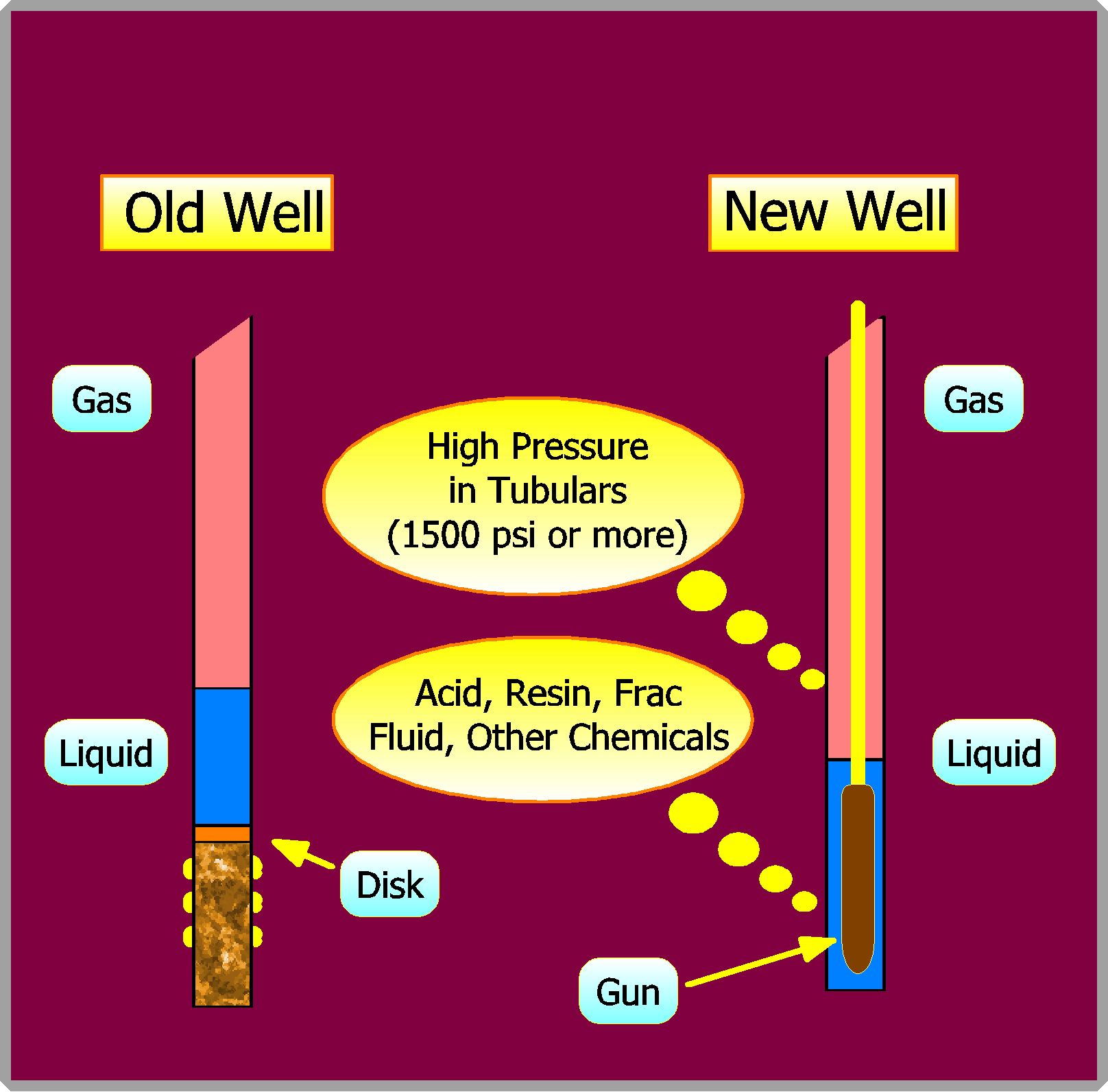
This technology has been adapted in various areas in straight hole, to minimize horsepower requirements. Oriented perforating in deviated wellbore - to reduce pressure drop in the region of well-fracture connection - has been advocated in the Kuparuk field (KRU). However, nearby, for PBU wells, it did not offer a clear advantage. The mixed results in these Alaskan fields may be the result of differences in the prevailing in-situ stress contrasts in the horizontal plane between the KRU and PBU. This technique has had no major proponent outside of KRU and PBU EOA. Further work may be necessary to provide evidence that this technique is viable in other reservoirs.
3) Chemical Stimulation
Trends and Techniques
To summarize this article, consider the following points.
How Good Does It Get? - Injectivity Improvements
Treatment |
Improvement? |
Features |
|
Acidizing |
15% to 140% |
foamed, gelled, encapsulated |
|
Chemical Treatment |
20% to 75% |
base, surfactants and de-emulsifiers |
|
Fracturing |
25% to 200% |
propped, staged, dynamic |
|
Near-Well Mechanical Stimulation |
10% to 30% |
perforating, slugging |