Examples
The Forties Field (Public Domain References)
"The Forties formation is a soft, poorly consolidated sand with a Young's modulus of approximately 0.1 x 10⁶ psi. … However, the rock strength is also very low and there is evidence from well test analysis and hydraulic impedance testing (HIT) for deformation of the sand around the wellbore, including increases in porosity and the evidence of substantial cavities or fractures. Mechanical damage including disaggregation is demonstrated by the fact that most injection wells have some degree of sandfill. HIT measurements on three wells in the Forties Main Sand indicated fracture or cavity dimensions in the range from metres to tens of metres in length, and perhaps one metre in height."8
In regard to measurements in this field, Simpson and Paige, 1991,6 also speculated that:
"It is proposed that water injection within Forties reservoir creates a main fluid path by hydraulic fracturing, combined with an extensive zone of failed and disturbed rock around the fracture. In the disturbed region, porosity and permeability are increased by the plastic response of the rock to shear stresses, set up after the created of the main fracture."6
A North Sea Field (Public Domain References?)
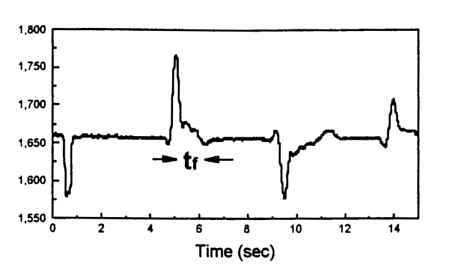
Figure 4 shows one of the HIT pressure traces obtained during a pressure fall-off on [field removed], a near vertical well with a constant diameter completion."
Figure 4. HIT trace .
"Figure 5 gives reflection coefficients at the fracture mouth for a series of HITs made during a pressure fall-off on [field removed]. The reflection coefficient increases as pressure is reduced, until the wellhead pressure reaches about 450 psi. This is about the same pressure as that at which the gradient changes on the step rate test, shown in Figure 6, and is taken to be the fracture closure pressure. After a small transition, the HIT traces measured below this pressure do not appear to change further, although the form of the trace indicates that a channel is still open into the formation."
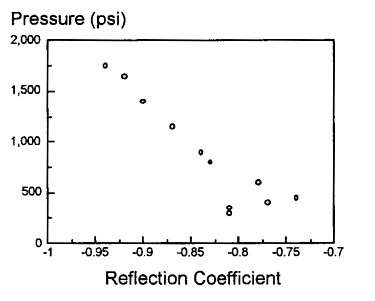
Figure 5. Fracture mouth reflection coefficient.
"The gradient of the step rate plot (Figure 6) beneath fracture closure pressure also supports the view that channels into the formation remain open. HITs performed, both on wells in the [this] field and elsewhere, indicate that for wells that have been injecting for several years, fractures do not appear to close fully when the wells are shut in, possibly due to propping on asperities."
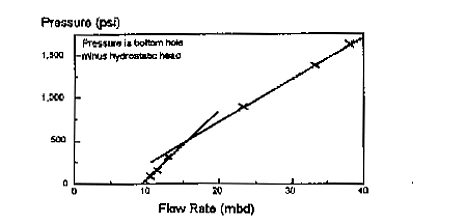
Figure 6. Step rate test.
A North Sea Field (Public Domain References?)
"For newly fractured wells, however, fractures appear to close almost completely when the wells are shut-in. Figure 7 shows three HITs from a [field removed] injector. The first trace shows the well before start up. The well was then deliberately fractured and the second trace shows the HIT response of the well with the fracture open. The well was then shut-in and the third HIT trace was obtained. The third trace is very similar to the first trace indicating that the fracture has closed. A step rate test, performed concurrently on the well, shows very low injectivity beneath fracture opening and a clear change in the gradient of the plot at the same pressure as HIT indicates fracture opening."
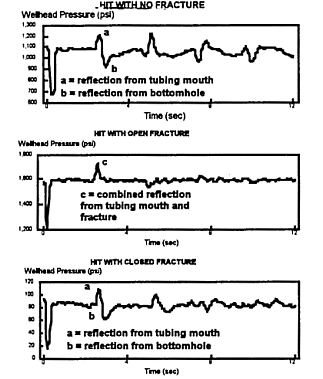
Figure 7. HIT traces.
Location Unknown (Public Domain Reference)
Holzhausen and Gooch, 1985,3 provided several examples, included HIT at an unspecified location. Figure 8 shows transients in a well before and after a hydraulic fracture. The perforations were at 1589 meters. "The period of these oscillations [pre-fracture] was 2L/a, where L is the well depth and a is sonic wavespeed in the fluid in the well [~80 cP], about 1400 m/sec. … The period of [the post-fracturing] oscillations was approximately double the pre-fracturing case."
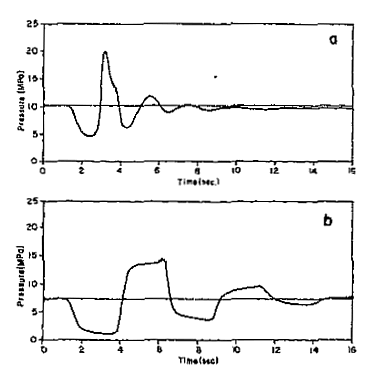
Figure 8. Free oscillations in 1,589-m deep perforated well - pre-fracture (a)and post-fracture (b).
Mounds, Oklahoma (Public Domain Reference)3
Figure 9 shows measurements in a hydraulically fracture well (in a cased hole) at Mounds, Ok. "The first oscillations were recorded when the wellbore pressure was about 0.4 MPa above the statically determined fracture closure pressure. The oscillations continued for several cycles before damping out (Figure 9a). In contrast, they damped out almost immediately after excitation at fracture closure pressure (Figure 9b). Subsequently, free oscillations were initiated above fracture closure pressure after different volumes of water had been injected into the already created fracture. In every case, greater volumes were characterized by reduced rates of attenuation of the oscillations (Figure 10)."3
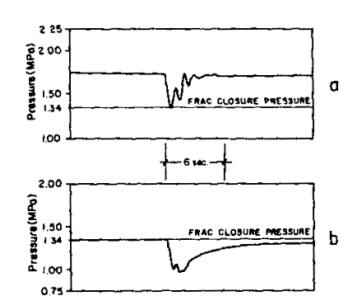
Figure 9. Free oscillations Mounds well: (a) above fracture closure pressure and (b) at the fracture closure pressure.
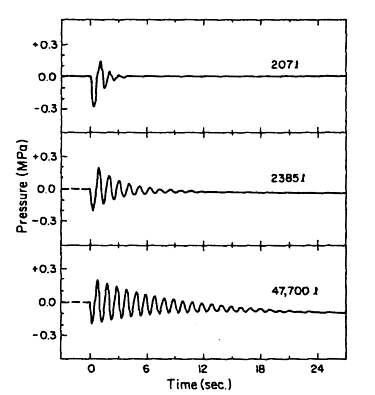
Figure 10. Free oscillations Mounds well after injection of 207, 2,385 and 47,700 liters of water.
Travis Peak Formation, West Texas (Public Domain Reference)
Holzhausen and Egan, 1986,5 provided some additional examples. Measurements were done in a test well, completed in a tight gas sand, in the Travis Peak formation, in East Texas. There were 27, 0.35-inch diameter perforations from 8830 to 8872 and there was a bridge plug at 9450 feet. The tubing was 2-3/8-inch and the casing was 5-1/2-inch. There were surface pressure transducers on the tubing and the backside. The records of the free oscillations are shown in Figures 11a through 11d.
Piceance Basin, Colorado (Public Domain Reference)5
Measurements were performed in the 2 Deep Seam, 30-4 well in a coal seam - Piceance Basin, western Colorado. The fracturing treatment was in an openhole section with a sand and coal layer. The coal zone had been washed out during drilling. This washout caused a large impedance contrast at the depth where the well entered the coal. Below closure, the washout volume was estimated from the free oscillation behavior. Above closure pressure, fractures in the sand and the coal were superimposed on this wellbore coal cavity. "Because the resistance expected for the fractures in the well was considerably greater than this value [the resistance in the coal zone], the effect of the coal was dominant. As a result free-oscillation attenuation, which is largely determined by variations in the downhole resistance, remained relatively constant throughout … ."5
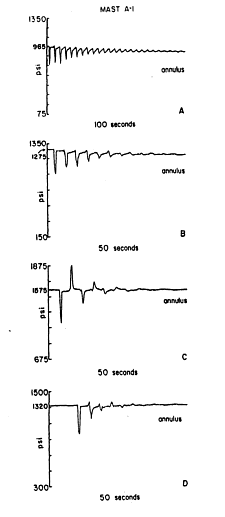
Figure 11. Measured free oscillations in Mast A-1 well, (A) before treatment, (B) after injection of 6 bbl of fluid, (C) 3 minutes after injection of 170 bbl of fluid, and (D) 105 minutes after same injection.
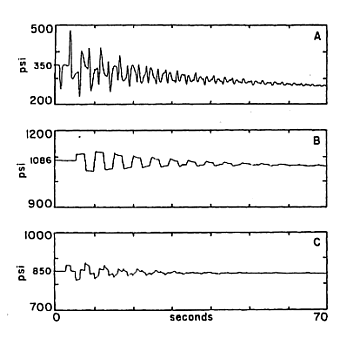
Figure 12. Measured free oscillations in 2 Deep Seam 30-4: (A) before treatment, (B) immediately after injection of 75 bbl of water, (C) 23 minutes after same injection.
| <Operational Techniques | Validation> |
 Back to Key Issues Back to Key Issues
|
Top
|
Previous
|
Monitoring Best Practices
|