Propellant Technologies – Stim-GunTM
Marathon has developed Stim-GunTM technology A schematic configuration is shown in Figure
1. As can be seen, there is a normal
perforation carrier with charges and an outer sleeve with propellant.
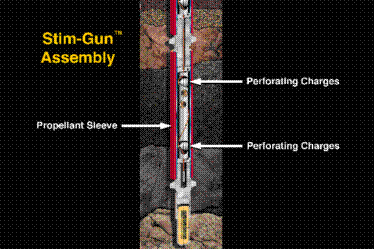
Figure 1. Stim-Gun schematic, showing a
conventional gun, sleeved with propellant.
Conventional perforating techniques can cause
significant damage. Consider an example
for a fifty-foot interval in a 500 md offshore well where the fluid loss is
much less than you might expect (suggesting significant damage. This has been verified by laboratory
experimentation and field observations.
For example, an East Brae gas injector did produce back some crushed
rock. A core log suggested high quality
rock and 250 MMSCFD injection was targeted.
The well was perforated slightly underbalanced and flowed. Only 25 MMSCFD was obtaining. Acidizing led to little improvement. The same was true for a xylene
treatment. The well was backflowed at
250 MMSCFD with less differential pressure.
Some crushed rock was produced.
On returning to injection, the target rate was achieved.
Recognizing difficulties with standard perforation
operations, Marathon ran laboratory single shot tests. One example is for a Cu/Zn 4.625” gun shot
into Oklahoma No.1 sand. This sand has
a grain size distribution quite similar to that at Ewing Bank. The experimentation showed filled
perforations, a dewatered zone, and virgin sand for conventional perforating
activity. In the dewatered zone, grains
were crushed, angular and less uniform than in the virgin sand.
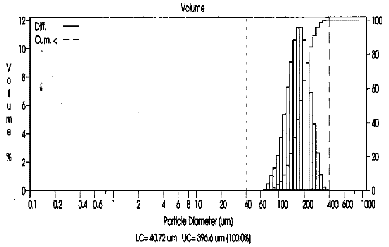
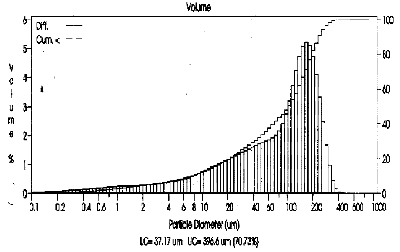
Figure 2. Grain-size distribution from a
conventional perforating operation (virgin material at the top and near-tunnel
material at the bottom). A reduction in
grain size, indicating crushing, is shown.
Traditional "Big Hole" charges can yield a
tunnel that is 7 to 8-inches long by 0.5 to 1.5-inches in radius (variations
occur depending on the formation strength, etc.) and the tunnel volume can be
as much as 42 in3.
Experimentation showed a total of ~5 lbm of "well-mixed,"
damaged material was present in the tunnel.
In the formations tested, reduced explosive load charges reduced damage
(29 in3). Deep Penetrator
(DP) charges were also seen to lead to significant damage. The damage occurring had led Marathon to
develop Minimal Penetrator Design systems (KISSTM charges). Experimentation suggested ~7 in3
of damage and shallow penetration.
Daniel indicated that acid is worth consideration.
Through its perforation performance evaluation
efforts, Marathon also developed the StimgunTM system. SPE 38365 is a good reference. An abstract of this paper is presented
below.
Perforation Damage Studies in Unconsolidated Sands: Changes
in Formation Particle Sizes and the Distribution as a Function of Shaped Charge
Design
Snider,
P.M,. Benzel, W.M. (Marathon Oil Company),
Barker,
J.MLeidel, D.JHalliburton Energy Company
SPE
38635, SPE Annual Technical Conference and Exhibition, San Antonio, Texas,
U.S.A. (5-8 October 1997).
Abstract
Studies
were undertaken in which different shaped charge perforating systems were fired
into simulated unconsolidated sand formations to examine the amount of material
crushed by the explosive event The changes in sand grain sizes were determined
using a laser particle size analyzer and sampling methods to "map"
the damage created over the length of the perforation. This is believed to be
one of the few studies to examine the crushed material created by perforators
on an individual grain basis, and results are quite disturbing when related to
the potential impact on well completion operations. For example, one conventional "big hole" perforation
charge in a 4-% inch (117 mm.) perforating system was found to damage as much
as 5 pounds of formation material and cement; generating as much as 30 % -40%
fines. It becomes apparent that several thousand pounds of damaged formation
material can be created in the near-wellbore area on a high shot density
perforating job of significant length. The damaged material is significant in
total volume, and the generated fines can create filter cakes which limit fluid
injection during subsequent operations such as gravel packing and acid
stimulation. This paper discusses the test results for typical charges utilized
in the industry today, and the potential benefit of a revised strategy to
develop charges designed to reduce the amount of damaged formation material to
less than 20% of the amount observed with some conventional shaped charges. The
revised strategy focused on developing charges to create very large holes in
the casing and through the cement, yet minimize formation penetration. These
revised charge designs have already been utilized on a few field applications
with improved results.
Some of the relevant observations from this paper include:
ü The rock
grains cannot withstand the shock loads associated with conventional
perforating. (A function of both peak
pressure and loading rate)
ü The
damage patterns are different in shape, depending on the charges and protocols
and the formation.
ü You can
create an excellent filter cake to limit injectivity. Even DP charges can cause significant damage (EOB results).
ü Larger explosive
weight charges may not be a wise choice in many instances.
ü Acid
still is worth consideration
Propellant is a combination of
an oxidizer and a fuel which, when ignited, burns rapidly, generating large
volumes of high-pressure combustion gases.
The perforations are fired and this ignites the propellant. As the propellant burns, it applies pressure
to the formation at a level that is below the formation rock’s yield strength
(in compression) but exceeds the stress concentrations and tensile strength at
the wellbore. Fractures are created and
the fracture volumes are increased by continued gas generation from the
progressive burn front of the propellant.
The burn duration averages 12 ms.
The propellant combustion gases also serve to backflush near-wellbore
damage.