Example - Injectivity as a Function of Temperature - Thermal Stress Alteration versus Viscosity
Reservoir Characteristics:
Although this is a weak sand, it was indicated that injection was under fracturing conditions. "Early" (pre-1997) PWRI experience indicated that this reservoir experienced a significant loss of injectivity, believed to be caused by BaSO4 scale carry-over.
Competing Mechanisms:
-
Since the produced water is hotter, you would expect higher in-stu stresses, but,
-
It would be anticipated that the thermally induced stress changes would be smaller because this is a material with a small Young's Modulus.
-
On the other hand, in this soft formation, it was expected that injectivity would increase because of reductions in viscosity; i.e., in the absence of plugging and scaling, it was expected that this hot, and fairly clean PW should have had a higher injectivity than cold seawater.
-
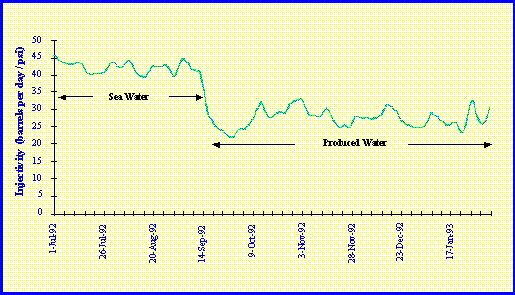
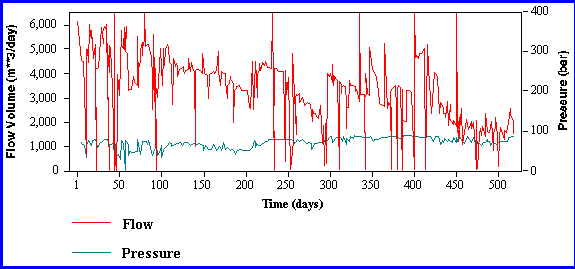
Figures 1 and 2 show that injectivity did not increase with increasing temperature, suggesting the BaSO4 scale carry-over mechanism.
-
The cause of the fluctuations in injectivity are not specifically known - they were not reported. They might be attribuatable to:
-
Periodic stimulation not reported to the analysts, although it is felt that this may not be likely because of difficulties in removing BaSO4 and it might be anticipated that this would be more of a problem for seawater.
-
Periodic shutdowns that allowed formation pressure to decrease. This is not known.
-
Characteristic plugging/propagation cycles that occur during fracturing produced water injection.
|
View Figure 1:
|
Injectivity Index versus time for seawater and produced water injection in this well.
|
|
|
|
View Figure 2:
|
Pressure and rate variations with time for the produced water injection phase, showing the potential "zig-zag" shape characterizing the Injectivity Index.
|
|
|
Back
Main
Documents