Soft Formations Workshop
November 22-23, 1999
Edinburgh
Monday November 22, 1999
Attendees:
| Jean-Louis Detienne | Ahmed Abou-Sayed | John Shaw |
| Laurence Murray | Håvard Jøranson | Clive Bennett |
| Bruce McIninch | José Piedras | David Davies |
| Mark Tuckwood | Paul van den Hoek | Robert Angel |
| Bjarni Palsson | Tony Settari | Jim Sommerville |
| Alastair Simpson | Orlando Cortez | Stavros Kastrinakis |
| John McLennan | Brian Smart | Nick Koutsabeloulis |
Proceedings:
Welcome by David Davies followed by Introduction of the Workshop by John Shaw and Jean-Louis Detienne. Preliminary request to add gas injection if there was time and discussion of the official release of PEA-23 data.
The first session was on basic geomechanics issues. Tony Settari outlined:
qualitative methods for identifying soft formations, and,
various situations for "fracturing" and the resulting "fracture structure"
For additional information, the presentation is available on Soft Formations, posted previously to the PWRI web site.
Ahmed Abou-Sayed described certain issues of injecting above the fracture gradient in soft formations. Some of the highlights included:
In addition to potential areas of dilation around fractures there could be areas of compaction. Dilation implies an increase in volume (and consequently porosity after the formation has yielded. Compaction implies a loss in porosity.
The issue of liquefaction was brought up. This was, in one way or another, a consistent theme throughout the workshop - for example, liquefaction accompanying water hammer pulsation leading to sand production.
The issue of perforations in soft formations received a considerable amount of discussion. What is actually created and how effective or detrimental are specific perforating procedures?
Fines movement and wellbore integrity were raised as issues.
The question of what is actually created was raised.
Modeling injectivity decline.
There was discussion, without agreement and, in fact, with some strong disagreements whether or not disposal operations had better success than pressure maintenance observations. It was argued that disposal operations were performed at shallower depths and that there were fundamental differences in the nature of the injection schemes - the continuous nature of PWRI versus the intermittent character of disposal operations. It was also suggested that there might be fewer pressure restrictions imposed on disposal operations.
In-situ stress conditions and their influence on successful injection were emphasized by Brian Smart and Nick Koutsabeloulis.
There was further discussion of the role of perforations. Some people argued that the effectiveness of the perforating would only lead to problematic startup and that afterwards the perforations would not be a substantial issue. Robert Angel indicated that Marathon was successfully applying the KISS perforating methodologies where it was desirable to create a large hole but only just penetrating through the casing and the cement sheath.
There was considerable discussion of N. Morita's SPE paper in regard to behavior of perforations in soft materials and the characteristics of the damage that was generated by perforating.
Another common theme arising in the discussions associated with this presentation was "What measurements should be made to identify what is occurring during injection above fracturing pressure? Falloff testing may or may not be able to determine what type of feature has been created."
Paul van den Hoek presented two case studies.
The first was a hard rock situation where the formation could not be broken down. Various attempts were made to overcome this problem, including perforating openhole, setting a plug to isolate a small interval and backflow to remove skin.
The second case, in soft sands, showed step rate data where it appeared that there was fracture-like behave at injection pressure levels significantly below the stresses that would be required for fracturing. One data point did in fact seem to indicate that there had been injection at pressure levels that could be attributed to breakdown and that subsequent lower injection pressures were in fact characteristic of fracture behavior. Laurence Murray suggested that skins should be calculated for the data points on the lower slope part of the step rate plot to assess if skin was zero or negative, which would indicate whether or not fracturing had actually occurred. Various participants indicated that part of the difficulty could be attributed to definitions. The frac gradient had been supplied to Paul by his operations colleagues and the stress level indicated by this frac gradient was above any of the pressures measured during the step rate testing (except the one point previously mentioned). It was suggested that the problem was one of definitions - that the "frac gradient" supplied to Paul represented the pressure required to cause the creation of a significant fracture at the wellbore (for example, the breakdown pressure divided by the depth) as opposed to the stress resisting propagation of a fracture (the minimum in-situ principal stress divided by the depth).
This focused discussion back onto diagnostics issues - for example, that it would be appropriate to confirm fracturing by assessing the level of skin associated with a particular rate/pressure combination. There was also discussion as to whether PE injection can be more effective than clean water injection because of impeded leakoff.
Jim Sommerville briefly outlined considerations for testing core samples to provide information relevant to determining the properties necessary for characterizing the stability of a wellbore in a weak formation and the behavior of material around a wellbore when pressure was increased as a result of injection. Some of the salient areas included:
Difficulties in preparing samples for testing from soft formations
Basic techniques for determining failure parameters (to assess stability and compaction characteristics)
Methods for doing thick-walled cylinder testing
Discussion of the influence of stress path on the results that are generated during laboratory testing. Jim emphasized that laboratory testing must be performed in an appropriate manner to provide results that are meaningful for field usage.
Presumably, an expanded discussion of this is required for a Best Practices Document, indicating what types of laboratory testing should be performed and how they should be performed to provide legitimate information for stability assessment and completion design. This came to light in further discussion on the second day of the meeting where there was debate on establishing an unconfined compressive strength above or below which stability of an openhole would become an issue.
John McLennan briefly presented methods for determining thermal characteristics of rocks. The major points were:
Thermal conductivity can be measured and its major influence was usually in determined how much heat would be lost to overburden and underburden.
Convective heat transfer associated with moving fluid is the dominant mechanism for temperature change in the target injection zones. It is largely controlled by specific heat. This can be measured but it can be estimated quite accurately from the weighted average specific heats of the individual components of the reservoir (minerals, saturating fluids).
In hard rock, the coefficient of thermal expansion controls the potential for thermal stress fracturing. In low modulus materials, stress changes associated with thermal changes are small. The question was raised whether or not strain changes in poorly consolidated materials, associated with changes in temperature could alter permeability and/or integrity? The answer to this is uncertain. Away from the wellbore the influence is likely small.
Additional thick-walled cylinder test data were provided. Unusual failure patterns were identified by x-ray tomography. The two issues were that current models may not be adequately explaining this behavior and secondly that even in soft formations, with the application of stress, localized failure zones can result with inferred local changes in permeability. Nick Koutsabeloulis observed that he had encountered similar behavior and that it could be explained on the basic of anisotropic characteristics of a reservoir.
Bjarni Palsson summarized public domain and JIP literature relevant to various completions techniques in soft formations. Basic observations included the following:
Screening criteria. One of Tony Settari's criteria for soft formation selection was that drilling was difficult. This was disputed and will be removed from the list. Field input strongly indicated that this is not necessarily the case.
The failure "mechanisms" (or activities causing failure and sand movement) most commonly cited in the literature were backflow, crossflow and water hammer "loading."
N. Morita's SPE paper again became a subject of discussion. Morita argued that 70% of the pressure drop commonly occurred in the perforation area. Ahmed Abou-Sayed disputed this indicating that he could not see how there could be significant damage if material was ablated into the perforation only. Clive Bennett indicated that damage can be attributed to charge debris. Others argued that indeed there would be a dissagregated zone around a perforation tunnel and that this could ultimately be squeezed into the tunnel by stress conditions.
A strong message brought out by Laurence Murray was that producers and injectors cannot be considered together and that features characteristic of producing wells cannot be directly translated to injection situations.
The consequences of water hammering in the Heidrun field were outlined, as were methodologies for reducing the impact. Petrobras has argued that retainer valves have cured this problem in the Marim field.
Examples were given from the Wilmington field (old data) as well as more recent data where steam injection has served to provide consolidation of the wellbore because of reprecipitation of certain silicates.
Experience in the Forties Field was provided. There had been crossflow and consequent sand production and fillup. Laurence Murray indicated that HIT testing had identified cavities. (In general, it was indicated that cavities can also be identified by pressure response and required volumes in water shutoff treatments and by behavior and volumes during cement squeezes.)
Bruce McIninch observed that Marathon has seen situations where there was no significant pressure response when some pills were pumped until they were overdisplaced by about five times.
Cavities were discussed by the general audience. There is some belief that cavities do exist in some injectors. There is a subsequent question relating to what are the causes of injectivity degradation in wells with cavities.
Bjarni and others presented a list of some of the new generation innovations that may be applied to soft sand injector completions - including expandable sand screens and intelligent completions.
Ahmed Abou-Sayed summarized some of the considerations in "Injector Operations Philosophy". The list below is not complete (refer to the presentation for complete details).
What are the objectives of the operation? For example, is it injection into a reservoir sand for sweep or injection into the water leg for pressure maintenance or disposal, etc. and how does the specific objective influence the completion and management operations?
Issues that are relevant for deployment included the beanup/down rates, the specific completion, what type (if any) of sand control is required and what monitoring methods should be implemented (PLT, microseismic, etc.).
Different design and management protocols are required depending on the type, shape and length of the well. Some of the issues discussed with regard to horizontal wells were temperature issues and how preferential fluid intake at the heel could be overcome (running tubing to the toe, dual completions, fracturing the toe during completion…). Håvard Jøranson supported this citing one PLT on a horizontal well where all of the injection was occurring at the heel. Laurence Murray emphasized the need for detailed temperature information to determine what was happening - fiber optics techniques were cited.
Producer-to-injector conversion considerations were indicated although specifics were not provided. This was discussed to a limited extent on the second day of the workshop.
José Piedras described Natural Sand Packs (NSP) entailing a screen in an openhole and allowing or encouraging sand to come in around the screen. Laboratory tests were described to characterize sand burst and backflow. Work by Rogaland and Johnson was cited on screen erosion. Some of José's observations included:
WWS's were recommended? For inverted WWS, Elf's laboratory testing indicated no sand arching and production of considerable amounts of sand. The maximum sand production occurred at the start.
Shales have been isolated with blanks or ECPs
For matrix situations, screens interspersed with blanks can be successfully used to distribute flow
A sacrificial screen can be run at the end of the other screens
In a basic literature search laboratory procedures could not be found for injector screen design. Consequently, Elf tested 2 WWS, 1 premium and 1 ESS
Low filtration threshold; fine gauge - to keep all fines in the formation.
For cleaning and filtration, partition the screen to eliminate a screen annulus.
Surface screen filtration was discussed.
The recommendation was circulation of two tubing volumes and that there should be a specific surface check with the screens actually being used.
José Piedras also presented a version of Elf's envisioned Best Practices for Water Injection Wells in Soft Formations. These recommendations were:
General
Do not use slotted liners.
Do not use chemical consolidation techniques.
Do not squeeze with mud acid.
Do not backflow for screen "cleaning."
Do not attempt to cleanup if injection is in the fracturing regime.
Do not clean up if there is saturated salt mud.
Drilling and Completion
Casing is set in the upper sands
If possible, only complete one zone with only one reservoir characteristic.
Use a bottomhole flow control device.
Perform an injectivity test after completion.
If the specific injection fluid is not available, do not place any damaging fluid in the tubing and prevent formation of hydrates in the wellhead and other surface equipment in environments where hydration formation is possible.
If there is cake cleanup, use a knockout valve (KOIV). If there is deeper cleanup into the formation use a surface controlled subsea valve (SCSSV).
Use partitioned screens.
During Injection
Be sure to use soft shut-ins and restarts.
Provide adequate QA/QC of the injected water (solids, oxygen, scale prevention ...).
Management of the injected water.
Provide surface pressure and flow rate monitoring.
Flush all lines and pumping equipment before resuming injection.
Do not use grease on wellheads or manifolds.
Provide a surface filtration system using an actual downhole screen to monitor performance.
Workovers
Determine fillup.
Laboratory investigations.
If acid is used, keep the concentrations low.
Material Specifications
Average slot tolerances
Slot no-go and go.
Wire design
Geometric and metallurgical characteristics.
José Piedras finally presented considerations on converting wells to producers. The issues to consider include:
Well selection (the reservoir, the field situation, the platform and the available facilities).
Completion selection (the state of the near wellbore area, sediment, integrity of hardware - metallurgy, test tubulars, annulus, wellhead - the specific hardware and jewelry - tubulars, GLM, packer anchors, nipples …, scale
Fluid selection (ensure compatibility with reservoir fluids and solids).
Clive Bennett presented a number of BP Amoco examples. These included:
Harding. Two wells, deviated at 60o were discussed. An 80-m section was underreamed and OHGP. This was a matrix injection only situation. Produced water injection followed 95% aquifer injection. One well behaved acceptably. The injectivity on the second degraded in conjunction with a plant upset. Laboratory studies indicated the susceptibility of a poorly gravel packed formation to plugging. Mutual solvents were considered for stimulation. Hypochlorite was also suggested. Safety issues should always be considered. Consideration has also been given to protecting this one well because of its position in the manifold.
Clive presented another Harding well example. The permeability was 10 darcy (matrix injection) and the net to gross ratio exceeded 98 percent. There was injection into a single channel in a very unconsolidated sand (an unconfined compressive strength of less than 10 psi). The well was horizontal with 540 m or pre-pack screens in openhole. Injection was maintained at 35,000 BWPD with an injectivity index of 220 BPD/psi. There was interference between this well and a producer. This should be a design consideration. Also, a PLT indicated that 50 percent of the flow in the injector was into the first 70 m. In the production well that was taking water, PDK logs indicated water entry at the heel. The well profiles of the producer and the injector diverge from heel to toe. Channelling is suspected and a proposed workover option was to put blank pipe in the heel of the injector to promote injection closer to the toe. (There is additional Harding data in SPE 48977).
The next situation described was tighthole. It was a deepwater turbidite environment (permeability of 400 md, a net to gross ratio of 70 percent). Injection was into a single zone, above fracturing pressure. This was an unconsolidated/friable sand with unconfined compressive strengths between 200 and 500 psi. Four wells were cased and perforated and two wells had screen completions. The cased in perforated injectors in one panel are either maintaining injectivity and providing good pressure support or have a good prognosis - for the latter situation, the one relevant well is taking 15,000 BPD below fracturing pressure. In the other two proven wells, rates have been maintained when the BHIP has been dropped below fracturing pressure.
The wells that are cased and perforated have had a large sump, where possible, based on the strength of the rock, owing to concerns associated with incomplete cleanup for the screen completions.
Data was provide on one of the wells completed with screens. The interval was short. Completions fluids were bullheaded into the formation. There was declining injectivity and this is probably associated with a confined fracture and localized buildup of reservoir pressure. A substantial drop in injectivity is encountered when the BHIP is less than the fracturing pressure.
There is no clear understanding yet of the impact of completion and cleanup design. Further clarification is anticipated when the other screened well (screens and partial cleanup) is brought on above fracturing pressure.
There are some facilities issues. A leak in the sub-sea water injection system is currently restricting injection to below fracturing pressure. Lack of sub-sea valves limits the ability to isolate sections of the system (i.e., a leak in one part may compromise the performance of the entire system). Also, since there is a lack of remotely activated chokes, the injection program is impacted (ROVs are required and weather restrictions are consequently more important).
At some point in this presentation, there was a discussion by several parties in the difficulties inherently involved with ECPS. Various parties reported substantial failures. Cement inflation has not been tremendously effective. Mud inflation has been successful. They have worked well when stage cemented. Failures of ECPs have been reported when they have been set against competent formations.
The next case that Clive presented was for single and multiple injection into an environment with permeability ranging from 200 to 3000 md. The associated strength of the sand varied from 50 to 2000 psi. Seven water injectors were completed with screens and one was cased and perforated. There were two high angle wells (one well was three zone and the other was single zone). Cleanup was accomplished by bullheading the mud into the formation or by partial cleanup to the rig. Injection is above fracturing pressure.
There has been an increase in near-wellbore pressure in most wells due to poor communication between the injectors and the producers. Wells that have high GORs can't get good support. This was seawater injection. It has been determined that this is a reservoir problem. Approximately one hundred reservoir pockets have been identified. Recently, there has been improved pressure support and lower GOR because of injection up-time and varying well rates. With the injection above fracturing pressure, there has been no evidence of fracturing out-of-zone but there are some concerns that this is a risk.
It was pointed out that 4D seismic has proven valuable in identifying pressure distributions and delineating problems in advance of breakthrough. The need for quality surveillance data was emphasized (inflow and temperature profiles, fiber optics methods…). The need for improved surveillance methods has become apparent for multi-zone injectors.
Pressure falloff testing and material balance data (i.e., indirect evidence) have suggested that there is injection into all zones (including the high angle multi-zone injector).
There is no evidence that bullheading the drillin fluid impacts performance any differently than clean-up to the rig.
It is planned to shut-in two of the injectors because there is no evidence that they are providing support to the producers.
In the next well (two zones), it is planned to fracture the toes through DP before/during bringing them on line to assist in the inflow.
They are also looking at ESS.
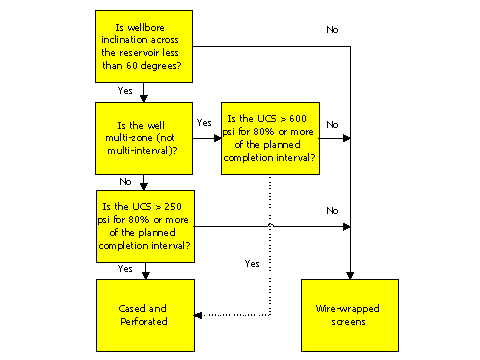
Finally, Clive presented a flow chart that is used in some aspects of completion selection (Figure 1).
Laurence Murray presented information from previous laboratory evaluations. Experiments have been done where there was dynamic filtration on Berea sandstone core. Brine containing 20 ppm oil and 200 ppm solids was first flowed through the sample and then by manipulating a valve at a specific pressure, it was also allowed to flow across the sample face. Post-sample evaluation showed a filter cake on the surface that was 1.3 mm thick. Quartz grains, ranging in size from fine silt to medium-grained sand, are suspended by injected fines in the "upper" (near surface) part of the filter cake. Below this, suspended fines are not present and the cake appears to be denser. There was an observable injected solids penetration into the sandstone matrix of 0.2 to 0.4 mm. Oil invasion extended 8 to 10 mm into the sample.
The message was that solids dominantly tend to stay in the fracture and that oil damage may be the dominant issue and that oil may bind the particulate material.
Laurence also presented an example of a method used to ensure (in hard rock) that the perforations are clean, prior to injection in order to improve conformance. Perforating was done underbalanced, and the well is backflowed at five gallons per foot. The well is then broken down with clean water and flowed back at least two tubing volumes.
Bruce McIninch outlined Marathon's West Brae subsea development, focusing on a joint development with Sedgwick, in approximately 350 feet of water. This is located in Block 16/7a in the UK Central North Sea. Two sandstone reservoirs are involved (Eocene Balder and Flugga sandstones). These are normally pressured, unconsolidated, submarine channels. The Balder sandstone has a porosity of 28%, permeability in excess of 2 darcies and contains viscous, heavy oil 22o API). The deviated injection well is W4, located between two structural highs with gas caps.
Reservoir pressure is close to the bubble point. Further pressure drop could not be tolerated and pressure maintenance became necessary. The targeted injection was 30,000 BWPD. Simulations indicated that one support well would be adequate.
The methodology was to provide sand control without gravel packing, based on poor injection histories for some gravel packs. The facility had 3000 psi of injection pressure available and gas lift mandrels were installed for backflow. Backflow to the rig was allowed during cleanup.
Screens were required for cleanup and for during pressure surging. They looked for plating on the inside of the screens. Measurements performed on a blanked and plugged screen showed that it would fail at 1350 psi. Consequently flow back would be restricted to 1300 psi. This was never an issue.
Bruce discussed aspects of the drill-in fluid used across the reservoir. Marathon drilled through the formation with water-based mud. They used sized salt for the injectors and carbonate for the producers. Their experience (and per Laurence Murray, BP's) indicated that carbonate could not be effectively removed in injectors. The salt sizing was based on laboratory return permeability testing.
The specific operations on W4z were as follows.
Drill 12-1/4 inch to TD with SOBM.
PB set 9-5/8 inch.
Drill 8-1/2 inch with NaCl based DIF with MgO oxidizer
The well was displaced to filtered brine.
6-5/8 inch screen (110 micron Excluder) was run.
An acid soak was performed to clean the filter cake.
The well was backflowed to remove residual filter cake.
Four hundred feet of reservoir was encountered from 6050 feet TVD to 8150 feet MD.
During the cleanup, 5% HCl soaks were used. The upper completion was installed and the well was backflowed for seven hours. Water samples were taken.
Currently injection is 20,000 to 30,000 at approximately 1700 to 2100 psi. Although there has been no real reduction in injectivity in approximately two years, it was indicated that the high injection pressures have been disappointing. Damage has been attributed to breaker pill control. Mechanical damage and friction also contribute to the injection pressures. It is also hypothesized that they were unable to get as much acid into the formation as they would have desired. Bruce felt that the injection pressures are still slightly below fracturing pressures although there was some speculation by other participants that the magnitude of the THP suggested that fracturing might in fact actually be occurring. An approximate injectivity index estimated roughly from the THP versus rate plot at 30,000 BWPD is 30000/2100 (ignoring friction) ~14.
David Davies polled the audience for views on plastic coated tubing. Elf uses it in the Cameroons. Laurence Murray indicated that ceramcote was possibly more robust. The concerns can include use in subsea gas wells if exposed to gas and how it stands up to rapid pressure release. The issue is to ensure the right coating for particular service conditions. BP uses coated tubing on subsea wells as a matter of course. Statoil and Shell use GRE. BP has found good drag reduction and corrosion protection for a small incremental cost (drag reduction of 40% on one well).
Robert Angel discussed MOC GOM soft rock completions in the Ewing Bank area. The Ewing Bank 873 lease was acquired in a 1990 lease sale. It is located 200 miles south of New Orleans in 800 feet of water at the platform. Marathon (67%) and Texaco (33%) are partners. The discovery well and three additional wells were drilled from a subsea template starting in December 1990. The platform was installed in June 1994 and production started in August of that year. There are seventeen producers, three water injection wells and three sub-sea wells (Arnold, Oyster and Manta Ray) on the platform. There are a sixteen-inch oil pipeline and a thirty-inch gas pipeline currently delivering 55,000 BOPD and 47 MMscfD of gas.
The completion interval varies from 32 to 256 feet interval length at depths between 10,000 and 13,000 feet TVD. Wellbores are deviated between zero and sixty degrees. Production is from the Pliocene Bull sand with a permeability between 400 and 1600 md. Reservoir fluid viscosity varies from 1 to 4 cP, with gravities between 18 and 25o API. The completions have been carried out in two stages (1994 - 1995 was Stage 1 development and 1997 - 1999 is classified as Stage 2 development).
The wells were fracpacked. Progressive development of skin was noted with time. Two of the injector wells experienced significant mud losses during drilling. Perforation fines during Stage 1 were a possible issue. This is a seawater injection operation, below fracturing pressure. The observation, which may be characteristic of many matrix operations, was:
Acid treatments lead to brief increases in production, followed by decline. Improvement was less each time a well was treated.
Robert provided a comparison of operations during Stage 1 and 2. Only producer information is available for comparison of the two stages. The comparative operations are shown in the Table below.
| Stage 1 | Stage 2 |
|
|
|
|
|
|
|
|
|
|
|
|
|
|
|
|
|
|
|
|
|
|
|
|
|
|
|
|
|
|
All of the injectors were installed in Stage 1. MOC success in GOM has been good in West Delta (adequate quality source water). Acceptable results in two sands in East Cameron. Disappointing results at Ewing Bank. Success in GOM areas where the wells are gravel packed or do not use sand exclusion.
Robert summarized with a tabulation of the current completion philosophy.
|
|
|
| Perforation Interval Selection | Entire target interval |
| Gravel Pack Service Tool | Eliminate tool movement |
| Pre-frac Acidizing | Organic mud acid |
| Perforating | KISS, 300 psi overbalance |
| FracPack design | 1000 lbm/ft, No data frac, pump pre-set design |
| FracPack Systems | Conventional |
| Tubing Landing Procedures | Underbalanced |
| Well Unloading | Underbalanced natural flow. Unload through the production facility. |
| DHPT Gauges | Platform wells: No gauges. Wireline for PT measurements. Subsea wells: Permanent down-hole monitoring systems have been installed in Arnold and Oyster wells. |
Miscellaneous Remarks at the end of the day:
What are the criteria for selecting injection candidates?
What surveillance and monitoring methods are required, especially for subsea completions?
Statoil experience with cased and perforated wells - decline has been attributed to sand problems?
Shell - now considering fracturing in the GOM.
BP - Interested in situations where they frac for skin removal and treat at matrix rates. They are interested in any suggestions for sustaining rates in matrix situations.
Tuesday November 23, 1999
Proceedings:
Håvard Jøranson discussed water injectors in the Heidrun Field (Fangst Group). Supplementary information is available in Santarelli et al (SPE 47329). Water injectors have been installed downdip in the C-Segment.
Six of the eight pre-completed producers were gravel packed (internal). The unconfined compressive strength has been measured to range from 0.5 to 25 MPa (most are on the low end). Usually, the strong intervals were too short for selective perforation to be an option.
They were reluctant to gravel pack the injectors. Ultimately, it was decided not to gravel pack the subsea injectors. It was anticipated that no crossflow would be experienced (crossflow did occur), backflow was not planned (backflow was performed) and any damage due to pressure oscillations due to rapid shutdowns would be dampened by downhole backpressure valves (these were not installed).
A chronological representation of injectivity indices was provided for 6507/7-C-1H. There is a substantial decline, each declining segment specifically associated with shut-in periods. Brief restoration in early 1996 (after backflow) is followed by decline and then a period of sporadic recovery followed by complete loss of injectivity in May 1996. Similar shut-in related damage was indicated in a plot for 6507/7-B-3H.
Rate-dependent injectivity was evidenced.
After two years a step rate test suggested a reduction in the propagation pressure. Interpretation of this step rate test might be disputed. Regardless, it would tend to indicate that thermal stress field reduction was likely occurring. Håvard recalled that Young's modulus varied from 1 to 5 GPa and the temperature differential was 65oC.
It turned out that crossflow was a problem. There was crossflow from low to high permeability zones and flowback of fines into/from the high permeability zones. In addition, calculations are that water hammer effects could have generated downhole pulses of 90 bars. The potential for crossflow was confirmed subsequently by laboratory permeability measurements (the example shown was from Well 6507/7-B-3H. For example, over a perforated interval of approximately 3242 to 3301.5 m MD-RKB, permeability varied approximately as follows.
|
(m MD-RKB) |
Average Permeability (md) |
| 3236 to 3241 | 700 |
| 3241 to 3258 | 1150 |
| 3258 to 3265 | 195 |
| 3265 to 3275 | 0.1 |
| 3275 to 3301 | 362 (with low zones) |
Calculations were carried out to assess the potential for crossflow (reference to a thesis by Hugdahl). Flow into or out of a lower and upper layer in Well 6507/7-B-3H was shown to continue for substantial periods of time after shut-in. Flow was out of the lower permeability zones and into the higher permeability zones.
Having correlated the loss in injectivity with shut-in stages, it was further established that loss of injectivity was minimized if adequate time was allowed before re-starting injection, to allow as much fine material in the wellbore as possible to settle out in the rathole. Some smaller grains could still be reinjected (because they would preferentially remain in suspension).
An overall summary of critical events was presented:
Well C1 was lost after an injection shutdown. 40 m3 was back produced but injection could not be re-established. More than 200 m of fill was bailed out from above the top perforations.
Well B1 was lost after an injection shutdown. No back production was possible. About 170 m of fill was bailed out from above the perforations.
Well B2 was lost after an injection shutdown. About 6 m of fill was bailed out from above the perforations.
Well B2 was lost again four months after it was bailed out, following a shutdown. The well is still shut in.
Water hammer (associated with valve closure) was indicated as a mechanism that could put pressure pulses (90 bars in these wells) onto the formation, with consequent production of fines. Measured pressure was available to reinforce the potential for sand liquefaction (and consequent production into the wellbore). In one case presented, a period of 5 seconds was indicated. It was hypothesized that the tensile stresses associated with the water hammer effect induced tensile stresses producing sand into the wellbore and increasing initial porosity of 30 to 35 percent to 37 to 45 percent.
There have been practical consequences from the observed well behaviors. These include:
The current philosophy is to only perforate 6 to 14 m in as homogeneous sand as possible.
Frac-packing is considered. One fracpack was attempted (A51). 175,000 lbm of regular 16/20 was pumped. There was a TSO at least 35 bars. The radius of the fracture was estimated to be 30 m (from modeling). The average conductivity was estimated at 25 darcy-feet. There were problems cleaning out all of the excess proppant. It was hypothesized that screen selection could have been improved. Hole angle was 40o. Injection was at 600 m3/D.
Limit the number of shutdowns.
Wait at least six hours before re-starting injection.
Continue some injection if it is a low level Emergency Shut Down.
The injection fluid is extremely clean seawater.
To remove accumulated sand, reverse circulation has been carried out (taking the check valve out of the CT).
Results of a PLT log for well 6507/7-A-51 indicated three perforated zones with flow only from the upper two intervals (3770 to 3778, 3788 to 3816 m MD-RKB).
What is the current status?
With the exception of B2 (which is shut-in), the subsea injectors are all taking high rates.
The new injectors have only 6 to 14 m of perforations. The injection is below expectations for two of the wells but this may be due to the limited kh.
The change to 50 micron filters has caused no adverse effects. There is a plan to bypass the filters completely. This will be contingent on the results of a pilot test on one well.
Paul van den Hoek presented several more field cases. The first was a matrix injection GOM program. The protocols were to avoid internal gravel packs. The mechanisms for decline in injectivity have been speculated (in an SPE paper) to be fines that are generated in the formation.
A North Sea example was then presented. This was seawater injection for pressure maintenance. The wells were cased and perforated across 30 to 60 m with permeabilities of approximately one darcy. Generally, the injection is below (but close to the fracture gradient. The average injectivity indices vary from 13 to 65 bbl/D/psi and the average half-lives are approximately one year. Regular HCl treatments are implemented and the wells are not backflowed. Some of the relevant observations for these wells included:
Acidizing did help restore injectivity,
A drag reducer trial showed temporary improvement but was suspended because of cost,
Higher injection rates were helpful (fracturing?), and,
Tripping hurt injectivity.
The injected fluid was seawater (Paul believed that there was no filtration but would confirm). To some extent in contrast to the Heidrun data, it was found that injectivity index decreases were associated with "longer" duration shutdowns - damage increasing with time. Falloff data presented were inconsistent with other data. David Davies volunteered to have the falloff data processed at Heriot-Watt University. Although, basic geology is apparently relatively homogeneous, slow crossflow is hypothesized to be causing the damage. Long shut-in times were required to initiate substantial crossflow.
Discussion of the validity of the presented falloff test interpretation continued. It was suggested that the signature that had been interpreted as a fracture could also be a channel. Elf also brought up a situation where a bacterial problem had been successfully cured by acidizing.
The second North Sea field case is not yet on stream. Some of the processes of selecting between screens and casing/perforating were described. The screen completions would offer sand control. However, some disadvantages were pointed out. For example:
Screen plugging could become an issue,
Since this is a normally pressured situation and because of the available facilities, backflow would be expensive,
Regular acidizing accelerates corrosion, and,
There has been a poor track record for ECPS.
Cased and perforated completions would provide a flexible design (isolation of shale zones) and fracpacking could be used. However:
There would not be sand control,
A large rat hole would be needed, and,
With multiple zones, sand failure due to crossflow was a risk.
Ultimately a cased and perforated completion style was selected.
Laurence Murray presented data from one GOM well on PWRI where 10 micron filters have been taken off. These wells were cased and perforated, permeability is approximately 1 Darcy and injection is above the frac pressure. The unconfined compressive strength was nominally 50 psi and modulus was approximately 100 to 200,000 psi. This was aquifer injection for disposal, supplement available aquifer drive. No injectivity decline has been observed on the well after one year of operation.
Laurence also discussed another BP example in Miocene sandstone. This was a converted producer. Two fifty-foot zones with one hundred feet of shale between them were fracpacked pre-production. Permeability was approximately 50 md. To convert to injection, tubing had to be pulled, gravel/fill cleaned out and a new packer was run (original inadequate for injection conditions). Only one zone (the lower) was injected into. It is believed that an unpropped fracture was created in addition to the fracpack fracture but with a different orientation resulted because of the character of the falloff curve observed following comparison of PBU on production and PFO on injection.
Paul van den Hoek emphasized the need for guidelines on costing and economics.
José Piedras presented on "Intelligent Completions and Water Management." A premise of the presentation was that reaching the injection quota does not necessarily mean that the optimum water distribution has been attained. Reservoir heterogeneities can still be a major issue and appropriate water management requires effective control of the water distribution - zone by zone. Intelligent completions were offered as a methodology for affording this. An Intelligent Completion System is a Remotely Operated Adaptive Completion System that provides real time data acquisition and the ability to reconfigure well architecture. Ten manufacturers of I.C. Systems were identified.
PES/Halliburton: SCRAMS (Surface Controlled Reservoir Analysis & Management System)
Camco/Schlumberger: FIRST (Fully Integrated Retrievable Smartwell Technology). Today this can entail WRFC (Wireline Retrievable Flow Controller)
Aker Maritim/Sintef: IPC (Integrated Production Control)
Smedvig: PROMAC (PRoduction Monitoring and Control system)
Subtech/Weatherford: PCV (Production Control Valve)
Baker Hughes: IPR (Intelligent Production Regulator)
Phoenix: MONITROL (MONIToring and contROL system)
Triangle Technology: NESCOS (Non Electrical Surface Controlled Operation System)
ABB Offshore Systems: ADMARC (Advanced Downhole Monitoring and Reservoir Control)
METROL: ANTICS (Annulus aNd Tubing Integrated Communication System)
José indicated that only PES and CAMCO have field proven experience. Nine SCRAM systems have been installed (flow devices and gauges). These include:
One device (out-of-service) installed as a prototype on SAGA Snorre.
Three partially working devices (two for AGIP on Aquila and one for Norsk Hydro on Oseberg).
Six fully operational systems (two on Oseberg for Norsk Hydro, one for Maersk, one on Statoil on Gulfacks and two on Allegany for British Borneo).
There have been six FIRST system installations:
Five on Troll for Norsk Hydro (for autogas lift activation - flow devices only).
One on Wytch Farm (BP Amoco - 3 valves for selectivity and flow control on a multilateral, all are fully operational after a year).
A comparison of the limitations of SCRAMS and FIRST systems is shown in the following table.
|
Limitations of SCRAMS (flow devices and gauges) |
Limitations of FIRST (flow devices and gauges) |
| New technology (electro-hydraulic activation) | New technology (more reliable since there is hydraulic activation only) |
| Maximum temperature is 110 to 120oC | Maximum temperature is 150oC |
| Subsea interfaces reliability (dedicated umbilical recommended) | Subsea interfaces reliability (less complicated than SCRAMS) |
| There was an overwhelming amount of disagreement on the compatibility of these devices in sand production environments. For clarification, refer to the section immediately following this table. | There was an overwhelming amount of disagreement on the compatibility of these devices in sand production environments. For clarification, refer to the section immediately following this table. |
| Flow limitation of 7,000 BPD |
Questions were raised as to the sensitivity to SCRAMS (and presumably FIRST) to sand flow. José's colleague had indicated that this was a present. Håvard , Laurence and John S. disagreed strongly and indicated that experimental work had been performed. José would seek clarification.
Some available field experience was described. This is a seawater injection well located between horizontal producers. There are three injection levels. The upper and intermediate levels are controlled by intelligent values. A choke, set in a standard CM sliding sleeve, is used to control the third level. The objectives were to provide a better control of water injection level by level. There would be a net benefit in oil production through better control of zonal injection - either through pressure or improved sweep.
The well schematic incorporated at 68o tangent section with a 9-58-inch shoe at 6145 feet TVD (10,300 feet MD). The tangent section continued to 6595 feet TVD (11,500 feet MD) at which point there was 4450 feet of horizontal section. The seven-inch was set at 15950 feet MD.
On injection start-up, the upper and intermediate level valves were fully opened. An injectivity problem was immediately detected in level 2. Corrective action included temporary closure of the upper level (this is the high injectivity level). Thermal fracturing was used to improve injectivity of the intermediate level. With this application (the only one currently using an I.C. system to manage water injection) a selective water injection profile has been identified, the original reservoir model has been reconsidered and it is possible to make ongoing adjustments to fine tune the injection profile.
The system was deployed in September 1998 and it is still functioning correctly. To now, the OPEX costs have been reduced to a minimum (there has been no well intervention).
Best Practices:
Much of the second day was spent in trying to consolidate experience so that there would be tangible deliverables from the workshop. At first, Alastair queried Sponsors on the desirable product. The responses included:
Develop a flow chart - decision tree. Later in the exercise, it was decided that a decision tree would be difficult and an alternate approach was taken.
There must be reference from the toolbox to relevant wells in the database. There must be the capability for searches (in the database) on different reservoir and completion types.
The toolbox should contain standard procedures or at least what types of testing should be done for selecting screen type.
Avoid being too generic, BUT …
The presentations should not be regionally oriented.
Consider wet versus dry tree situations.
Clive Bennett presented an example multi-layered reservoir situation to stimulate discussion (refer to the figure below).
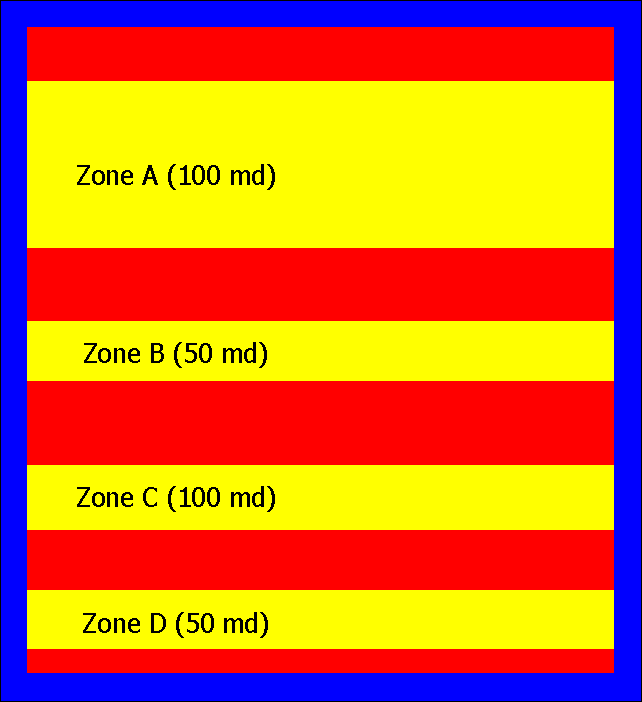
In this real case, the minimum horizontal stress gradient is approximately 0.95 psi/ft. It is desired to put water into all four zones, although this can be accomplished by using more than one well. The formations dip steeply and there is no cementation. Continued injection above fracturing pressure is restricted because there are 5,000 psi trees. There is a large potential for crossflow.
Additionally, a dual completion may not be possible. As indicated, it is not essential to inject into all four formations at the same time. Bruce McIninch indicated that the wells could be completed by using a tree saver and fracturing the 50 md zones. Tony Settari indicated that equally important to the injectors is controlling the producers in this situation. It is felt that the producers are drawn down equally in all four zones. Another suggestion was ESS with intelligent completions. There was indicated concern with filter cake in openhole completion scenarios.
This example led to preliminary discussions on developing a decision tree - the first decision point was whether or not one could continually inject above frac pressure, followed by whether the well was horizontal/high angle or vertical, etc., etc.
Eventually, the participants conceded that there were too many variations and that a tree would need to be multi-dimensional. Suggestions for proceeding included developing a list of actions to avoid, a list of techniques that have worked, a list of questions that you might ask or would typically ask with a weighting factor. This ultimately led to the final product that was developed in spreadsheet form. This was a crossplot of completions techniques versus reservoir environment etc. This is available for review in the most recent newsletter, in JIP Waterworks. Click on the Newsletter button in the frame on the left.
A running list of additional topics was maintained throughout the two days. The following is that list. It is not prioritized.
What parameters should be measured (injection mechanisms).
Paul van den Hoek had outlined a situation where breakdown pressures were high. What are the causes and how can this be cured?
There is considerable difficulty in definitions (i.e. frac gradient versus breakdown gradient versus closure stress gradient versus minimum stress gradient etc.).
Stress paths are an important issue in prescribing legitimate laboratory tests.
There was considerable mention of the importance of relatively small variations, particularly in horizontal wells and the need for sophisticated surveillance and monitoring systems. Fiber optics technologies were mentioned multiple times (refer to the Sensor Highway web site).
Throughout the workshop, there was considerable contention as to the validity of some statements in N. Morita's SPE paper on water injectors. The character of pressure drop through perforations was a subject of considerable discussion, including ablation versus plastic deformation and the role of compaction. [Pressure drop through perforations appears to be an unresolved issue.] Certainly perforation fill has been identified as a problem. Ultimately, it would be worthwhile to comprehend what happens during backflow. Also, is there firm evidence that supports a particular perforation philosophy? Morita also contended that his simulations showed that crossflow was not important. Presentations during this workshop have hypothesized that crossflow is a major consideration. Crossflow is part of Task 5 (Layered Formations). Can crossflow be modeled, can velocities be determined and can it be assessed if this is adequate for sand production?
There was an item entitled "Definitions of Well Objectives." Some of the sub-headings were also related to Monitoring. For example, for horizontal wells, PLT and temperature surveys were indicated. Also, new technologies for distributing flow were discussed. These included controlled cooling and fracturing and dual completions to push injection to the toe. For matrix wells, some possible follow up on thermal fracturing was suggested. The question has been raised as to whether thermal fracturing is a completion technique.
A chart summarizing possible causes of loss of injectivity was suggested.
It was desired to get an update on Shell's ESSs (number and performance).
Categorize/summarize field experience on new generation monitoring methods (e.g. fiber optics).
At various times during the workshop, Alastair Simpson and others emphasized that the success of the injection operation can depend on activities from the drilling stage, particularly drilling and mud cake damage and how these impede cleaning up and injection through the cake. Problems could result later in the life of the well.
Aquifer injection and powered injectors were brought up. Alastair Simpson argued that power requirements were a limiting factor.
Fluid movement diagnostics (i.e. 4D Seismic).
What sort of completion procedures should be adopted if matrix injection cannot be avoided?
Economics of PWRI was brought up. Per the minutes from the Calgary meeting, Sponsors are to provide a list of elements for an economic assessment.