How Does It Work?
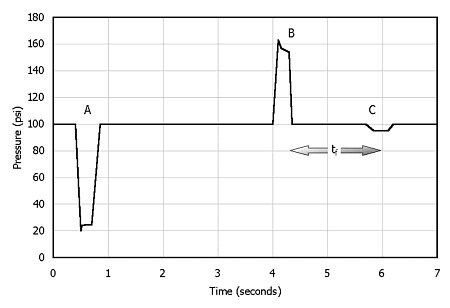
The HIT concept entails interpreting the observed change in hydraulic impedance that exists between a wellbore and an open hydraulic fracture at the bottom of the wellbore. If the wellbore is not fractured, the pulse will reflect off the bottom of the wellbore, which acts as a stiff reflector. The reflected signal will have the same "sign" as the source signal. Conversely, If the wellbore is fractured, the impedance of the wellbore is differentiated. The fracture acts as a soft reflector. The reflected signal from the mouth of the fracture (where it intersects the wellbore) will have the opposite sign from the source signal. Figure 1 is an example. The wave-speed in the wellbore is dictated by the injection string, the compressibility of the wellbore fluid (for water a ~ 1500 m/s), and the location of the fracture is calculated using the known wave-speed, and the arrival time of the inverted reflected signal from the fracture mouth.
As the pressure pulse intersects the fracture mouth, a pulse is also propagated into the fracture. The wave-speed in the fracture is dictated by the compliance of the fracture walls rather than the compressibility of the fluid, and is typically much lower than the wave-speed in the wellbore (50 – 100 m/s). The wave pulse propagated into the fracture is reflected at the fracture tip, and shows up in the recorded signal as a smaller signal following the inverted signal from the fracture mouth. The length of the fracture is calculated by using the wave-speed of the fracture, and the time difference between the signal reflected from the fracture mouth and the signal reflected from the fracture tip. However, the signal reflected from the fracture tip is often severely attenuated, and may be difficult to detect.
Figure 1 is a generic HIT trace. It has several relevant features:
Figure 1. Generic HIT pressure record.
The fracture closure pressure may be determined from several HIT traces run during a pressure falloff test, as any changes in the reflected signal with change in well pressure, will indicate a change in the fracture geometry. The minimum in-situ pressure is estimated at where the reflected fracture signal disappears, or stays constant with a further reduction in pressure. The reflected signal from the fracture may remain below the minimum in-situ stress, as the fracture may be riding on asperities, however, the reflection coefficient will remain constant.
From the HIT trace a reflection coefficient is estimated, which is used to determine the impedance of the fracture. This fracture impedance is again used in calculations of the fracture height using the properties of the formation, and the excess pressure in the fracture.
The fracture half-length is calculated as mentioned above, and the fracture width is calculated by an expression relating the excess pressure, and the fracture length, and fracture height.
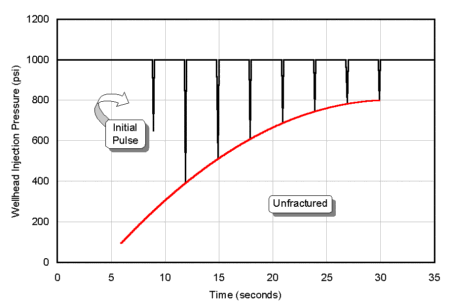
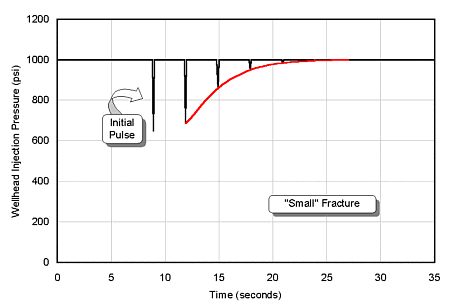
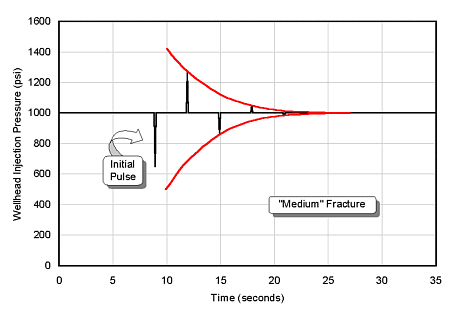
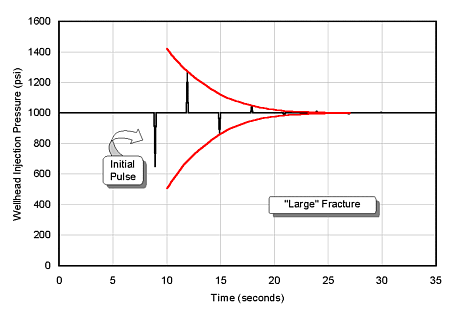
Figure 2 is a demonstration of generic HIT behavior above and below fracture closure pressure.
|
|
|
|
|
|
|
|
|
Figure 2. Simulated HIT traces for various fracture extents (after Simpson and Paige, 1991).6
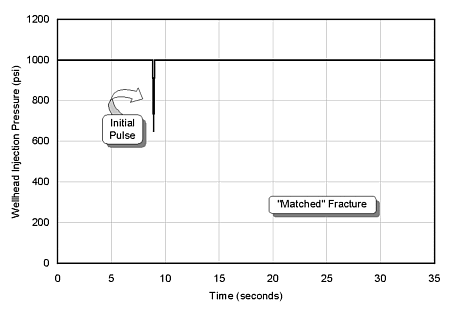
"The pressure pulse is typically initiated by rapidly opening and closing a valve connected to the wellhead. The pressure pulse travels down the wellbore and is reflected at various points along its path. … The first trace shows the response of a constant diameter unfractured wellbore. The pressure pulse travels up and down the wellbore, is only reflected at each of the two ends and is attenuated slowly. When a small fracture is created the reflection from the vicinity of the well bottom is reduced and energy is transmitted into the fracture. In this plot, and in the remainder of the sequence, the pulse which travels into the fracture is assumed to decay to nothing and so is not seen again in the wellbore. The decay of the main pulse is effectively increased."6
"As the fracture size is increased the reflection coefficient moves to zero and no reflection occurs (matched impedance). Increasing the fracture size further then leads to reflection of an inverted peak. As fracture size grows the inverse reflection grows and so decay of the pule becomes less rapid. The preceding sequence illustrates how HIT can be used to detect fractures and indicate fracture size."
| <Definitions | Theory> |
 Back to Key Issues Back to Key Issues
|
Top
|
Previous
|
Monitoring Best Practices
|